
June–July 1940: The Soviet annexation of northern Bessarabia
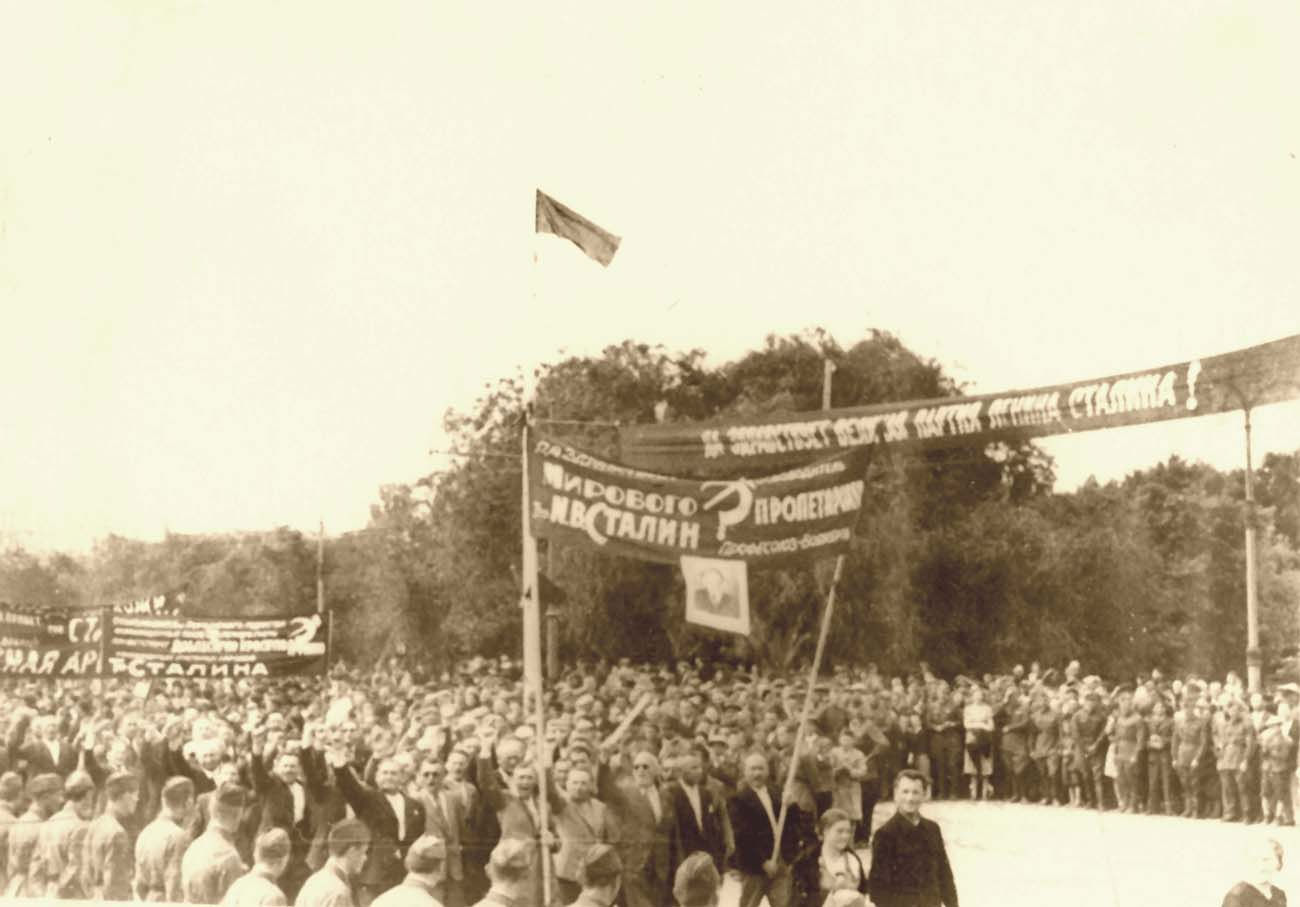
Following a Soviet ultimatum in late June 1940, Romanian forces withdrew and Soviet troops entered Khotyn. The city became part of the Ukrainian Soviet Socialist Republic. The Dniester here ceased to be an international frontier, while travel toward Romania came under new restrictions.
Soviet agencies took over government, policing, schools, and economic administration. Residents who had lived under Romanian rule now faced a new set of authorities and regulations.

Summer–Autumn 1940: Nationalization and the end of independent communal institutions
Nationalization took businesses and property out of private hands. The communal council, independent schools, charities, and Zionist organizations lost their freedom to operate.
The community history recalls the closure of the Tarbut school and the dispersal of its Hebrew and Yiddish library. Families lost institutions that had provided education, loans, and help in difficult times.
1940–June 1941: Arrests, deportations, and uncertainty
Soviet security policies targeted former officials, property owners, political activists, Zionists, and people classified as socially suspect. Khotyn memorial literature describes arrests and deportations during this first Soviet year.
Arrest or deportation could remove a parent or wage earner from a household. Nationalization cost families their businesses, and contact with relatives abroad became dangerous. The organizations that had offered relief were themselves being dismantled.
22 June–early July 1941: War returns to Khotyn
Germany invaded the Soviet Union on 22 June 1941, with Romania joining the campaign to recover Bessarabia and northern Bukovina. Khotyn again became a military objective. Soviet authorities evacuated some personnel and residents eastward, while others fled independently or remained because escape was impossible, too dangerous, or seemed unnecessary.
The distinction between those who evacuated, those deported by the Soviets, those mobilized into Soviet service, and those trapped under Romanian-German occupation later shaped survival. Families were scattered in several directions before mass anti-Jewish violence even began.
Sources for 1940–1941
Notes on sources
Town-level arrest and deportation totals in later accounts are community estimates. The narrative follows the sequence described in the cited memorial and archival sources.
- Shlomo Shitnovitzer, ed., ספר קהילת חוטין (בסרביה) (Sefer kehilat Ḥoṭin (Besarabyah)) [Book of the Khotyn Community (Bessarabia)] (Tel Aviv, 1974), Holocaust section, pp. 83–96; linked through the JewishGen Yizkor Book Project. Read translation
- Shlomo Shitnovitzer, ed., ספר קהילת חוטין (בסרביה) (Sefer kehilat Ḥoṭin (Besarabyah)) [Book of the Khotyn Community (Bessarabia)] (Tel Aviv, 1974), Yiddish destruction section, pp. 199–217. Read translation
- Ancel, Jean, and Theodore Lavi, eds. “חוטין” (Ḥoṭin) [Khotyn]. In פנקס הקהילות: רומניה (Pinkas ha-kehilot: Romanyah [Encyclopedia of Jewish Communities: Romania]), vol. 2, 353–57. Jerusalem: Yad Vashem, 1980. Read English translation.
- International Commission on the Holocaust in Romania. Final Report, ed. Tuvia Friling, Radu Ioanid, and Mihail E. Ionescu (Iași: Polirom, 2004), especially the Bessarabia, Bukovina, and Transnistria chapters. Read source
- United States Holocaust Memorial Museum. Selected archival records relating to Chernivtsi Oblast and wartime Jewish persecution; collection search and catalog. View archive catalogue
See the Sources & Bibliography for publication details, original-language titles, and image credits.