
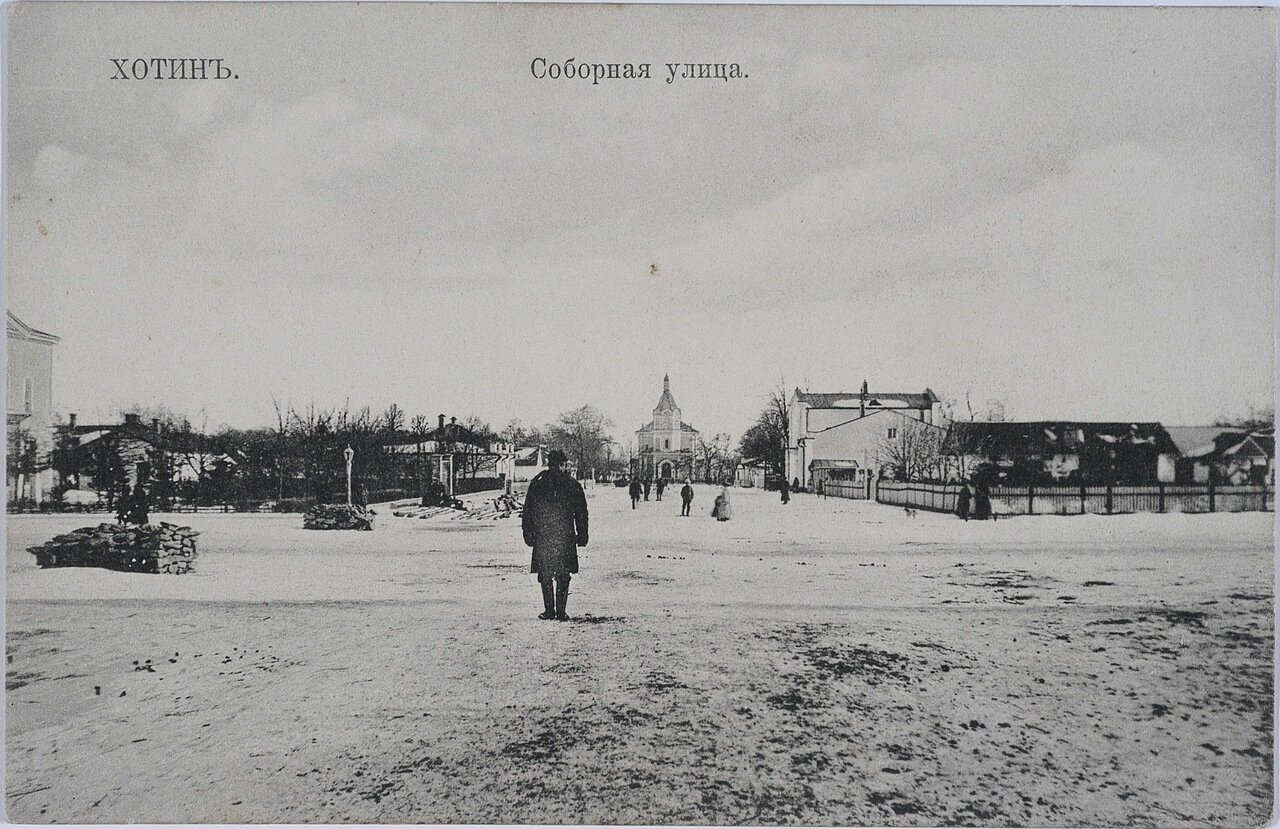
1812–1828: A new government and new records
In 1812 the Treaty of Bucharest transferred Bessarabia, including Khotyn, to the Russian Empire. Khotyn became the center of a district, called an uyezd. Officials now dealt with residents through Russian courts, taxes, and registrations. Families who had traded across an Ottoman–Moldavian frontier lived under a government with different categories for merchants, townspeople, and other subjects.
One result was the paper trail descendants use today. Revision lists registered households for taxation and other obligations; they could record ages, relatives, absences, and changes since an earlier list. The Jewish community kept its own affairs alongside these state requirements. Traveler Pavel Svinin’s 1816 account captures the town early in the transition, when Russian administration was still taking shape.
An 1822 business agreement recorded by historian Oleksandr Bezarov bears the signature of Khotyn rabbi M. Z. Yosef-Dov. It reminds us that Jewish merchants and religious authorities continued to settle matters within their community while also living under imperial courts.
1824–1848: Neighbors, property, and families in the records
JewishGen identifies an 1824 set of community records for Khotyn and other places in its district. By 1847, later reference works counted 1,067 Jewish families in the town. These numbers describe a growing community, but individual documents make its streets and relationships visible.
In 1835, S. Vaisman was identified as an Austrian subject who had come from Okopy in neighboring Galicia. He had married a daughter of a Khotyn resident, A. Tsipris. Officials examined his right to reside in town. The case shows how marriage, migration, citizenship, and paperwork could become intertwined for a single household. Bezarov also describes lists of people suspected of lacking residence permission, illustrating what local authorities tried to monitor.
In 1844, sisters Kh.-B. and R. Maiorkevych sold a two-room house inherited from their parents, Maiork Yankelevych and Feiga. Its deed located the home on a street running toward the fortress, next to Perets the shoemaker. In 1848, A. Reinis sought permission to sell a house with three shops near the homes of Moishe Yankelevych and Aron Saper. The documents name relatives, neighbors, a trade, and the arrangement of home and shops. They show how a family could leave a trace in a court file even when no photograph survives.
1847–1864: Learning, worship, welfare, and service
A government Jewish school opened in 1847, according to community reference histories, followed by a girls’ school in 1857. Children also studied in cheders, elementary religious schools. Adults gathered in batei midrash, houses of study, and smaller prayer houses called kloyzn. These institutions offered families different paths into religious learning and secular education.
Rabbi Isaiah Schorr served in Khotyn during the first half of the century. Avraham Ber Gottlober, a writer associated with the Haskalah or Jewish Enlightenment, visited and wrote about the town. Their presence hints at the range of Jewish thought in a community that also supported Hasidic worship and older forms of study.
Military obligations could affect an entire household. Bezarov identifies 1853 district recruiting files that include medical examinations and payments by families relating to military service. A record of a recruit may therefore sit beside evidence of his parents’ resources, residence, or attempts to manage an obligation. Khotyn’s community also developed welfare institutions, including a hospital in the 1860s. By 1864, later histories report 6,342 Jewish residents.
1864–1881: Work, property, and changing opportunities
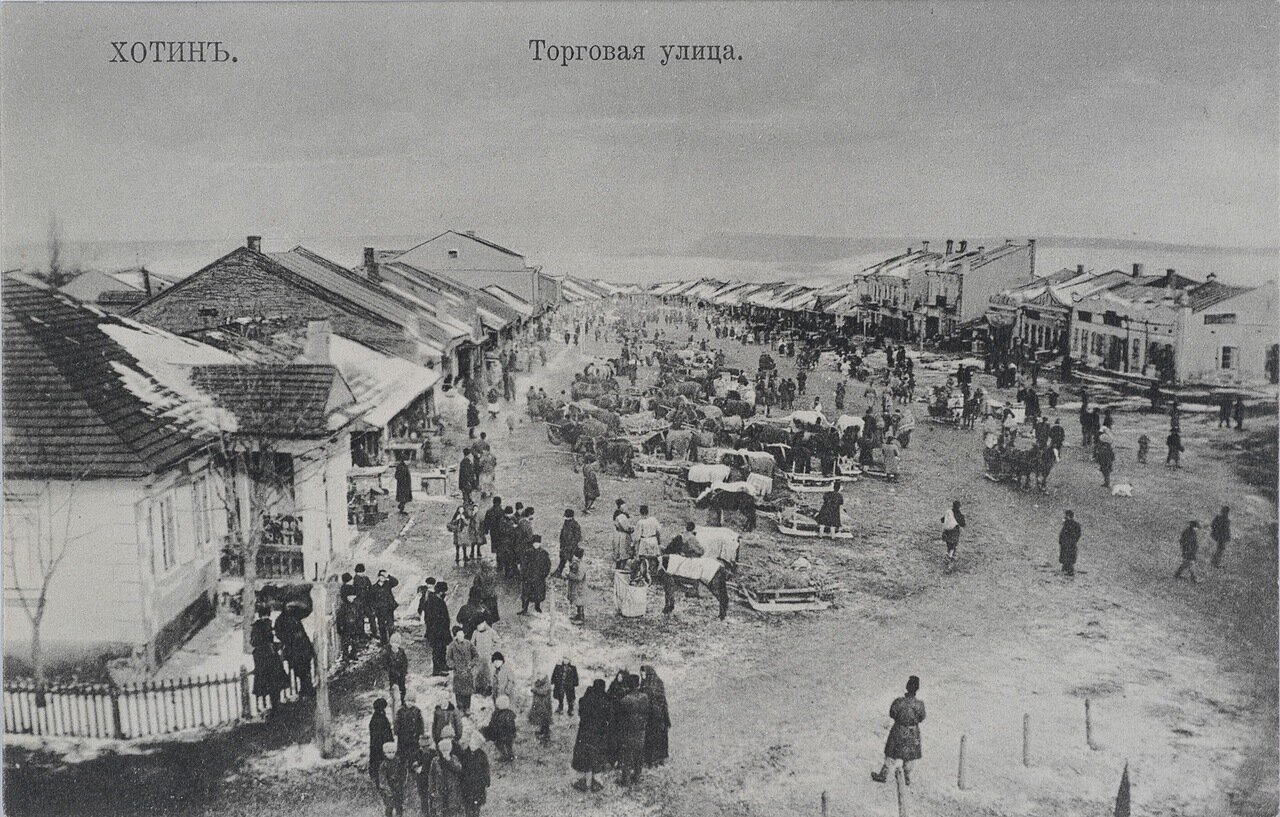
Merchants and shopkeepers bought produce from the countryside and supplied clothing, tools, and household goods. Tailors, shoemakers, carters, and peddlers connected Khotyn to neighboring villages; the Dniester connected its market to Podolia. Administrative offices and schools added other kinds of work. A 1917 postcard of Market Street preserves the commercial setting in which many families earned their living.
Across the empire, reforms under Alexander II opened some educational and professional paths to particular groups of Jews. They did not give all Jewish residents equal rights. Rules depended on a person’s education, occupation, merchant status, and place of residence. For Khotyn families, the practical questions were concrete: Could a child enter a school? Could an apprentice work elsewhere? Could a business owner move or hold property? The answers changed over the century and sometimes depended on local officials.
In his 1926 survey, historian Ștefan Ciobanu contrasted the old narrow streets with broader avenues created under Russian rule. The older commercial lanes, new institutions, and expanding Jewish population belonged to the same city.
1880–1897: A large community with different prospects
A community history gives 10,229 Jewish residents among 16,173 inhabitants in 1880–1881. The 1897 imperial census is commonly summarized as about 9,291 Jews among 18,126 residents, roughly half the town. Homes, shops, schools, prayer houses, and charities made Jewish Khotyn a large part of everyday urban life. Those totals do not mean that every household prospered or shared the same position.
One local episode shows how families considered alternatives. According to the Khotyn entry in Pinkas ha-kehilot, about one hundred Jews sought permission in 1886 to lease land for farming after economic conditions worsened; the request was refused. A group of eighty families then organized to seek land in Palestine with outside assistance. This was one response to hardship, and America became another destination for people from the town.
Military service, limits on where Jews could live and work, and new economic pressures shaped young people’s plans. At the same time, families had homes, relatives, trades, and congregations that bound them to Khotyn. Those who emigrated made decisions within an established community, often leaving parents, siblings, and familiar streets behind.
1897–1914: Schools, politics, and departure
Children and young adults encountered Hebrew and Yiddish cultural activity, Russian schooling, Zionist organizing, socialist movements, and continuing religious study. Some residents argued about the future of Jewish life in Bessarabia; others concentrated on finding work or helping relatives. A town large enough to sustain varied institutions also had room for different responses to its uncertain future.
The Khotyn community entry in Pinkas ha-kehilot cites an 1888 report in the Hebrew newspaper Ha-Melitz that many emigrants were craftsmen and young artisans. Emigration to the United States increased during the 1890s. In 1904, Khotyn immigrants organized the Independent Chotiner Bessarabian Benevolent Association in New York, which helped preserve hometown connections across the ocean. Earlier emigrants could give later arrivals a familiar destination.
The 1909–1914 Bessarabian address calendars document physicians, pharmacies, banks, post and telegraph services, officials, and other parts of urban life. The records reveal an active town in the very years some of its residents chose to leave it. The emigration page follows those decisions through the pressures at home, the pull of relatives abroad, and the evidence a descendant may find.
1914–1917: World War I on the Bessarabian frontier
World War I brought the border back to the center of everyday life. Khotyn lay behind a volatile southwestern Imperial front and received refugees from nearby war zones. Jewish press reporting preserved in later Bessarabian histories describes the 1915 expulsion of Jewish farmers from Khotin uyezd, part of a broader pattern in which Russian military authorities treated Jewish populations near the front with suspicion.
Wartime shortages, military requisitions, population movement, and interrupted trade undermined the urban economy. Families with sons in the army or relatives across enemy lines faced uncertainty that no local institution could resolve. The American Jewish Year Book’s contemporary chronology provides a wider frame for these wartime Jewish crises, while community memoirs preserve how the disruptions were experienced locally.
For a Jewish household, the war could interrupt business across the river while increasing the danger of a son’s service or a relative’s displacement. Contemporary reports of the expulsion of Jewish farmers from Khotyn district in 1915 show that border security policy reached local families. District reports do not identify every town resident affected; they show the climate in which those families tried to continue their lives.
1917–1918: Revolution, collapsing authority, and a new border
The revolutions of 1917 ended Imperial rule. Soldiers, local committees, and competing political movements struggled for authority across Bessarabia. Khotyn’s Jewish residents organized communal elections amid the uncertainty.
Romanian forces entered Bessarabia in 1918. Courts, schools, and local administration gradually adopted Romanian forms and language, bringing new citizenship and documentation requirements.
The transition also changed the language of public life and the kinds of documents families had to present. The Romanian-period page continues the story of residents who stayed, while the emigration page follows relatives who had already begun new lives abroad.
Households in the records
BessarabiaSIG volunteers have indexed revision lists and related household records. Read the revision-list guide and search JewishGen’s Romania–Moldova Database for Khotyn and its district. These lists can connect relatives across generations; surviving years and coverage vary.
Sources for 1812–1918
Notes on sources
Community sources date the hospital’s establishment to 1860 or 1865. Some reference works give 9,227 Jewish inhabitants for 1897, rather than 9,291. The main text retains the commonly cited census summary.
- Svinin, Pavel P. “Письмо к брату моему — из Хотина” (Pis’mo k bratu moemu — iz Khotina) [Letter to my brother from Khotyn]. Сын Отечества (Syn Otechestva) [Son of the Fatherland] 31, no. 30 (1816): 140–149.
- Daragan, Mikhail. Военно-статистическое обозрение Российской империи: Бессарабская область (Voenno-statisticheskoe obozrenie Rossiiskoi imperii: Bessarabskaia oblast’) [Military Statistical Survey of the Russian Empire: Bessarabia Region]. Vol. 11, pt. 3. St. Petersburg: General Staff Department Printing House, 1849. Library catalogue
- Zashchuk, A. I. Материалы для географии и статистики России, собранные офицерами Генерального штаба: Бессарабская область (Materialy dlia geografii i statistiki Rossii, sobrannye ofitserami General’nogo shtaba: Bessarabskaia oblast’) [Materials for the Geography and Statistics of Russia, Collected by General Staff Officers: Bessarabia Region]. Vol. 2. St. Petersburg, 1862. See p. 183.
- Gottlober, Avraham Ber. “מסע ברוסיה החדשה” (Masa be-Rusya ha-Hadasha) [Journey in New Russia]. 1864. Reprinted in זכרונות ומסעות (Zikhronot u-masa’ot [Memoirs and travels]). Jerusalem: Bialik Institute, 1976. Read digitized text.
- Russian Empire. Первая всеобщая перепись населения Российской империи 1897 г. (Pervaia vseobshchaia perepis’ naseleniia Rossiiskoi imperii 1897 g.) [First General Census of the Russian Empire, 1897], Bessarabia/Khotin town tables.
- Iorga, Nicolae. Neamul Românesc în Basarabia [The Romanian people in Bessarabia] (1905), Hotin visit section. Contemporary travel account; its antisemitic rhetoric requires source-critical reading.
- Bessarabian address-calendar editors. Адрес-календарь Бессарабской губернии (Adres-kalendar’ Bessarabskoi gubernii) [Address calendar of Bessarabia Governorate], editions 1909, 1910 (and supplement), 1911, 1912, 1913, and 1914; Hotin city and district entries. National Library of Russia catalogue
- Рассвет (Rassvet) [Dawn]. 17 April 1915, report on expulsions of Jewish farmers from Khotin County; presently accessible through the later Bessarabian historical citation. Read translation
- American Jewish Committee. “Events in 5676: June 1, 1915, to May 31, 1916.” American Jewish Year Book 18 (1916): 80–220. Read source
- Shlomo Shitnovitzer, ed., ספר קהילת חוטין (בסרביה) (Sefer kehilat Ḥoṭin (Besarabyah)) [Book of the Khotyn Community (Bessarabia)] (Tel Aviv, 1974), Yiddish historical section, pp. 115–130; linked through the JewishGen Yizkor Book Project. Read translation
- Ancel, Jean, and Theodore Lavi, eds. “חוטין” (Ḥoṭin) [Khotyn]. In פנקס הקהילות: רומניה (Pinkas ha-kehilot: Romanyah [Encyclopedia of Jewish Communities: Romania]), vol. 2, 353–57. Jerusalem: Yad Vashem, 1980. Read English translation.
- JewishGen Bessarabia Research Division. “Khotin” town page: projects, documents, cemetery data, alternate names, and indexed collections. Read source
- JewishGen Bessarabia Research Division. “Bessarabia Revision Lists” database description and project documentation. View database
- Bezarov, Oleksandr. “Джерела з історії єврейського населення Хотинського повіту Бессарабської губернії ХIХ – початку ХХ ст. у фондах Державного архіву Чернівецької області” (Dzherela z istorii yevreiskoho naselennia Khotynskoho povitu Bessarabskoi hubernii XIX – pochatku XX st. u fondakh Derzhavnoho arkhivu Chernivetskoi oblasti) [Sources on the History of the Jewish Population of Khotyn County, Bessarabia Governorate, in the Nineteenth and Early Twentieth Centuries in the State Archive of Chernivtsi Oblast]. Архіви України (Arkhivy Ukrainy) [Archives of Ukraine] 4, no. 337 (2023): 125–141. Journal article and PDF. Local examples: pp. 133–139; archivally cited transactions and recruitment records.
- Bezarov, Oleksandr. “Особливості політико-правового становища євреїв періоду Великих реформ у Російській імперії” (Osoblyvosti polityko-pravovoho stanovyshcha yevreiv periodu Velykykh reform u Rosiiskii imperii) [Peculiarities of the Political and Legal Situation of the Jews during the Great Reforms in the Russian Empire]. Проблеми всесвітньої історії (Problemy vsesvitnoi istorii) [Problems of World History] 2, no. 6 (2018): 95–103. Journal article and PDF.
- Kuzmina, Snizhana. “Єврейське населення Бессарабії в першій половині ХІХ століття” (Yevreiske naselennia Bessarabii v pershii polovyni XIX stolittia) [The Jewish Population of Bessarabia in the First Half of the Nineteenth Century]. Етнічна історія народів Європи (Etnichna istoriia narodiv Yevropy) [Ethnic History of the Peoples of Europe] 38 (2012): 75–79. Read PDF.
- Borshevskiy, Andrei. “Правовые причины изменения демографического и социально-экономического положения еврейского населения Бессарабии в XIX веке” (Pravovye prichiny izmeneniia demograficheskogo i sotsial’no-ekonomicheskogo polozheniia evreiskogo naseleniia Bessarabii v XIX veke) [Legal Causes of Changes in the Demographic and Socioeconomic Position of Bessarabia’s Jewish Population in the Nineteenth Century]. Верховенство права (Verkhovenstvo prava) [Rule of Law], no. 2 (2016): 5–14. Read PDF.
See the Sources & Bibliography for publication details, original-language titles, and image credits.