
Jewish life across the town
In the late nineteenth century, Jews made up roughly half of Khotyn’s population. Families lived and worked throughout the town, sharing streets, markets, and public institutions with their neighbors. Yiddish, Hebrew, Russian, and later Romanian served different parts of everyday life.
Home, street, and market
Homes often contained shops or workshops. Farmers came from surrounding villages to buy and sell, while townspeople earned their living through trade, crafts, and professional work. Explore streets and neighborhoods, family life, and work and commerce.
Prayer houses and religious life
The 1926 regional survey edited by historian Ștefan Ciobanu recorded seventeen Jewish prayer houses. Synagogues and smaller prayer and study houses served different neighborhoods and religious groups. Read about religious life.
Schools and culture
Children attended religious, state, and modern Jewish schools. The town also supported a library, amateur theater, choirs, and a wind orchestra. The education page follows learning from childhood into adult cultural life.
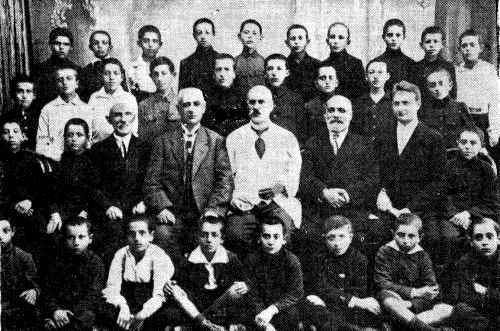
Community care
Community funds supported a hospital, an old-age home, food relief, interest-free loans, and aid for children. Neighbors and volunteers supplied help alongside formal institutions. Read about charity and community government.
Politics and public life
Communal elections brought together competing religious, Zionist, business, and other groups. Elected representatives managed institutions and responded to discrimination. Explore politics and public organizations.
Family celebrations and the Jewish year
The calendar shaped work and family gatherings. Births, weddings, and mourning connected households with religious and communal institutions. Read about holidays and food and lifecycle customs.
Khotyn communities abroad
Emigrants maintained family connections, organized mutual-aid societies, and sent help home. Later, survivors and descendants preserved photographs, songs, and recollections in the memorial book. Explore migration and the diaspora.
Jewish Streets & Neighborhoods
Streets, houses, markets, synagogues, fires, and the shape of the Jewish city.
Explore →Synagogues, Rabbis, & Religious Life
Prayer houses, rabbis, study, Hasidism, ritual, and religious institutions.
Explore →Family & Household
Kinship, language, names, household economy, and documentary families.
Explore →Childhood, Schools, & Education
Cheder, Talmud Torah, modern schools, Tarbut, libraries, sports, and youth.
Explore →Work, Markets, Trades, & Commerce
Merchants, artisans, professions, peddlers, credit, and seasonal work.
Explore →Community Institutions & Charity
Hospital, old-age care, loans, food relief, summer camp, and civic welfare.
Explore →Politics, Zionism, & Public Life
Elections, Zionism, professional defense, culture, and public organizations.
Explore →Holidays, Customs, & Food
Shabbat, festivals, communal matzah, charity, and household observance.
Explore →Weddings, Family, & Lifecycle
Birth, naming, marriage, health, death, burial, and mourning.
Explore →Migration, Landsmanshaftn, & Diaspora
Emigration, New York societies, Israel, memory, songs, and descendants.
Explore →Writers, Musicians & Cultural Figures
Authors, teachers, singers, and collectors with connections to Khotyn.
Explore →Read more of the community’s memories
The Khotyn Yizkor Book offers longer accounts of family life, schools, religious institutions, and the Holocaust. Browse the English table of contents to continue reading beyond the stories on these pages.
Sources for Jewish life in Khotyn
- Shlomo Shitnovitzer, ed., ספר קהילת חוטין (בסרביה) (Sefer kehilat Ḥoṭin (Besarabyah)) [Book of the Khotyn Community (Bessarabia)] [The Book of the Community of Khotin (Bessarabia)] (Tel Aviv: Khotin (Bessarabia) Society, 1974), pp. 11–20. Read translation
- Shlomo Shitnovitzer, ed., ספר קהילת חוטין (בסרביה) (Sefer kehilat Ḥoṭin (Besarabyah)) [Book of the Khotyn Community (Bessarabia)] (Tel Aviv, 1974), communal records and institutions, pp. 131–145; linked through the JewishGen Yizkor Book Project. Read translation
- Ancel, Jean, and Theodore Lavi, eds. “חוטין” (Ḥoṭin) [Khotyn]. In פנקס הקהילות: רומניה (Pinkas ha-kehilot: Romanyah [Encyclopedia of Jewish Communities: Romania]), vol. 2, 353–57. Jerusalem: Yad Vashem, 1980. Read English translation.
- Ciobanu, Ștefan, ed. Basarabia: Monografie regională [Bessarabia: A Regional Monograph]. Chișinău: Imprimeria Statului, 1926. Khotyn: pp. 92–93 and 195–199. Read source
- Shlomo Shitnovitzer, ed., ספר קהילת חוטין (בסרביה) (Sefer kehilat Ḥoṭin (Besarabyah)) [Book of the Khotyn Community (Bessarabia)] (Tel Aviv, 1974), Yiddish historical section, pp. 115–130; linked through the JewishGen Yizkor Book Project. Read translation
- My Shtetl / JewUA. “Jewish Khotyn.” Modern heritage photographs, synagogue and cemetery context, and local historical compilation. Read source
- Smithsonian Center for Folklife and Cultural Heritage. “Yiddish Wedding Hop: The Archives of Song Collector Ruth Rubin,” on Khotin-born folklorist Ruth Rubin. View archive catalogue
- Yiddish Song of the Week. Itzik Gottesman, “Vi zent ir geveyn? / Where were you?” Rose (Roza/Reyzl) Jaffe of Khotin, recorded c. 1986–1987; commentary and recording context. Read source
- American Jewish Joint Distribution Committee Archives. New York Office, 1933–1944, Countries and Regions: Latvia–Yugoslavia finding aid; entry “Chotin, Bessarabia, 1939,” with related Romania relief, medical, yeshiva, and welfare files. View archive catalogue
- Shlomo Shitnovitzer, ed., ספר קהילת חוטין (בסרביה) (Sefer kehilat Ḥoṭin (Besarabyah)) [Book of the Khotyn Community (Bessarabia)] (Tel Aviv: Khotin (Bessarabia) Society, 1974), “Jewish Life in Khotyn,” printed pp. 219–229. JewishGen Yizkor Book Project. Full book citation.
- Shlomo Shitnovitzer, ed., ספר קהילת חוטין (בסרביה) (Sefer kehilat Ḥoṭin (Besarabyah)) [Book of the Khotyn Community (Bessarabia)] (Tel Aviv: Khotin (Bessarabia) Society, 1974), “Education and Culture,” printed pp. 147–166. JewishGen Yizkor Book Project. Full book citation.
See the Sources & Bibliography for publication details, original-language titles, and image credits.