
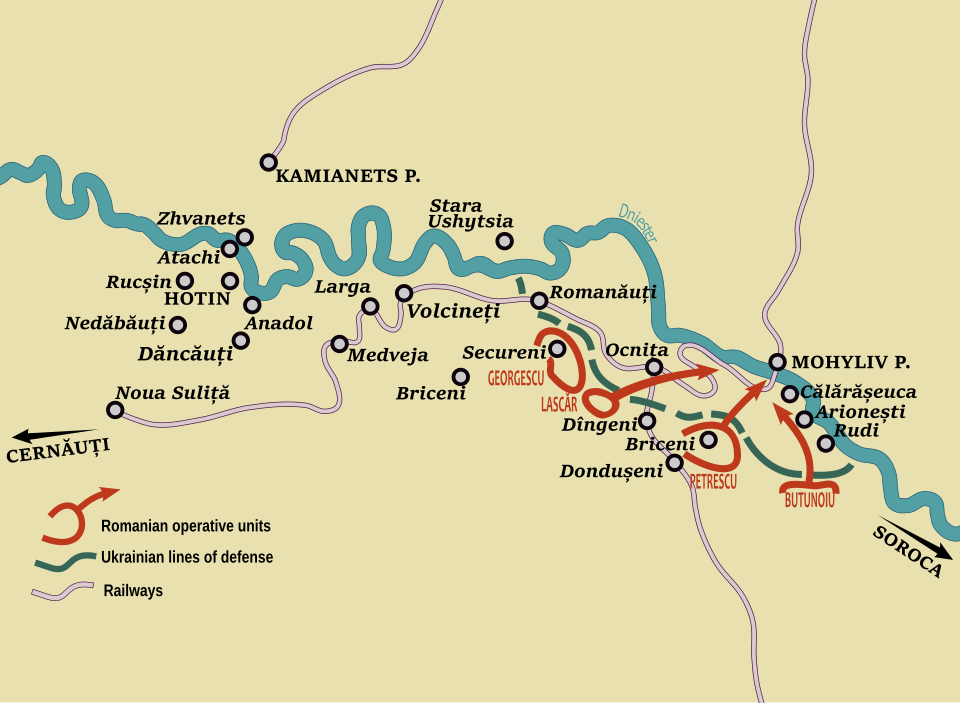
1918–1919: From Imperial collapse to Khotyn under Romanian rule
Romanian administration followed the collapse of Russian power in Bessarabia. Residents encountered Romanian courts, schools, language requirements, and citizenship rules while military control along the Dniester remained unsettled.
The January 1919 Khotyn uprising brought violence to the border region. Accounts emphasize varying combinations of peasant grievances, Ukrainian national aspirations, Bolshevik influence, cross-border support, and opposition to Romanian rule. Jewish residents faced the dangers of the revolt and its suppression alongside other townspeople.
For Jewish residents the new border had personal consequences. Their work and relatives were tied to the towns and farms on both sides of the Dniester. Under Romanian administration, a language change at the court or school could mean that a familiar document had to be interpreted anew, and proof of citizenship could determine a family’s standing.
1920–1926: A Jewish city under Romanian institutions
Under Romanian rule, Khotyn became the seat of Hotin County. Jewish schools, charities, prayer houses, and community organizations continued their work while residents dealt with new administrative and citizenship requirements.
The Bessarabian historian Ștefan Ciobanu’s 1926 regional survey describes the town’s streets and schools and records seventeen Jewish prayer houses.
The Jewish population was far from uniform. Some families owned businesses, others worked at crafts or moved through villages selling goods, and many depended on communal help at difficult moments. Their institutions were therefore practical as well as religious: a school could shape a child’s future, and a loan fund could keep a small trader at work.
1927–1929: Elected community government and organized welfare
The communal pinkas, a register of minutes and community affairs, records elections and welfare work. In 1927, reported turnout reached 92 percent of eligible voters. Candidate lists represented craftsmen, business interests, democrats, Zionists, independents, and Mizrachi, a religious Zionist movement. Women served on committees within a largely male-led administration.
Community budgets supported schools, charity, religious services, the cemetery, and health care. Interest-free loans helped small merchants, craftsmen, and village peddlers. Former residents abroad contributed funds.
Community elections were about how to spend money raised from residents and where to direct help. Voting brought together people with different political and religious commitments. The minutes show an organization administering ordinary needs and debating its priorities, while members abroad remained connected enough to send aid.
1930: Population, fire, and the scale of Jewish Khotyn
About 5,800 Jews lived in Khotyn in 1930, more than a third of the town. In May that year, a fire left fifty families homeless. The community raised money and arranged relief; another fire in February 1932 displaced fifteen poor families.
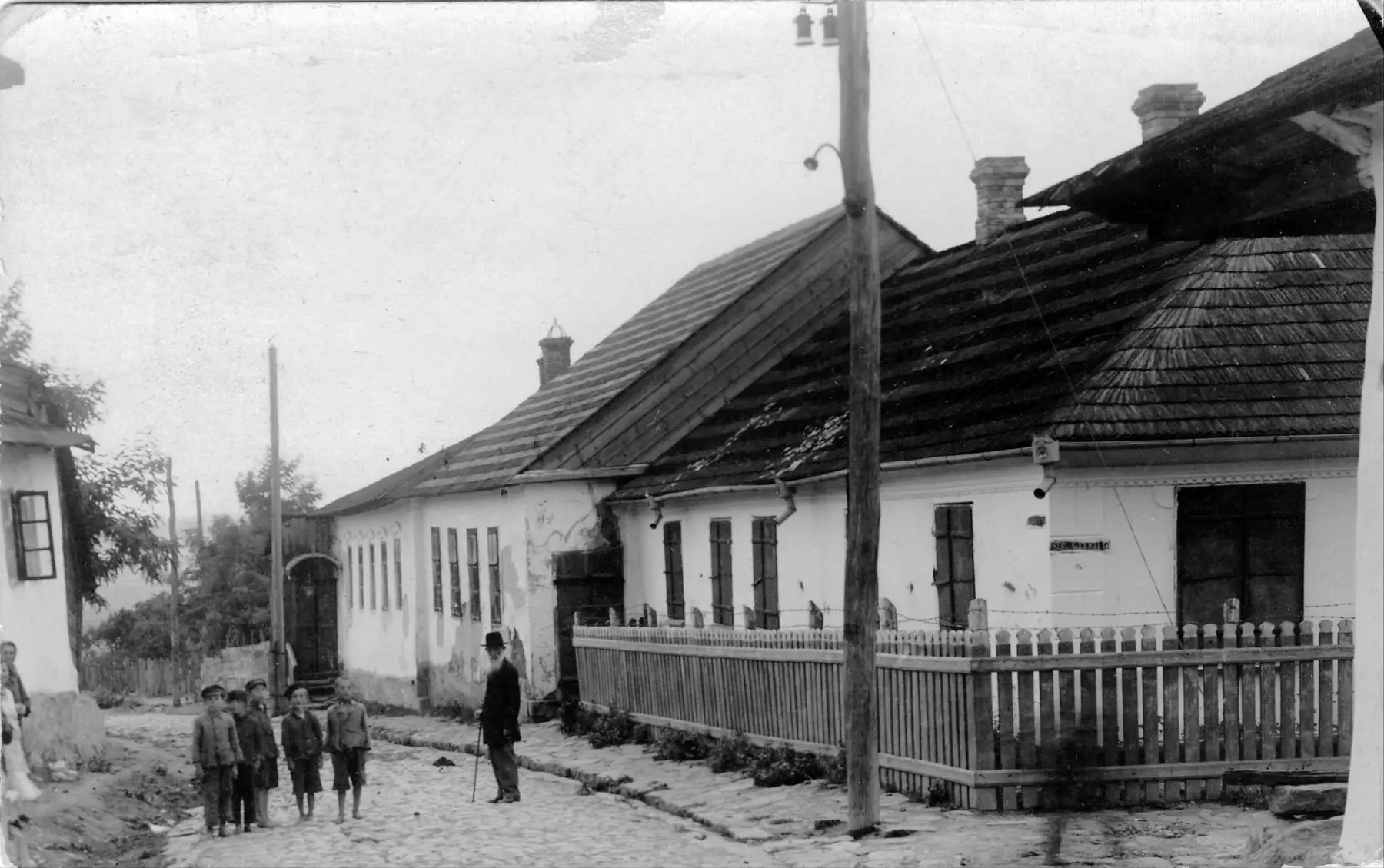

Fires made the community’s welfare system visible. Neighbors who lost a dwelling needed immediate shelter and a way to restart household life or a business. The response involved collecting money, distributing assistance, and deciding who needed help most urgently.
1931–1933: Schools, youth, charity, and political engagement
The community supported schools, a library, and youth activities, including Tarbut, a Hebrew-language educational network. In 1932 it purchased land to enlarge the cemetery. The following year, its existing registry office improved the recording of births, marriages, and divorces.
In 1933 the community also joined the boycott of German goods after Hitler came to power.
1934–1937: Antisemitism, professional restrictions, and civic defense
Romania’s political climate became increasingly hostile to Jews during the mid-1930s. Nationalist movements demanded restrictions in universities and professions, while antisemitic rhetoric entered mainstream public life. Khotyn’s Jewish lawyers and communal activists responded through organized protest. Community material records participation in a democratic attorneys’ front opposing discriminatory professional measures.
Zionists, religious movements, businessmen, craftsmen, and cultural activists competed in local elections and cooperated on community work. Their minutes record disagreements as well as joint responses to antisemitism.
Welfare work continued. A 1937 account describes summer camps for poor children, supported with help from the American Jewish Joint Distribution Committee. Read more about community institutions and charity.
For a young person seeking a profession, public hostility could translate into barriers at a school or professional association. For a communal leader, it meant defending access to work while continuing to fund meals, schools, and the cemetery. The records preserve those efforts and the disagreements within the community itself.
1938–June 1940: Authoritarian Romania and approaching catastrophe
King Carol II’s authoritarian regime, citizenship revisions, and antisemitic legislation narrowed Jewish civic security before the Iron Guard ever entered government. Economic discrimination and political uncertainty intensified. Yet local institutions continued to feed children, maintain religious life, operate welfare programs, and support education.
On 26–28 June 1940, after a Soviet ultimatum, Romania withdrew from Bessarabia and northern Bukovina. Khotyn was incorporated into the Ukrainian Soviet Socialist Republic (Ukrainian SSR). For the second time in a generation, residents changed states without moving. The communal structures recorded so vividly in the 1920s and 1930s were immediately exposed to Soviet policies that rejected independent religious, political, and charitable organizations.
Remembering life under Romanian rule
Read personal recollections of schools, work, and communal life in the Khotyn Yizkor Book contents.
Sources for 1918–1940
Notes on sources
Some transcriptions give 5,781 Jewish inhabitants for 1930. Interpretations of the 1919 uprising differ among the cited documentary collections and reference works. The summer-camp account is discussed with its date and source on the charity page.
The fire relief and 1933 registry-office changes appear in the memorial book’s community account, pp. 134–135. The 1937 camp account appears on p. 139. The registry was improved in 1933, rather than newly established.
- Encyclopedia of Ukraine. “Khotyn Uprising.” Read source
- Editorial collective. Хотинское восстание 1919 года: документы и материалы (Khotinskoe vosstanie 1919 goda: dokumenty i materialy) [The Khotyn uprising of 1919: Documents and materials] (Chișinău, 1976), 443 pp.
- Shlomo Shitnovitzer, ed., ספר קהילת חוטין (בסרביה) (Sefer kehilat Ḥoṭin (Besarabyah)) [Book of the Khotyn Community (Bessarabia)] (Tel Aviv, 1974), communal records and institutions, pp. 131–145; linked through the JewishGen Yizkor Book Project. Read translation
- Ancel, Jean, and Theodore Lavi, eds. “חוטין” (Ḥoṭin) [Khotyn]. In פנקס הקהילות: רומניה (Pinkas ha-kehilot: Romanyah [Encyclopedia of Jewish Communities: Romania]), vol. 2, 353–57. Jerusalem: Yad Vashem, 1980. Read English translation.
- Ciobanu, Ștefan, ed. Basarabia: Monografie regională [Bessarabia: A Regional Monograph]. Chișinău: Imprimeria Statului, 1926. Khotyn: pp. 92–93 and 195–199. Read source
- Anuarul Socec al României-Mari [Socec yearbook of Greater Romania]. 1923/24–1925 editions, Hotin section (around p. 2033 in the 1924/25 edition).
- Romanian Central Statistical Institute. Recensământul general al populației României din 29 decemvrie 1930 [General census of the population of Romania of 29 December 1930], Hotin town and county tables. Read source
- Center for the Study of the History of the Jews in Romania (CSIER). Hotin Jewish Community file, 1920–1940, “Activitate. Instituții.” Read source
- American Jewish Joint Distribution Committee Archives. New York Office, 1933–1944, Countries and Regions: Latvia–Yugoslavia finding aid; entry “Chotin, Bessarabia, 1939,” with related Romania relief, medical, yeshiva, and welfare files. View archive catalogue
See the Sources & Bibliography for publication details, original-language titles, and image credits.