
Leaving Khotyn before the First World War
Migration accelerated during the late Imperial period. Economic opportunity, military service, antisemitic restrictions, political unrest, and existing family networks all influenced decisions to leave. Some migrants moved only to another Bessarabian or Ukrainian city; others crossed oceans. A relative who had already found work abroad could send money, a ticket, an affidavit, or the promise of a bed and first job.
Letters, remittances, family visits, and marriage arrangements sustained connections after departure. Relatives abroad could pay for tickets or help newcomers find work.
For the conditions behind the prewar journeys to America, read 1880–1914: Leaving Khotyn.
New York: the Independent Chotiner Bessarabian Benevolent Association
people from Khotyn in New York organized the Independent Chotiner Bessarabian Benevolent Association in 1904. Like other landsmanshaftn, it provided mutual aid, social connection, sickness or death benefits, and a framework for burial. The organization’s cemetery plot at Wellwood Cemetery on Long Island preserves the town association physically in the United States.
A hometown society’s burial plot can suggest a connection with Khotyn. Spouses and relatives born elsewhere could also belong or be buried there. Compare plot records with immigration documents and family evidence.
JewishGen describes surviving papers of the Chotiner Hospital Moshev Zkenim Relief organization at YIVO in New York. The papers cover 1934–1935 and 1946–1947; about 310 names have been extracted. Read the collection description.
Workmen’s Circle and secular mutual aid
Khotyn emigrants also participated in broader Jewish labor and secular organizations. JewishGen’s town materials identify a Chotiner Bessarabier branch of the Workmen’s Circle, reflecting the political diversity carried into the diaspora. A person could belong to a hometown society for mutual aid while also identifying with socialist, labor, religious, or Zionist organizations.
These associations recreated social trust among immigrants who shared language, memories, and networks. They also helped newcomers navigate employment, sickness, funerals, and American institutions.
Palestine and Israel
Zionist life in interwar Khotyn made Palestine part of the town’s political imagination before mass postwar migration. Individuals and families emigrated during the Mandate period, while Holocaust survivors and later Soviet emigrants built new lives in Israel. Khotyn organizations there helped preserve community memory and contributed to memorial activity.
The 1974 memorial book, Sefer Kehilat Khotin (Bessarabia), was edited by Shlomo Shitnovitzer and published in Tel Aviv by the Khotin (Bessarabia) Society. It gathered memoirs, photographs, survivor accounts, and community history.
North America and the circulation of culture
The folklorist Ruth Rubin collected Yiddish songs in North America. The singer Rose Jaffe, also from Khotyn, preserved local and regional songs in later recordings.
Refugees, survivors, and forced migration
The twentieth century blurred the boundary between voluntary migration and flight. World War I created refugees. The Soviet annexation produced arrests, deportations, and movement east. The Holocaust forced Khotyn’s Jews into Transnistria or flight within the Soviet Union. Postwar survivors then made decisions under radically constrained circumstances about whether to return, move elsewhere in the USSR, go to Romania, or seek a future abroad.
A family’s migration history may therefore include several distinct statuses: emigrant, evacuee, deportee, soldier, displaced survivor, and later immigrant. Each status generated different records.
Preserving family and community memories
Memorial books, interviews, and family collections preserve names and experiences alongside civil and communal records.
Together, diaspora memory and local archival evidence allow Khotyn to be reconstructed as both place and community. The town on the Dniester is the geographical center; the descendants and repositories scattered across continents are the documentary continuation.
Khotyn hometown societies
BessarabiaSIG provides descriptions of these societies and their surviving material. The links include collection information and, for the Chotiner Branch, a banquet photograph. Names are retained as catalogued; some entries cover connected branches or later names of the same organization.
- Chotiner Bessarabier Branch 200, Workmen’s Circle
- Chotiner Bessarabier Unt. Verein
- Chotiner Branch
- Chotiner Hospital Moshev Zkenim Relief
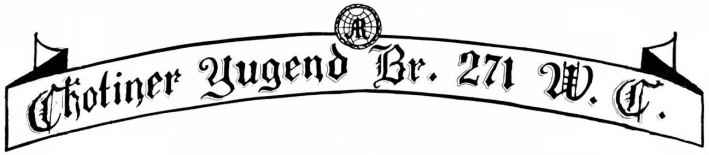
- Chotiner Yugend Branch 271, Workmen’s Circle — Chotiner Bessarabier Branch 200
- Chotiner-Bessarabier Emergency Club
- Independent Chotiner Bessarabia Benevolent Association
- United Chotiner Bessarabier Relief, Inc.
For songs and literature carried abroad, see Writers, Musicians & Cultural Figures.
Sources for migration, landsmanshaftn, and diaspora
- Shlomo Shitnovitzer, ed., ספר קהילת חוטין (בסרביה) (Sefer kehilat Ḥoṭin (Besarabyah)) [Book of the Khotyn Community (Bessarabia)] [The Book of the Community of Khotin (Bessarabia)] (Tel Aviv: Khotin (Bessarabia) Society, 1974), pp. 11–20. Read translation
- New York Public Library Digital Collections. Sefer Ḳehilat Ḥoṭin (Besarabyah), 1974, Yizkor Book Collection catalog/digital item. Read source
- Museum of Family History. Independent Chotiner Bessarabian Benevolent Association, Wellwood Cemetery, New York: landsmanshaft and burial-plot documentation. Read source
- JewishGen Bessarabia Research Division. “Khotin” town page: projects, documents, cemetery data, alternate names, and indexed collections. Read source
- JDC Archives. Names Index and remittance-list collections, including Romania and Bessarabia-related materials. View archive catalogue
- Smithsonian Center for Folklife and Cultural Heritage. “Yiddish Wedding Hop: The Archives of Song Collector Ruth Rubin,” on Khotin-born folklorist Ruth Rubin. View archive catalogue
- Yiddish Song of the Week. Itzik Gottesman, “Vi zent ir geveyn? / Where were you?” Rose (Roza/Reyzl) Jaffe of Khotin, recorded c. 1986–1987; commentary and recording context. Read source
- Yad Vashem. Central Database of Shoah Victims’ Names and document/testimony collections; search Khotin/Hotin/Khotyn and variants. Read source
- JewishGen. JewishGen Online Worldwide Burial Registry (JOWBR). Search Khotin/Khotyn burial records and photographs. View database
- Shlomo Shitnovitzer, ed., ספר קהילת חוטין (בסרביה) (Sefer kehilat Ḥoṭin (Besarabyah)) [Book of the Khotyn Community (Bessarabia)] (Tel Aviv: Khotin (Bessarabia) Society, 1974), “Khotyn Jews in America,” printed pp. 239–265. JewishGen Yizkor Book Project. Full book citation.
- Shlomo Shitnovitzer, ed., ספר קהילת חוטין (בסרביה) (Sefer kehilat Ḥoṭin (Besarabyah)) [Book of the Khotyn Community (Bessarabia)] (Tel Aviv: Khotin (Bessarabia) Society, 1974), “Life in Town,” printed pp. 97–104. JewishGen Yizkor Book Project. Full book citation.
- Shlomo Shitnovitzer, ed., ספר קהילת חוטין (בסרביה) (Sefer kehilat Ḥoṭin (Besarabyah)) [Book of the Khotyn Community (Bessarabia)] (Tel Aviv: Khotin (Bessarabia) Society, 1974), “Jewish Life in Khotyn,” pp. 219–229. Read translation
- JewishGen Bessarabia Research Division. “Chotiner Hospital Moshev Zkenim Relief.” Records at YIVO, Record Group 1120, Box 3; 1934–1935 and 1946–1947. Collection description.
See the Sources & Bibliography for publication details, original-language titles, and image credits.