
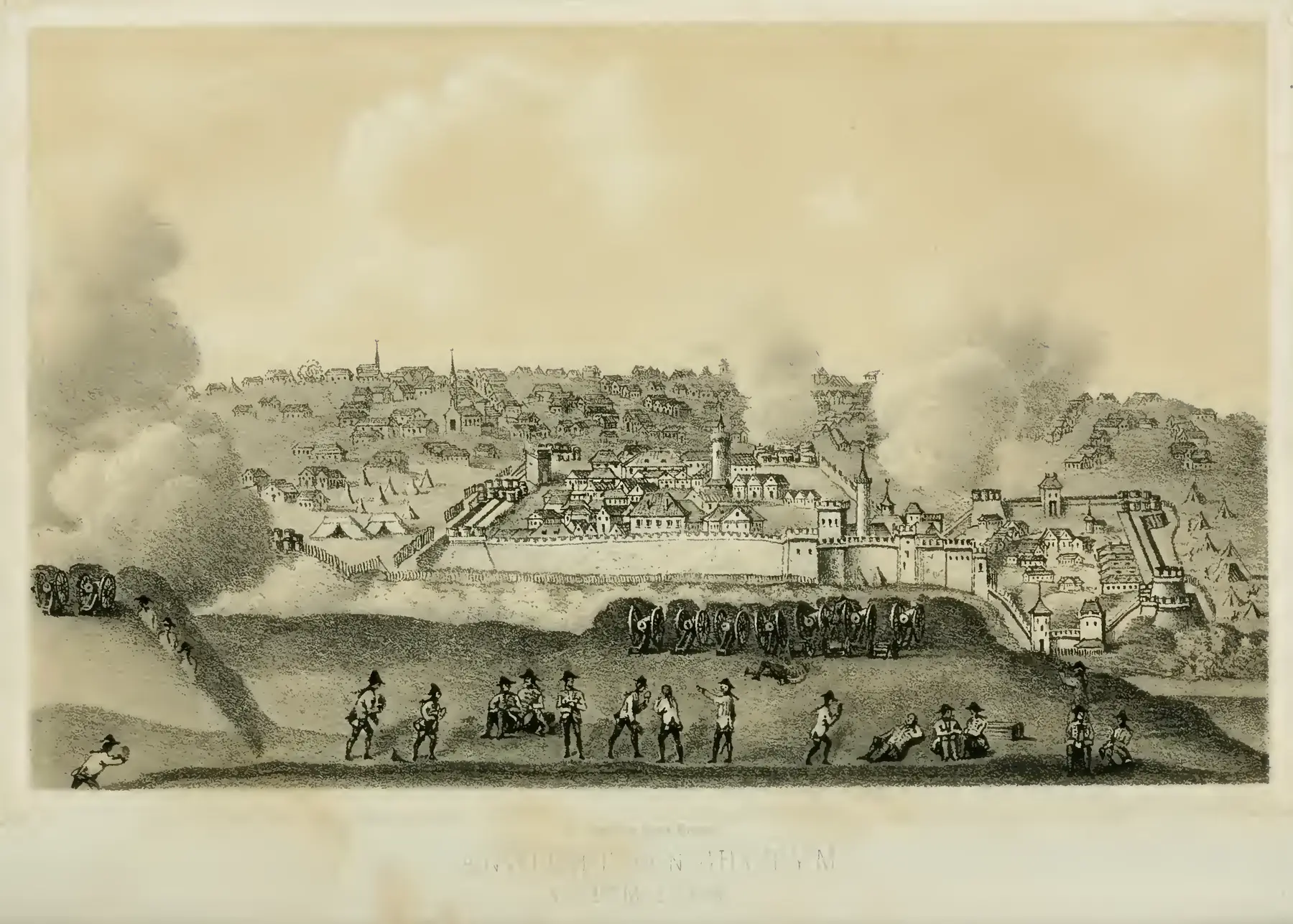
1538–1600: Ottoman power and an international market town
Sultan Süleyman I’s campaign in 1538 strengthened Ottoman authority over Moldavia, whose rulers continued to govern under Ottoman overlordship. Khotyn remained a fortress and trading town. The French traveler François de Pavie described its market in 1585.
For merchants and their families, a border could offer access to several markets. It also meant paying duties, negotiating with officials, and adjusting when military campaigns closed roads. The town’s Jewish community grew within this traffic between Moldavia, Podolia, and the Ottoman lands.
1600–1711: Polish–Ottoman conflict and the fortress city
The battles of 1621 and 1673 made Khotyn famous across Europe. Polish-Lithuanian, Ottoman, Cossack, and allied armies fought for the Dniester frontier. Repeated campaigns damaged the town and interrupted trade, while garrisons required food, transport, and supplies.
The fortress supplies a great deal of the surviving imagery, but the surrounding settlement had its own rhythms. Residents supplied garrisons, worked in markets, and kept households through repeated changes in military control. Evidence for particular Jewish families becomes much clearer in the eighteenth century.
Some Jewish histories recount a flight of Jews from violence in the lands north of the Dniester in 1648–1649. The presence of soldiers and refugees made frontier movement an enduring part of Khotyn’s story, although the surviving records do not let us reconstruct all the households that arrived in that episode.
Early eighteenth century: The Khotyn raya
In the early eighteenth century, the Ottomans brought Khotyn and its surrounding district under direct administration. This fortress district was called a raya, also spelled raia. Its enlarged defenses and garrison supported a market drawing people from Moldavia, Podolia, and neighboring regions.
By 1742, documents name Jewish merchants associated with the district.
A raya, also written raia, was a district directly administered by Ottoman officials around a fortress. Khotyn’s district drew traders from both sides of the Dniester. A document identifying someone as being “of the Khotyn raya” placed that person within this administrative district; it did not necessarily give a street address in the town.
29 July 1742: Avram and Boroh of the Khotyn raya
A Moldavian order dated 29 July 1742 names the Jewish merchants Avram and Boroh of the Khotyn district. Their names survive in the documents published by historian Nicolae Iorga, offering a glimpse of individual Jewish traders on the Ottoman–Moldavian frontier.
Avram and Boroh are among the first Jewish people whom a dated document lets us name in this period. The order associates them with commerce in the fortress district. It leaves much of their lives unrecorded: their homes, families, and daily routes must be sought in other documents. By following names across tax, property, and communal records, researchers can begin to recover the people behind a town-level history.
1763–1774: War, markets, and the first substantial Jewish list
Descriptions from the 1760s portray Khotyn as a busy Ottoman fortress and market. The Russo-Ottoman War of 1768–1774 brought renewed fighting. A published transcription of the 1774 fiscal census lists fifty-nine Jewish entries for the town.
The census identifies taxpayers by given name and, in many cases, a patronymic, meaning a name derived from their father’s name. Other identifiers include places of origin, occupations, kinship terms, and nicknames. These entries offer early details about individual Jewish households.
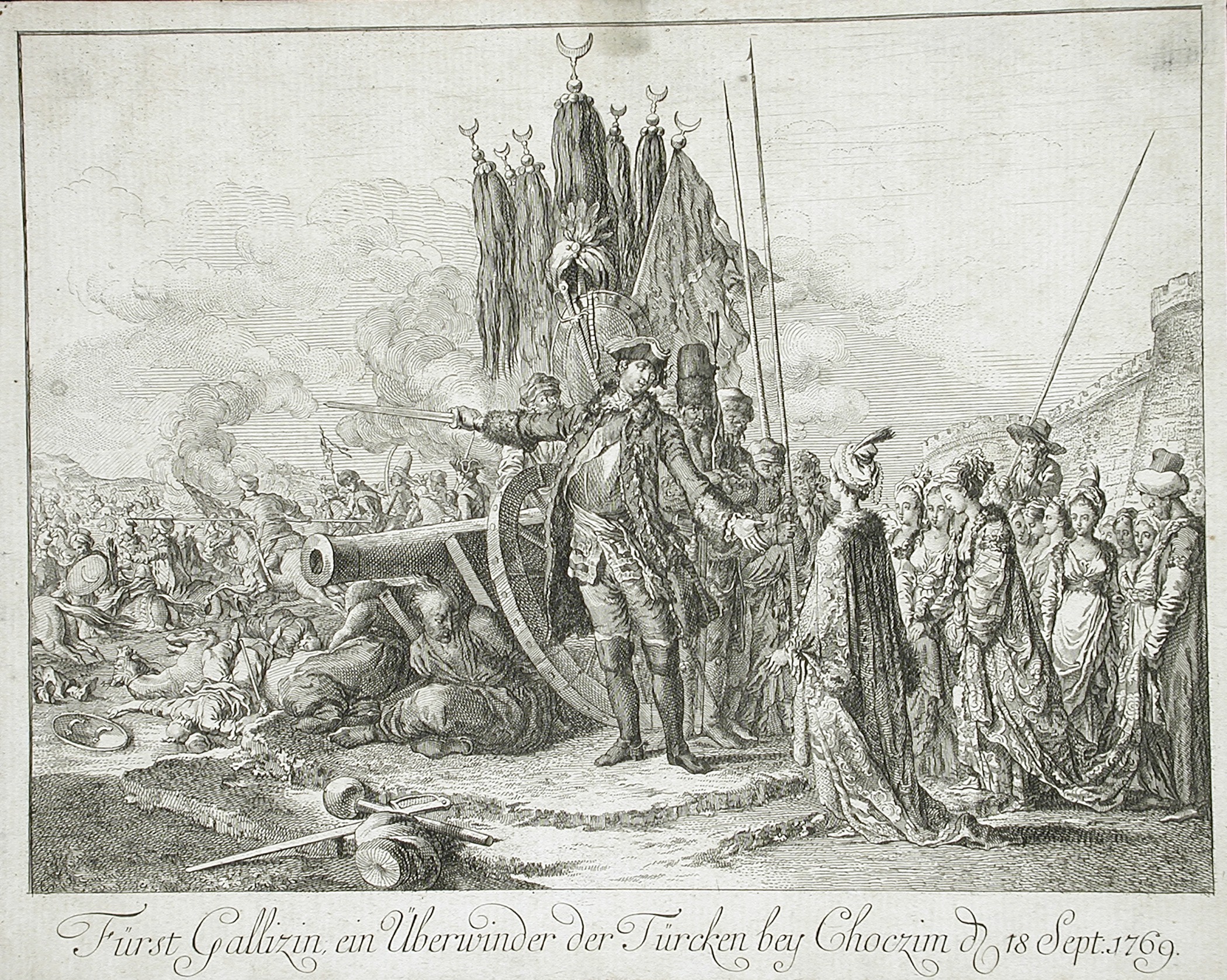

The 1774 fiscal list brings the community into closer view than an account of a battle can. Given names, fathers’ names, trades, places of origin, and kinship terms help distinguish one taxpayer from another. They also suggest a community that included migrants and people who worked across the frontier. For a family historian, the list is an early starting point rather than a complete census of everyone who lived in town.
1774–1792: Migration on a militarized border
The historian Emre Mutlu’s study of late-eighteenth-century migration describes Ottoman efforts to repopulate, supply, and stabilize the Khotyn frontier. Jewish merchants and artisans moved through the region alongside villagers and displaced families.
The siege of 1788 brought another change in control of the fortress. Military maps show roads, river approaches, camps, and settlements used by soldiers and civilians during the conflict.
One later account records a Jewish lessee, Moshko of the Khotyn district, in a 1774 dispute over an estate. A traveler in 1782 described Jewish merchants among the people trading in the fortified town. Such glimpses give the tax entries occupations and surroundings: leasing, buying, supplying, and crossing boundaries while armies fought nearby.
1792–1812: From Ottoman frontier to Russian annexation
By the early nineteenth century, reference works describe a substantial Jewish population in Khotyn. The community grew during the decades between the merchants named in 1742 and Russian annexation in 1812.
The Treaty of Bucharest in 1812 transferred Bessarabia, including Khotyn, to the Russian Empire. The town became a district center. Russian administration produced household tax registers known as revision lists, birth and marriage registers, census publications, and directories that now help trace local families.
Researching families in this period
The Genealogy & Records page includes published household lists and references for the years before Russian rule. Check each entry’s date and coverage before looking for a particular family.
Sources for 1538–1812
Notes on sources
Some later accounts use 1741 for the beginning of Jewish residence. The dated order discussed here is from 1742. Early population estimates, including figures for 1808, are reported through later reference works.
For the order naming Avram and Boroh, see Iorga, volume VI, part II, p. 381, nos. 1292–1293, and Schwarzfeld’s discussion. The migration section follows Emre Mutlu’s study; the 1774 fiscal list is a separate source.
- Ștefan Ciobanu, ed., Basarabia: Monografie Regională (Chișinău: Imprimeria Statului, 1926), pp. 195–199. Read source
- Iorga, Nicolae. Studii și documente cu privire la istoria românilor [Studies and documents concerning Romanian history], vol. VI, pt. II (Bucharest, 1904), p. 381, nos. 1292–1293: order of 29 July 1742 concerning Jewish merchants Avram and Boroh of the Hotin raya. Read source
- Dmitriev, P. G., and P. V. Sovetov, eds., Moldova în epoca feudalismului [Moldavia in the feudal era], vol. VII, pts. I–II: Recensămintele populației Moldovei din anii 1772–1773 și 1774 [Censuses of the population of Moldavia in 1772–1773 and 1774] (Chișinău: Știința, 1975), Hotin Jewish fiscal/household list; Genealogica digital edition. Read source
- Schwarzfeld, Elias. Din istoria evreilor: împopularea, reîmpopularea și întemeierea târgurilor și târgușoarelor în Moldova [From Jewish history: The settlement, resettlement, and founding of towns and market towns in Moldavia] (Bucharest, 1914), Hotin/1742 discussion. Read source
- Gumenâi, Ion. Istoria ținutului Hotin: de la origini până la 1806 [History of the Hotin district: From its origins to 1806] (Chișinău: Civitas, 2002). Read source
- Mutlu, Emre. “Migration on the Last Frontier: Migration Movements in Late 18th-Century Khotyn.” Codrul Cosminului [The Forest of Cosmin] XXXI (2025): 321–344. Read source
- A. Egunov, Bessarabian Statistical Committee publications, 1860s, cited by Ștefan Ciobanu, Basarabia: Monografie regională (Chișinău: Imprimeria Statului, 1926), vol. 2, p. 200; vol. 3, pp. 287–288. Exact original publication and title remain to be identified; consult Ciobanu before using these figures.
- Encyclopaedia Judaica, 2nd ed. “Khotin” (2007); online reproduction at Jewish Virtual Library. Read source
See the Sources & Bibliography for publication details, original-language titles, and image credits.