
Public life in a politically plural community
Communal election lists represented religious and Zionist groups, craftsmen, merchants, democrats, and independents. The council managed budgets and represented Jewish residents before the authorities.
Political identity could overlap. A shopkeeper might support Zionism while voting for a business list in a communal election; a religious family could send a child to a modern cultural organization; a worker could participate in both a synagogue and a labor-oriented group.
Late Imperial period: Haskalah, Zionism, and socialism
By the early twentieth century, Khotyn residents encountered Zionist and socialist ideas through schools, reading, meetings, and family connections. Memoirs recall young people debating the Jewish future and choosing between movements.
1927: Ninety-two percent turnout in a communal election
Interwar communal records report that 92 percent of eligible voters participated in the 1927 Jewish community election. Competing lists included democrats, craftsmen, Mizrachi (a religious Zionist movement), businessmen, Zionists, and independents. The unusually high turnout suggests that residents understood the community council as consequential: it controlled budgets and made decisions affecting education, charity, religion, and representation before Romanian authorities.
Women served on committees responsible for welfare, education, and other community affairs. Formal leadership remained largely male.
Zionism: fundraising, youth, and public culture
Zionist groups organized fundraising, Hebrew education, youth activities, and public meetings. Some members emigrated to Palestine, while others supported these activities from Khotyn.
Sports and physical culture also entered Zionist youth life, reflecting the movement’s emphasis on a “new Jew” capable of physical as well as intellectual and national renewal.
1933: Boycott of German goods
Community minutes record participation in the Jewish boycott of German goods after Hitler came to power in 1933. The action connected a town on the Dniester to an international Jewish response to Nazi persecution. Local merchants and consumers were being asked to use everyday economic choices as political action.
1935–1937: Defending education and the professions
As Romanian antisemitism intensified, Jewish students and professionals confronted demands for quotas and exclusion. Khotyn records refer to attorneys organizing against discriminatory measures and to communal protests. Lawyers were especially visible because they operated in the public institutions of the county seat and could articulate legal challenges.
External pressure sometimes encouraged cooperation across internal political differences. A Zionist and a non-Zionist could disagree about the Jewish future while jointly opposing restrictions that threatened both.
Culture as public life
Libraries, lectures, theater, and music brought young people together beyond home and synagogue. Hebrew and Yiddish cultural interests overlapped with political commitments. The Education page describes these activities.
1940: The abrupt end of legal pluralism
Soviet annexation ended the environment in which independent Zionist, religious, cultural, business, and charitable organizations could operate legally. Political activists could become targets of state suspicion, while communal assets and associations were nationalized or dissolved.
Public life abroad
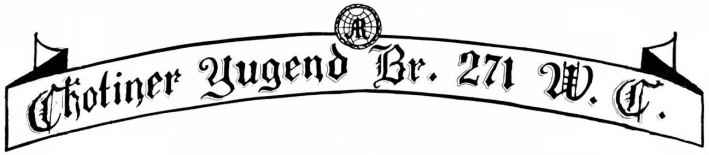
BessarabiaSIG documents the Chotiner Bessarabier Branch 200 of the Workmen’s Circle and a Chotiner Branch banquet photograph. See Khotyn hometown societies for related organizations and collections.
Sources for politics, Zionism, and public life
- Shlomo Shitnovitzer, ed., ספר קהילת חוטין (בסרביה) (Sefer kehilat Ḥoṭin (Besarabyah)) [Book of the Khotyn Community (Bessarabia)] (Tel Aviv, 1974), communal records and institutions, pp. 131–145; linked through the JewishGen Yizkor Book Project. Read translation
- Ancel, Jean, and Theodore Lavi, eds. “חוטין” (Ḥoṭin) [Khotyn]. In פנקס הקהילות: רומניה (Pinkas ha-kehilot: Romanyah [Encyclopedia of Jewish Communities: Romania]), vol. 2, 353–57. Jerusalem: Yad Vashem, 1980. Read English translation.
- Shlomo Shitnovitzer, ed., ספר קהילת חוטין (בסרביה) (Sefer kehilat Ḥoṭin (Besarabyah)) [Book of the Khotyn Community (Bessarabia)] [The Book of the Community of Khotin (Bessarabia)] (Tel Aviv: Khotin (Bessarabia) Society, 1974), pp. 11–20. Read translation
- Shlomo Shitnovitzer, ed., ספר קהילת חוטין (בסרביה) (Sefer kehilat Ḥoṭin (Besarabyah)) [Book of the Khotyn Community (Bessarabia)] (Tel Aviv, 1974), Yiddish historical section, pp. 115–130; linked through the JewishGen Yizkor Book Project. Read translation
- Center for the Study of the History of the Jews in Romania (CSIER). Hotin Jewish Community file, 1920–1940, “Activitate. Instituții.” Read source
- Encyclopedia of Ukraine. “Khotyn Uprising.” Read source
- American Jewish Joint Distribution Committee Archives. New York Office, 1933–1944, Countries and Regions: Latvia–Yugoslavia finding aid; entry “Chotin, Bessarabia, 1939,” with related Romania relief, medical, yeshiva, and welfare files. View archive catalogue
- Shlomo Shitnovitzer, ed., ספר קהילת חוטין (בסרביה) (Sefer kehilat Ḥoṭin (Besarabyah)) [Book of the Khotyn Community (Bessarabia)] (Tel Aviv: Khotin (Bessarabia) Society, 1974), “Life in Town,” printed pp. 97–104. JewishGen Yizkor Book Project. Full book citation.
Notes on sources
The meeting recalled through rival songs is a participant’s recollection; the Internationale is a socialist anthem and Hatikvah a Zionist anthem.
See the Sources & Bibliography for publication details, original-language titles, and image credits.