
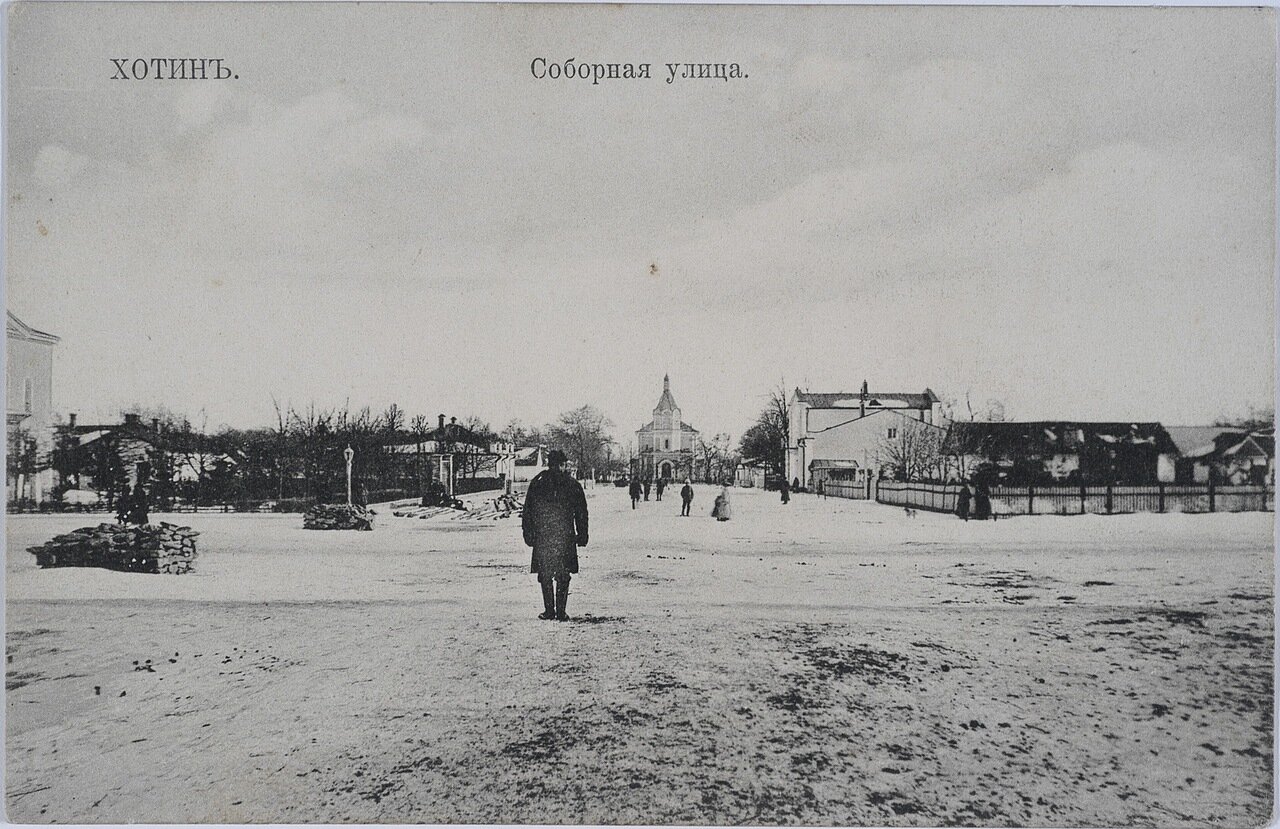
Why leave a town full of family?
A Khotyn resident preparing for America could know exactly what would be missed: relatives nearby, a familiar market, a synagogue, customers, and the streets walked since childhood. Jewish Khotyn was a large community. Some households owned shops or property; others relied on daily trade, craft work, or seasonal customers. The decision to go grew out of those particular circumstances. There was no single reason that explains every family’s journey.
In the decades before the First World War, more Jews from the Russian Empire were leaving for the United States. Khotyn was part of that movement. Economic hopes, legal restrictions, military service, fear of antisemitic violence, and news from relatives abroad could all enter a family’s discussion. A young artisan deciding whether to follow a brother to New York and parents deciding whether to keep their children nearby faced different choices.
A living from trade and crafts
Many Khotyn Jews made a living through trade and crafts tied to the town and its agricultural surroundings. Shopkeepers sold goods to rural customers; tailors and shoemakers depended on people able to pay for their work; merchants handled produce and supplies. A slow season or a shift in trade could be felt throughout a household. New training and opportunities existed, but laws and local practice limited access unevenly.
A revealing example survives from 1886. According to the Khotyn entry in Pinkas ha-kehilot, about one hundred Jews sought permission to lease land and farm when economic conditions worsened. The district supervisor refused. Eighty families then organized to seek land in Palestine with philanthropic help. That group’s response was not emigration to America, but it shows Khotyn residents actively looking beyond their usual trades and even beyond the town when they saw too few possibilities at home.
The same account cites the Hebrew newspaper Ha-Melitz on 31 July 1888: craftsmen and young artisans formed a large share of emigrants. Those are occupations a descendant might find again in a passenger manifest, marriage record, or American census.
Unequal rights, service, and insecurity
Bessarabia was governed by the Russian Empire, which classified residents by status and restricted Jewish residence and economic activity. Laws changed over time. Education, occupation, and merchant standing could open exceptions for some people while others found their movement or work constrained. A young person might compare the prospect of an apprenticeship elsewhere, the demands of military service, and what an older sibling reported about earning a living overseas.
The 1874 reform of military service had changed the terms of conscription from the earlier system. Service could still weigh on family plans in the emigrant generation. It might help explain a particular young man’s timing if supported by his records or family account; a departure at draft age alone does not tell us why he left.
Pogroms elsewhere in the empire and antisemitic politics added fear. The attacks in Kishinev in 1903 and 1905 took place elsewhere in Bessarabia, not in Khotyn. News of them traveled far beyond the city. For a Khotyn family, they could affect how secure a future in the region felt, even as economic and family considerations remained important. Historians of eastern European Jewish migration caution against attributing the entire movement to one outbreak of violence: departures had begun earlier and continued for many reasons.
A destination became familiar
The journey was easier to imagine when someone from Khotyn had already arrived. A relative or neighbor might send a letter, help pay a fare, offer a place to stay, or suggest work. Families could leave in stages, with one member testing a new city before others followed. Some went to other cities nearer Khotyn, to Palestine, or elsewhere in the Americas. The United States drew many Khotyn emigrants as the wider migration accelerated.
Immigrants also carried their town with them. The Independent Chotiner Bessarabian Benevolent Association formed in New York in 1904. Its members built a network for mutual aid and burial among people connected to Khotyn. Later Khotyn organizations supported people in their new homes and maintained ties with the old one. A society’s records or cemetery plot can bring together names that appeared separately on ship lists and censuses.

The family in two places
Leaving did not end an emigrant’s connection with Khotyn. Letters and money went back; relatives abroad helped later arrivals; marriages and deaths linked family branches across the ocean. Some people returned to visit or live in Europe. Others never saw their parents or siblings again. The outbreak of war in 1914 made movement and communication harder, giving earlier departures a significance families could not have foreseen.
A family history may contain several motives at once. A parent might remember danger, a child might recall an uncle’s offer of work, and an immigration form might only give a last residence. Read such evidence together with the documented conditions of Khotyn at the time, while allowing each family its own story.
Following an emigrant in the records
Start with the immigrant’s name, approximate age, occupation, and closest known relatives. U.S. passenger lists often identify a last residence and sometimes a person left behind and a person to join; the questions and surviving details vary by date. Compare that information with naturalization files, U.S. censuses, marriage and death records, hometown society papers, and JewishGen’s Khotyn district records. Search historical spellings such as Khotin and Hotin when a database uses them.
Dates of arrival and ages may suggest questions about employment, family networks, or conscription. A letter, testimony, or closely related set of documents may tell you more about a particular person’s decision. Continue with Genealogy & Records and the Migration and Diaspora page for societies, burial plots, and later migrations.
Sources for 1880–1914
- Ancel, Jean, and Theodore Lavi, eds. “חוטין” (Ḥoṭin) [Khotyn]. In פנקס הקהילות: רומניה (Pinkas ha-kehilot: Romanyah) [Encyclopedia of Jewish Communities: Romania], vol. 2, 353–57. Jerusalem: Yad Vashem, 1980. Read English translation. Local 1886 land request and 1888 newspaper report.
- YIVO Encyclopedia of Jews in Eastern Europe. “Population and Migration before World War I,” “America,” and “Military Service in Russia.” Regional patterns and the changing rules of service.
- Bezarov, Oleksandr. “Джерела з історії єврейського населення Хотинського повіту Бессарабської губернії ХIХ – початку ХХ ст. у фондах Державного архіву Чернівецької області” (Dzherela z istorii yevreiskoho naselennia Khotynskoho povitu Bessarabskoi hubernii XIX – pochatku XX st. u fondakh Derzhavnoho arkhivu Chernivetskoi oblasti) [Sources on the History of the Jewish Population of Khotyn County in the State Archive of Chernivtsi Oblast]. Архіви України (Arkhivy Ukrainy) [Archives of Ukraine] 4, no. 337 (2023): 125–141. Journal article.
- JewishGen Bessarabia Research Division. “Khotin” town resources and descriptions of Khotyn hometown organizations.
- Shlomo Shitnovitzer, ed. ספר קהילת חוטין (בסרביה) (Sefer kehilat Ḥoṭin (Besarabyah)) [Book of the Khotyn Community (Bessarabia)]. Tel Aviv: Khotin (Bessarabia) Society, 1974, pp. 239–265, for the later history of Khotyn émigré organizations. Read available translation.
Full entries and credits appear in Sources & Bibliography.