| JewishGen.org KehilaLinks Home Page |
|
|||||||
 |
|
| JewishGen.org KehilaLinks Home Page |
|
|||||||
|
|
NYC Area Cemetery and Burial Resources by
Phyllis Kramer z"l
The Jews from Rohatyn must have been an organized and fervent
group. I have located four separate Landsmanshaftn organizations,
founded in the late 1800s in New York City and one in Israel. The
following are the details and the founding officers.
The Independent Rohatyner Young Mens Benevolent Association (IRYMBA) . On the Certificate of Incorporation, dated 1903, in Manhattan, the purpose is stated: to voluntarily aid and assist the distressed and needy members of the said corporation and their families. To advance the social intercourse among its members, morally, intellectually and physically".
I believe that this society is the same as The Independent Rohatyner Sick and Benevolent Society which was founded June 18, 1896.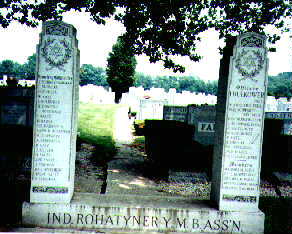 certificate was signed by
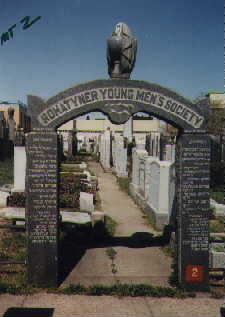
A few years ago I visited with the President, Herman Skolnick, who was born in Rohatyn. A lovely man who has since passed on. His wife still lives in Brooklyn, and his son Michael Skolnick, is still active in the Society, along with Yossi Benjamin, the Recording Sec. About 35 members still pay dues. This society maintains gravesites at Beth Israel, in Woodbridge New Jersey and "Old" Montefiore, in St. Albans, New York. Thanks to Herman Skolnick, all the names in these landsmanshaftn plots are in a database you can query on-line. The list contains the names of the folks buried in 2 landsmanshaften plots inBeth Israel and Old Montefiore. There is another landsmanshaftn plot for the Independent Rohatyners Young Mens Benevelent Society at Mt Hebron. This plot is not included in the database.
The following names were contained in the Golden Jubilee Fiftieth Anniversary Banquet of the IRYMBA in 1953 at the Broadway Central Hotel, in various sections, including a memorial.
The minutes of this Landsmanshaften are at YIVO in New York City (Record Group 1082). They cover the years 1953 to 1977, and I believe they are written in Yiddish.
The list contains the names of the folks buried in the two RYMS landsmanshaftn plots in Mt. Hebron and Mt. Zion, as well as those plots which were purchased and reserved. The source of the RYMS information is Alvin Edelstein, the Cemetery Chairman of the Rohatyner Young Men's Society. Alvin inherited this position from his late father-in-law, who held it for over fifty years.
If you want to search the full list of Rohatyners buried in Mt. Hebron cemetery online, go to https://www.mounthebroncemetery.com/interments/, enter 'Rohatyn' in the society name field. Second and third generation Rohatyners still meet annually in New York City. I'm proud to say that I (Phyllis Kramer) am a member and have attended meetings.
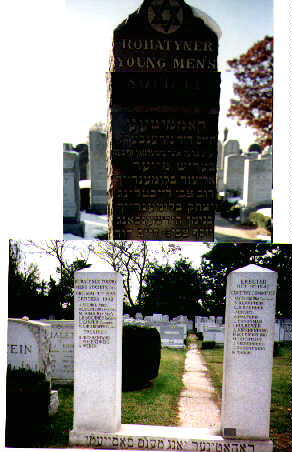
Pictured at the left is Mt. Hebron plot, and at the right, Mt Zion plot; both cemeteries are in Queens (New York).
Alvin Edelstein transcribed the names on the Mt Hebron posts, as
follows: Monument I: Rohatyner Young Men's Society, Inc. Organized
May 19th, 1894.
Officers, 1942: J. Eichel, President, M Leichtling, Vice Pres, M.
Tabak, Rec. Sec y, LB Bochner, Fin. Sec y, C Kanfer, Cashier, MA
Hulkower, Guard,
Trustees: B Hirschenfang, C Rosenzweig and A. Weber.
The second monument reads: Rohatyner Young Men s Society Committee: Chaim David Nierenberg, Ex Pres and Chairman, Beresh Mayer, Eliezer Blumenreich, Dov Zvi Leichtling, Yitzhak Blumenreich, Benjamin Hirschenfang, Yosef Zvi b reb Chaim, David Nierenberg, Mechl Schechter, Yitzhak Hilkever, Chaim Bernstein, Yehezkel Kanfer, Mordechai Helfman, and Moshe Altman.
The following lists members of the Rohatyner Young Men's Society, from a number of documents from their 50th Anniversary Banquet, held at the Central Plaza Hotel in NYC on December 20, 1947, a 1946 meeting, a 1950 request for contributions for the UJA Israel housing campaign, 1 1953 Installation of Officers, and a 1999 memorandum.
All the minutes of Rohatyner meetings of the first 50 years, or so, were meticulously hand written (in Yiddish) and preserved, and were given to YIVO in New York, for their use and further preservation. You can locate these records (1928-1964) and the memorial book at YIVO (Record Group 1016).
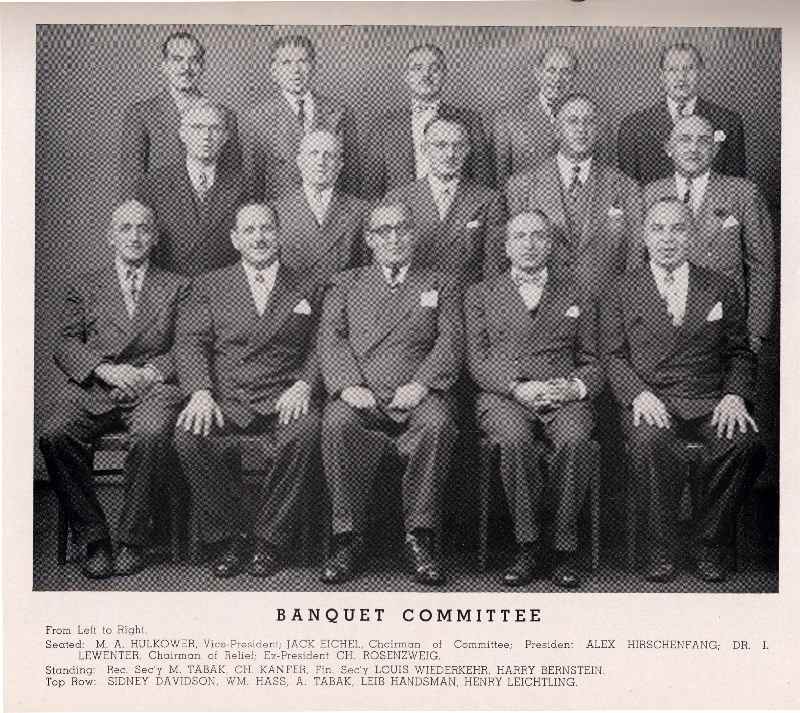
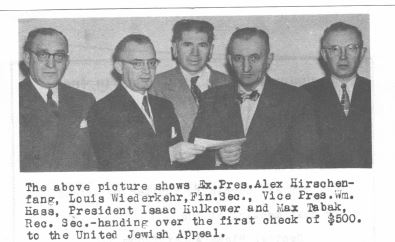
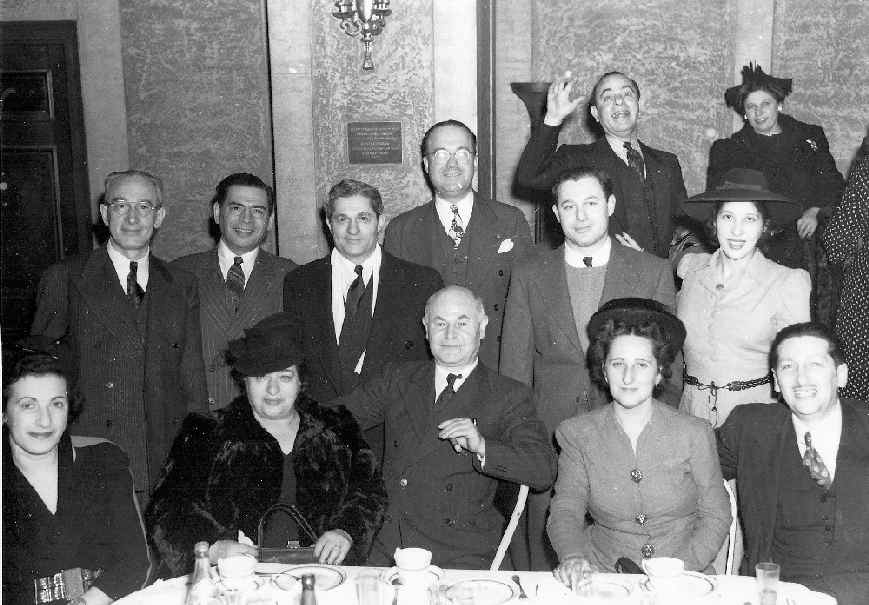
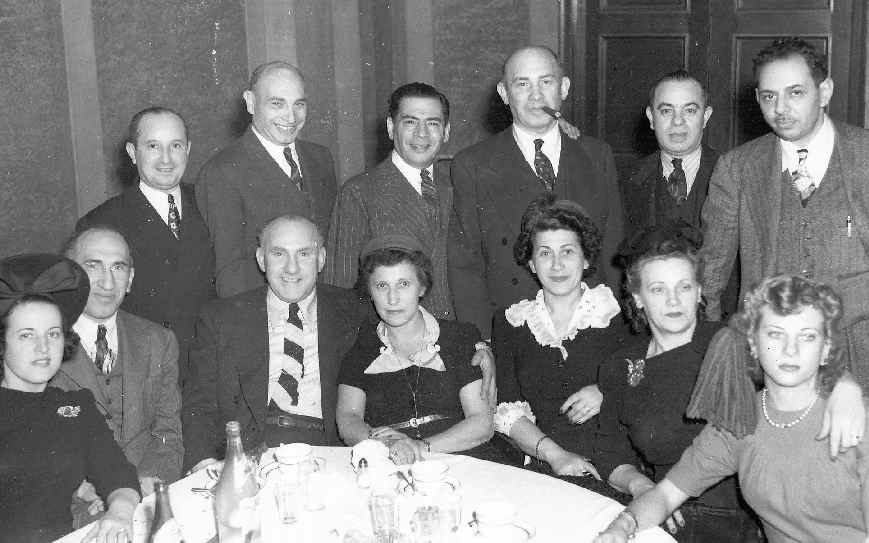
Can anyone identify the participants??
GUARDIAN: Rohatyner cemetery chair David Reich (above) worries that gravesites will suffer if the aid society that oversees them folds. For the members of a century-old Jewish fraternal society, the organization's breakup has literally turned into a fight over graves. The Rohatyner Young Men s Society is one of the last of the landsmanschaftn, benefit societies formed at the turn of the past century by groups of townsfolk who had emigrated from Eastern Europe. Thousands of landsmanschaftn once dotted American cities with Jewish immigrant populations, but the few that remain are now struggling to plan their own demise.
Several generations removed from its point of origin, Rohatyner, as members call it, may have outlived the conditions for its existence. Its dispersed constituents, the great- and great-great-grandchildren of the group's founders on Manhattan s Lower East Side, do not socialize outside of biannual dinners and no longer need the organization as a dispenser of loans and medical help. Instead, like other landsmanschaften in their final stages, Rohatyner now primarily functions as a burial society and will likely soon cease to be even that.
The normal life of an organization like that is, it goes from having all kinds of social activities to something like an annual banquet, and the last thing to survive is the burial benefit, said Robert Kestenbaum, who, as an officer of the Yiddish cultural and political organization Workmen s Circle/Arbeter Ring, has seen the decline of dozens of landsmanschaften. And that's where the really sad stuff comes in.
A vote conducted by mail last month suggested that most Rohatyner members are resigned to closing the group s doors for the last time. Of the 32 households that voted many members belong to the organization along with their families, and indeed several extended clans stretch through the association 24 favored disbanding.
But those who oppose disbanding feel strongly that they may lose not only a link to the past, but also a plot in the cemetery. Rohatyner owns land in two Jewish cemeteries in Queens where, according to the group s treasurer, 72-year-old Alvin Edelstein, about 850 society members are buried. Another 100 graves remain open. Enrollment in the organization entitles an individual to a heavily subsidized burial, an increasingly pressing concern for Rohatyner s aging membership....
According to Kestenbaum, when landsmanschaftn break up, their gravesites can become stuck in limbo. In New York State, unless a disbanding society deeds its graves back to the cemetery or to the families that plan to use them, those plots, by law, must remain empty. There are thousands of graves in New York that under current statutes can never be used, Kestenbaum said.
This is not the first time that the issue of burial has raised uncomfortable questions for the group. Ten years ago, the organization voted to seal its ranks permanently even excluding members children from joining because of a lack of cemetery space.
These concerns mark the distance from the organization s halcyon days, which members say lasted from its establishment in 1894, when the group s founders named it for their hometown of Rohatyn in what is now western Ukraine, through the World War II era. (The town also lent its name to its most famous son, investment banker Felix Rohatyn.) In 1900, Rohatyn was a lively community of 7,000 people, about half of whom were Jewish. According to the town s page on the Web site JewishGen, it spawned no fewer than four landsmanschaftn in the United States and Israel.
My father was a failed grocer during the Depression, and he would put on a suit when he went to the meetings, recalled Bernard Hulkower, the group s 80-year-old president. It was a big deal. As members became more prosperous, Rohatyner directed its budget away from aid for members and toward charitable donations to such Jewish organizations as Hadassah.
We eat, we give to charity and we bury people, Edelstein said. What to do with the money that remains in the group s coffers is a matter that will have to be dealt with if the organization breaks up. According to Hulkower, $160,000 remains, and some members want the money given away; others, however, believe that it should be divided among them.
For now, arguing about whether, and how, to disband appears to be Rohatyner s one remaining group avocation. There s been talk about disbanding for at least 10 years, said Robyn Katz, who is Edelstein's niece and, at 50, one of the group's youngest members. And arguing about the cemetery is not a new pastime in the society. Katz's late grandfather once worked the group into a tizzy by posing the perplexing question of whether a member who already buried one wife in the Rohatyner plot could bury a second wife there, as well. Everyone discusses it; it gets very heated, Katz said. It s very philosophical. And then my grandfather said: Well, this is what I told him already. One spouse per plot. He had already decided! If this summer s vote turns out to be definitive, those conversations may be about to come to an end.
There's a general feeling that we're not going anywhere, Hulkower said. The next meeting should be the last.
This page is hosted at no cost to the public by
JewishGen, Inc., a non-profit corporation.
To support this and other projects of JewishGen, please consider
making a donation to JewishGen-erosity
Your contribution would be deeply appreciated.
Created and compiled by Phyllis Kramer z"l
(1999-2019)
Last Update by Alexander
Feller on July 12, 2026
Copyright © 1998 Phyllis Kramer z"l