| JewishGen.org KehilaLinks Home Page |
|
|||||||
 |
|
| JewishGen.org KehilaLinks Home Page |
|
|||||||
|
|
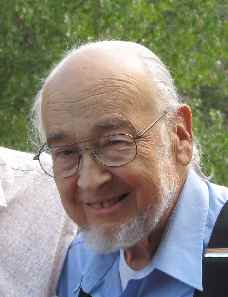
In November of 2010 we lost a wonderful friend. Howard Steinmetz. We are a small band of Rohatyn researchers...and Howard was, in many ways, our leader, our mentor, our friend. Our group began through JewishGen….and then grew into a Google Group. Today it is worldwide..Paris, Rio, Jerusalem, Buenos Aires, San Francisco, Chicago, Berkeley, New York. We’re drawn together genealogically, our families are interrelated but not close.
Howard shared his Rohatyn memories, conversations, photographs and documents, and helped us to make the connections and respect the past. Each of us understood the value of Howard’s memories and papers. And we’re pledged to preserve them.
He will be sorely
missed.
Eliezer Makovsky, from
Jerusalem, sent us this brief record of the Rabbi's family:
Eliezer (Elazar ben Issachar Halevi) served as the town rabbi of
Rohatyn in the 1850s and 1860s.
He had 5 children:
In 1863, Rabbi Eliezer
Horowicz published a book call Devar Halacha.
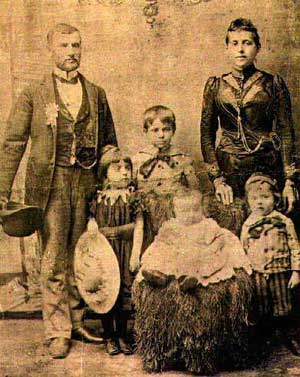


My great grandmother Dora EICHEL was born in Rohatyn in 1862. Dora married Reuven LINDNER (photo circa 1893). Dora's father, Anschel EICHEL was a tailor who specialized in making uniforms for the Pravoslav priests and monks. We can trace the Eichels back to Yitzhak Eichel, who lived in Hamburg at the end of the 18th century; he was a scholar who published a textbook of the Yiddish language and was a pupil of the German philosopher Kant.
Here is the family tree: Anschel EICHEL married Beile BERLIN in Rohatyn around 1850. Their children were:
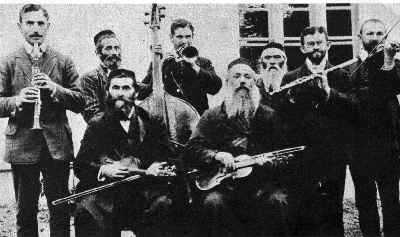
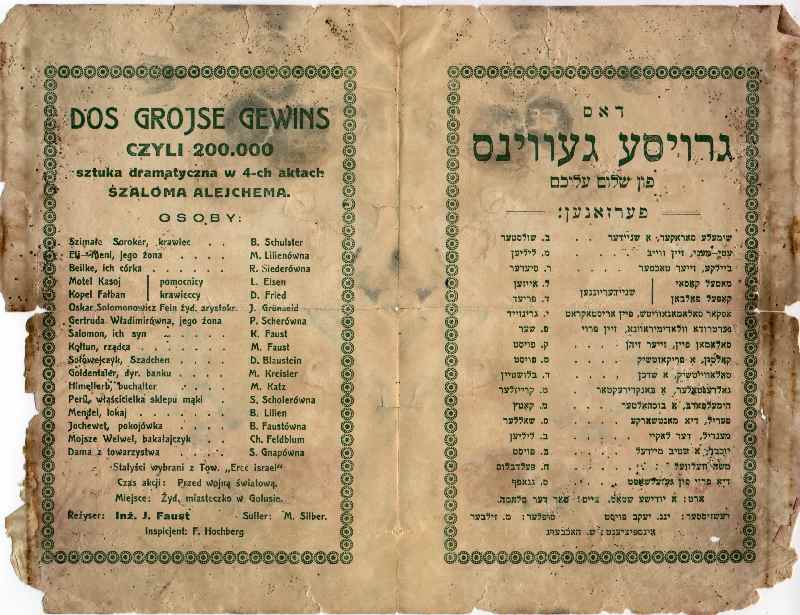
The attached playbill is
for a play called "The Big Lottery" written by Sholom Alechem and
performed in 1924 in Rohatyn. The play was directed by Jack Faust
and actors included other
members of the Faust family such as Max, Kalman, and Bertha.
Listed on the play are other actors and contributors from Rohatyn.
This photo is courtesy of the Faust Family Collection by Alexander
Feller, August 2007
One last note: the
nearby town of Bukachevtsy also has a Kehilalinks site, and there
are quite a number of wonderful photos of the Blitz family
recently added by the author of that page (Cipora Blitz's mother
was Bertha Faust, daughter of David Faust, from Rohatyn and her
father was Joseph Blitz from Bukachevtsy).
My grandfather, Isaac Snow, on arrival in the US was asked by his brother whether he wanted to keep the Schnee name or go the way his brothers have gone with Snow. Most of their cousins stayed with Schnee". The earliest record of the SNOW family reaches back to Eleazer-Wolf SCHNEE born and raised in the town of Rohatyn, not far from the big city of Lemberg, Austria. After the second World War, when the Soviets took possession of the area the name was changed to Lvov.
Eleazor-Wolf lived to be 102 and died in 1898. That implies that he was born in 1796. He served in the Austrian army for seven years and was rewarded for excellence the right to sell salt, which was a government run monopoly. With this advantage he established a successful general store. He obtained a water powered mill where the farms had their grains ground. This led to a thriving cattle and lumber trade which extended into Russia. He had three sons, Gudle, Hersch and Chaskle. My father remembers him as a giant of a man who was very vigorous and very alert. When advanced in years he gave the general store to Gudle, the mill to Chaskle and the cattle and lumber business to Hersch, and went to live with his married grandson Fahvish.
My record is incomplete.
Gudle had several children. Yoineh who went into the grocery business in NYC. Abe Schnee's father came to Philadelphia. My mother spoke of him as a brilliant fine man. Mrs ? Mandle who brought her ailing husband to me for medical advice; she impressed me as a gentle caring wife. A son whose idealism led him to Palestine from where he shortly returned coming to NYC. He came to live with is nephew, my father, Isaac, until he got established. He told us that the Jews in Palestine where not trained to be pioneers then. A daughter, Freda-Hannah married Mr. nathan and went to live in Dayton Ohio. She and my father would like to get married, but dismissed this idea because of the danger of first cousin marriages.
Chaskle married Sara. Their children:
Moses lived in Toronto, operated a furniture business. A son
became business manager for the hatter's union. A grandson was
in the USA war as a sky diver.
Schmeel (Sam) farmed in Connecticut, near Bridgeport, dairy and
summer guests. Eight children, not known to me.
Shulam (Solomon) leading Socialist. Eight children. One, Eleazer
(William) inventor of airplane equipment. Sheriff of Bridgeport,
reelected several times Declined after refusing to favor
Socialists for positions in government.
Fahvish married Mahtle. Farmed in Connecticut near Bridgeport.
Eight children, all educated in one room school. Eleazer (Bill)
self educated himself, with unskilled help built a modern dairy
barn to house 150 milking cows. The children Israel, Charlie,
Moses, Rahtza, Fannie, Annie, Esther all settled in the
Bridgeport area, where there are a large number of their
offsprings.
Fannie married Louis (Leibish) Baumrind. Baking operation. Two
daughters, Sadie and Bessie.
Sadie married her second cousin Abe Schnee. During World War I
Abe became very successful in real estate deals, Bridgeport was
becoming an important munitions center. When he was 39 he went
to Carlyle in Pennsylvania where in one year he got his law
degree. He became economics advisor to Woolworths. He showed
them that after they built a store they should sell it and take
a long lease. Instead of saving 5% on interest, the frequent
turn-over in product sale even on a low markup would earn
several times the 5%. He helped to select new store locations
all over the country. Sadie and Abe had three children. Charles
became a moving picture director for MGM. Won an Oscar. Was
beloved by all of the workers. Thelma became an actress. In the
play The Corn is Green she outskilled Ethyl Barrymore in my
opinion. She married -- Moss. Together they produced and
directed a movie The Dectective which gave Alec Guiness his
start. Shortly her husband died and she dedicated her life to
psychology. Betty got a medical degree but shortly died of
cancer.
Molly was the other of the eight children. She was married to a
Mr. Schwartz but had no children. When he died she went to live
on the farm with her brother Fahvish.
Louis (Leibish) was the youngest child for Chaskle. He was a
very gentle person. His first wife disppeared. he travelled
about, landing in Buffalo, where he took on his common law wife;
eventually they were married. They had two daughters, Louise and
Bettie. Both were nurses. Bettie married her first cousin Bill,
Fahvish's son. They had two children. The son is an albino. he
is almost blind, still with his mother's help he went through
college and began to teach. The daughter also has albinism with
partial loss of vision. She is able to write and corresponds
with me. Louis was deeply interested in philosophy as were his
brothers. He soap box lectured in a park in Buffalo. He was
roughed up by rowdies who accused him of being a Socialist. He
wrote two books of poetry, all very sad.
Itzik (Isaac) married Annie, six children. Bakery business in
NYC.
Dora married William Intner. Mattress manufacture. Commercial
real estate incentral Manhattan. Three children, Melvin,
Matthew, Mildred. Melvin and Matthew -real estate. investments.
Mildred - dealer in arts of nineteenth century.
William (Eleazer-Wolf) physician. Marry Amy 62 years. She was a
xray technician. Married Maggie Duncan. She trained as a
horticulturalist. Taught school. Now publisher and editor of
nature column.
Charlie (chaskle) Baker. Chief steward transatlantic liners.
Manager William intner mattress factory Married-Nettie. Three
children-Diana, Howard, Diane. Diane-hair dresser; her son dean
of college. Howard-computer operations in a bank in NYC.
Benjamin Baker; glass installation. Married to Elsie. Three
daughters. Florence's son a stock broker with Solomon Brothers
Wall Street. Mindie-schoolteacher, Thema housewife.
Fannie married Goerge Gang. Housewife. Son industrial engineer,
changed to education. Philip lecturer for United Nations.
Daniel- glass industries. His son lecturer for computer
operations for United Nations. Ruth-secretarial work.
Esther married Max Pitch who was a certified public
accountant.They were world travelers. Her daughter, Riva is a
physician who is doing eye surgery One son Herbert operates a
private school in NYC. One son Donald was in the glass business,
is retired leaving the operations to his son.
William and Amy progeny
Barbara entered MIT at age 15. Honor student. Physician skilled
in psychiatry, married to Dr Leon Sokoloff, world authority on
arthritis, lectures worldwide by invitation. Their son Michael
is a professor of physics at Cinncinnate University in Seattle.
Their daughter Naomi is a professor of Hebrew at Washington
University in Seattle. Published books in Hebrew, one on child
care. Paul- pathologist. General practice, married to Faye, who
operates a ballet and aerobics school. Soon taking a ballet
troupe to Europe. Daughter Wendy designs clothes for theater.
My children and grandchildren are very interested in reading about their roots. In the Yizkor Book there is an article by Jack's Uncle Zev Barban. Too bad that Jack is not alive to read it. In his immediate family, Jack was the only survivor after the Holocaust. He gave his testimony to the Shoah Spielberg foundation . The copy of his biography could be found in Yad Vashem and also in the United States Holocaust Memorial Museum. Jack’s entire family came from Rohatyn. He told us:
My maternal grandparents, Leah and Kalman Yankel Barban, lived and died in Rohatyn. My father, Meyer Glotzer, emigrated to the United States. My mother, Toba Barban Glotzer, perished in the holocaust along with my uncles/aunts, Morris Barban and Golda and Wolf Rappaport. Zissel and Joseph Loew immigrated to the US.
My brothers, Samuel and Moshe Glotzer, perished in the Shoa, along with my aunts and uncles, Iser and Esther Glotzer, Jack and Goldie Glotzer, Malka Glotzer Altman, and Malka Glotzer. Uncle Max Altman came to the United States, along with aunts Chane Kuperman, Rose Altman, Jeni Hecht and Charne Schwartz.
Thank
you very much, Bea.
This photograph at left
is of 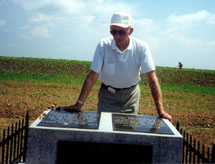 Jack
(Kuba) Glotzer, a native of Rohatyn, who returned to the
town of his birth in June 1998 with his family. The photograph was
taken at the monument for the mass grave in Rohatyn and sent to us
for publication on this web page.
Jack
(Kuba) Glotzer, a native of Rohatyn, who returned to the
town of his birth in June 1998 with his family. The photograph was
taken at the monument for the mass grave in Rohatyn and sent to us
for publication on this web page.
Kuba lost his entire family in Rohatyn during the Holocaust. He was ordered with few other young men from the ghetto, to bury the victims of the March 20th massacre. When it was suggested that he could look for his cousins, with tears in his eyes he said "I buried my cousins in the mass grave where the monument is erected, the one in the photo". During the liquidation of the Rohatyn Ghetto, Kuba escaped to the woods and survived.
My maternal grandmother left her home shtetl, Bukaczowze, in what
was Austria-Hungary and is now Ukraine, in 1910. This past May,
2001 I had the opportunity to visit it and explore my personal
history, on a trip that included visits to Cracow, Lviv, Poninka,
Polonnoye, (my grandfather's towns) and Kiev as well as the
Galician towns of my grandmother, Pauline.
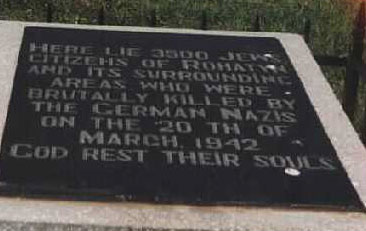
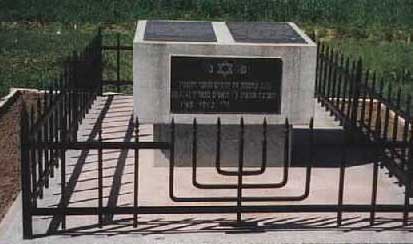
We stayed in Ivano-Frankivsk, Stanislau in my grandmother's time, as a base to explore Galicia. From there, we drove through Burstyn and Rohatyn on our way to my grandmother's town of Bukaczowze. In Rohatyn we visited the Holocaust memorial on the site of the mass grave, where most of my grandmother's siblings and their families were slaughtered in 1942. The Holocaust memorial is in the middle of a field, on the outskirts of Rohatyn.
There is one marker, in
Cyrillic, which commemorates the Soviet citizens who died during
World War II, with no mention of Jews. The more recent monument,
put up by Israelis, commemorates the 3500 Jews from
Rohatyn and surrounding communities who were killed by the German
in March 1942.
My relatives who died at
this spot were among those 3500. I grew up knowing their names and
faces from family photos. I am named for one of my great-aunts and
there I was standing at her grave. I don't have the words to tell
you how I felt. As a history teacher I have taught the story of
the Holocaust countless times. As a genealogist I have thought
about it many times. But standing at that place where my Mandel
family was actually killed brought it home in a way that nothing
else ever has.
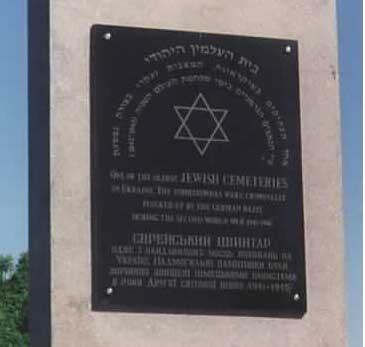
The Jewish cemetery
stands on a hill a little nearer to town. There are only a few
stones left and they are largely illegible. The monument on the
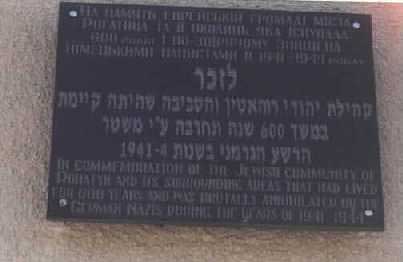
cemetery site reads " In
commemoration of the Jewish community of Rohatyn and its
surrounding areas that had lived for 600 years and was brutally
annihilated by the German Nazis during the years of 1941-1944." It
also indicates that the tombstones were destroyed by the Nazis,
during the war.
This page is hosted at no cost to the public by
JewishGen, Inc., a non-profit corporation.
To support this and other projects of JewishGen, please consider
making a donation to JewishGen-erosity
Your contribution would be deeply appreciated.
Compiled by Phyllis Kramer z"l (1999-2019) and Alexander Feller
(2026-)
Last Update: June 1, 2026
Copyright © 1998 Phyllis Kramer z"l