History · 1939–1945
Occupation, Expulsion, & Destruction
The central local rupture came in October 1939, when most Jews were expelled from Tarnobrzeg and their later fates spread across German- and Soviet-controlled Europe.
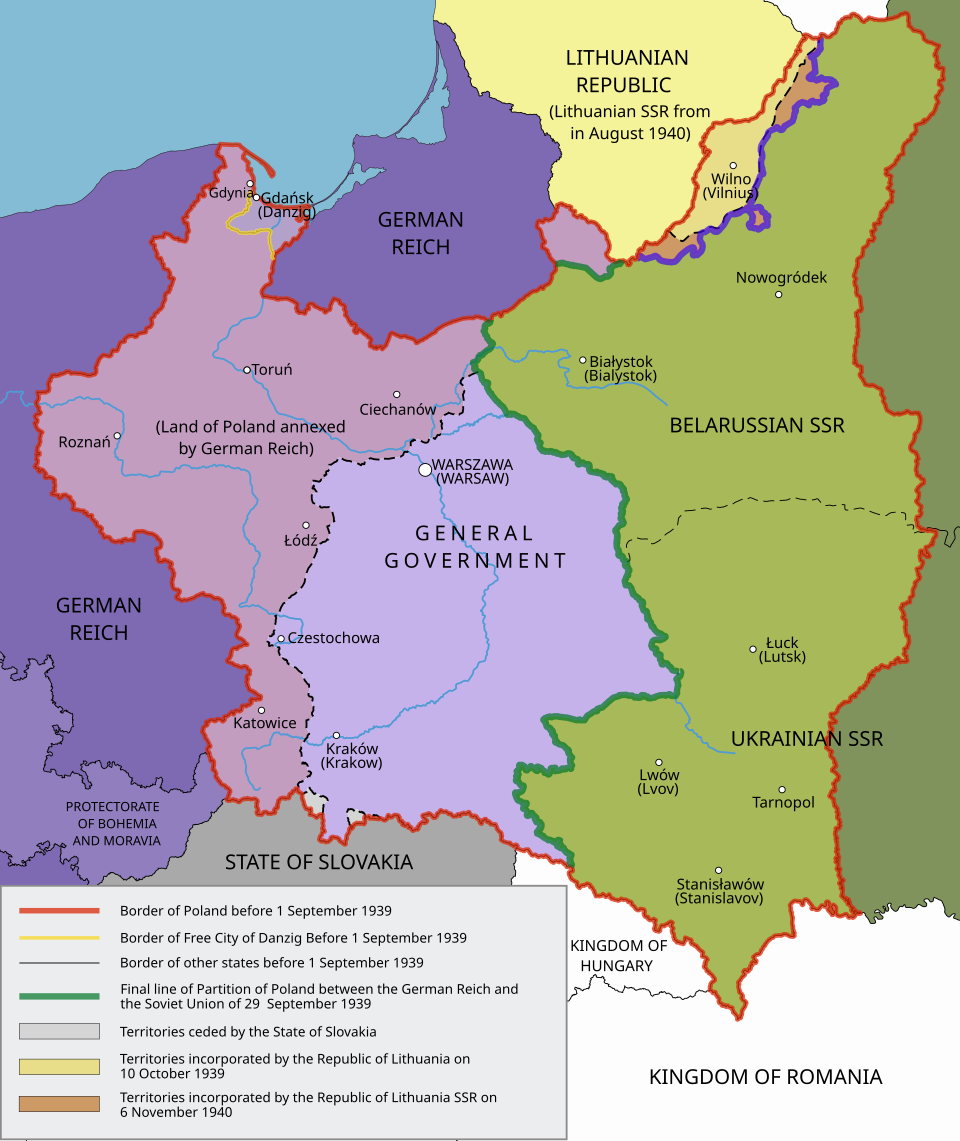
September 1939: occupation begins
German forces entered Tarnobrzeg during the invasion of Poland in September 1939. Jewish life was attacked immediately. Accounts describe beatings, humiliation, robbery, forced labor and the seizure of property. The synagogue and other Jewish institutions were vulnerable from the first weeks of occupation, and prominent Jews were among those targeted.
The decisive local rupture came very early. Tarnobrzeg did not first experience the Holocaust through a ghetto liquidation in 1942. In October 1939, only weeks after the invasion, the German authorities expelled most of the Jewish population from the town.1
The October expulsion
Jews were assembled, deprived of property, and ordered out of Tarnobrzeg. Survivor testimony and later accounts describe columns of families leaving with what they could carry. The German–Soviet partition of Poland had created a new frontier to the east, and expulsion toward or across that boundary was part of the early German policy in the region.
The expelled population did not move to a single destination. Some reached Soviet-controlled territory. Others remained in, returned to or moved among nearby towns under German occupation. Sandomierz, Baranów, Rozwadów and other places appear in accounts of the dispersal. The community that had been concentrated in Tarnobrzeg was suddenly fragmented across a rapidly changing borderland.
Different paths after expulsion
For those who crossed into Soviet territory, survival often came through another form of displacement. Some were deported or evacuated deep into the Soviet Union, endured labor, hunger and disease, or later served in military formations. These experiences were harsh, but Soviet exile ultimately saved some Tarnobrzeg Jews from the German killing system.
Those who remained in German-occupied Poland faced escalating persecution. As ghettos, forced-labor camps and deportation operations spread through the region, expelled Tarnobrzeg families were caught in the destruction of the communities in which they had sought refuge. Their deaths therefore appear in records from many places rather than in a single “Tarnobrzeg liquidation.”
Those who remained in Tarnobrzeg
A smaller Jewish population remained in or later returned to Tarnobrzeg. Forced labor continued, including work connected with German military and economic needs. The surviving Jewish presence was progressively reduced and eventually destroyed as German policy moved from expulsion and concentration to systematic murder.
Because the October 1939 expulsion scattered families so widely, reconstructing individual fates requires following people beyond the town itself. A person listed as a prewar Tarnobrzeg resident may later appear in Soviet records, a neighboring ghetto, a forced-labor file, a Page of Testimony or a postwar displaced-person document.
The destruction of a community
By the end of the war, the Jewish community that had existed in Tarnobrzeg for centuries had been destroyed. Some individuals survived, but the social world of synagogues, study houses, shops, schools, Hasidic institutions, charities and extended families was gone. The German occupation therefore destroyed more than a population: it broke the dense network of institutions and relationships that had made Tarnobrzeg a Jewish town.
Sources cited on this page
- YIVO, Papers of Julian (Yehiel) Hirszhaut, including Ozjasz Kalach's testimony concerning Tarnobrzeg in October 1939; Kehilat Tarnobrzeg-Dzikow, wartime sections.
- Tadeusz Zych, Tarnobrzeg pod okupacją niemiecką 1939–1944 (2008).
- Yad Vashem, USHMM, Arolsen Archives and Jewish Historical Institute collections for individual fates and regional persecution.