I am related to the Wertheim/ Wirtheim and Weinberger/ Veinberger families of Bacsava. I believe I'm also related to some Grunberger and Klein families from the area.
My late grandfather, Simon Wertheim, was born in Bacsava on 8 March 1927. He never spoke about the Holocaust, but when I was a young adult my mum and I interviewed him to try and collect some of his story. I recently found my notes from that interview.
________________________
§ I was born in Batschive [Bacsava]. In Czechoslovakia. My father was Solomon Wertheim and my mum was Jeti Wertheim, nee Weinberger. They were also born in Batschive and their parents were too. We were all from there. My Aunts and Uncles too. I had 3 younger brothers- Israel, Bernadot and Avraham. And I had 2 little sisters- Malka and Devorah.
§ We lived on a farm. It was 16 acres. On our farm we had everything that grows. There were many people in the village. Before Pesach a lot of people from the village would gather at my place to bake their Matzos in our oven. We had a big wood fire oven. And on Fridays we would use it to bake bread for the whole week.
§ I went to Chedar and school in Batschive. I had to go to chedar every day from the time I was five years old. I had to go first thing in the morning, then from 7am to 8am I could eat breakfast, and then after I would go to public school until 1 o'clock, and then go back to Chedar from 2 to 7pm.
§ I had my Bar-Mitvah in Batschive.
§ When I was born, Batschive was Czechoslovakia. When I was 12 years old the cavalry rode in, and right behind them came the Hungarians, the Germans, and the Italians. And then we were under Hungary. Then we all have to wear the full yellow star with written Judah, Jew. We had to wear it whenever we left the house for being in Batschive around the occupation of the territory.
§ I never got to high school because I was taken away to the Holocaust.
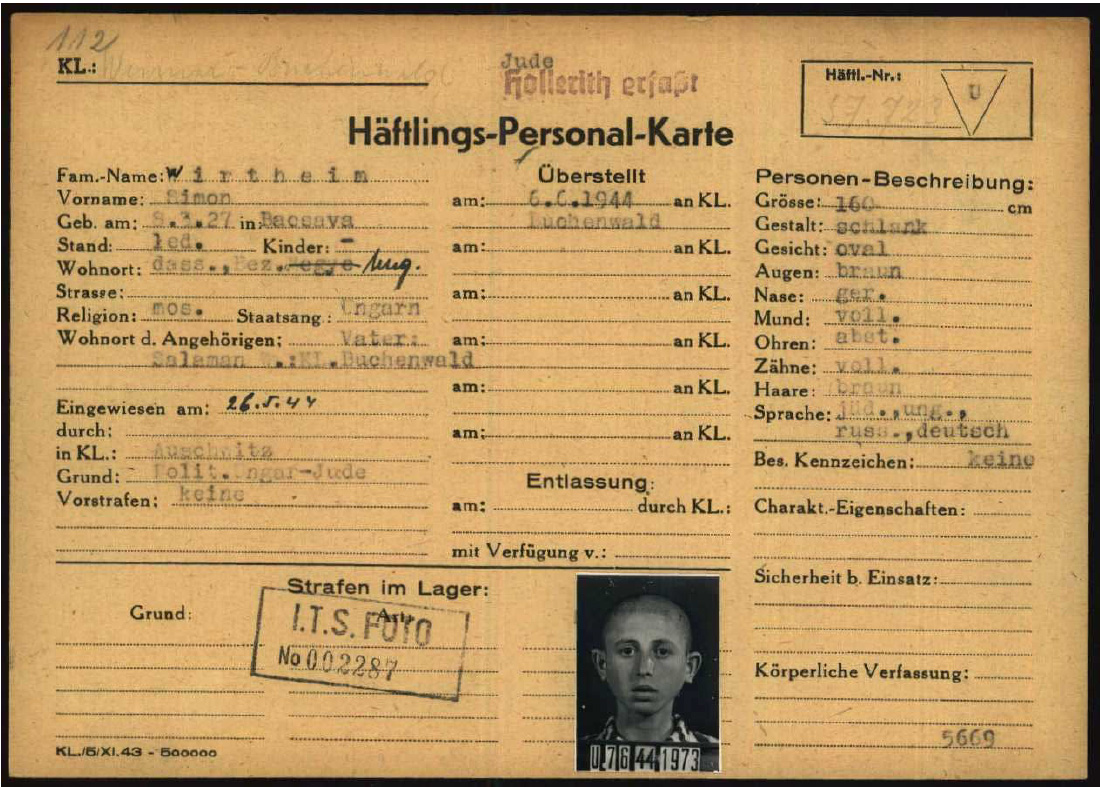
Prisoner card – Auschwitz (click to enlarge)
§ In 1944 they took us to Uzhgorod and they put us in the ghetto and after that they took us to concentration camp. My dad and I went to the right and the others went to the left and we never saw them again. I went to Buchenwald and then after they made me work at Troeglitz. My prisoner of war number was 75723. It's always in my head. I got frostbite and nearly died. I was lucky and they let me go to the hospital. And then the Americans came to take Troeglitz, so the Germans marched us to Theresienstadt and the Russians came and liberated us from there on May 8 1945.
§ At liberation, I was skinny. I was very, very skinny. I stayed in the camp in Theresienstadt, and after that, I went back home. I wanted to see if maybe somebody was alive. When we were in the concentration camp, they told us everyone was probably alive. We didn't know what they'd done. But when I came home, there was nobody. The farm was destroyed. Everything had been taken; even the wood had been pinched. Where we used to keep the cows was all destroyed, and the cows were taken away. The house was still alright, though. I went to Budapest three or four times, to check the lists of survivors in case any of my family had been found and to get some food rations and documents. And the last time I came back from Budapest, the new Ukrainian government had given away my house and land to a Ukrainian blacksmith. He took all my land and he wouldn't give it back to me. Not the house, not the land, nothing. I didn't have anywhere to eat or live, so I left.
________________________
Afterword
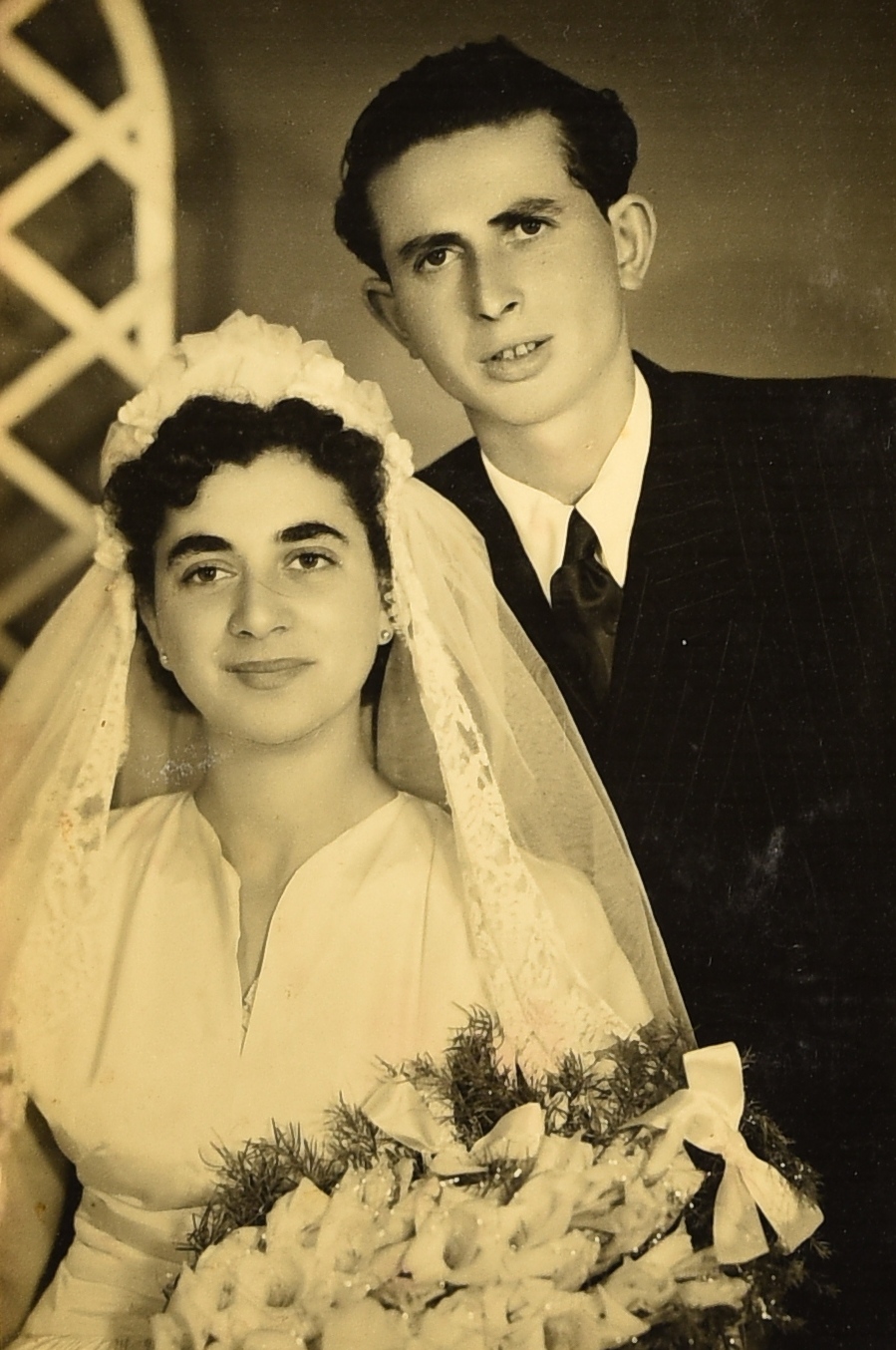
Simon with his wife Paula on their wedding day Israel 1953 (click to enlarge)
Simon was forced to leave the shifting borders of the region and ended up joining a kibbutz and spending time in an Austrian displaced-persons camp before boarding an illegal immigration ship to Palestine. He was captured and interred in Cyprus by the British authorities for entering international waters without a permit. He was released shortly before the War of Independence and was basically sent straight to the front line for that war and following military campaigns. He met his wife and had a daughter (my mum) in Israel, but moved to Australia when she was two years old in the hope she would not have to grow up surrounded by war.
I have always hoped that I may one day find a photo of Simon's mum and siblings, but I fear that there may not be any that exist. At least I have found their names and birth records through JewishGen’s Transcarpathia records, so that is something. It's sad to think of their memories being erased to time.
— Ilana Green
____________________________________________
photos, courtesy of Ilana Green. Simon's prisoner card issued on his arrival at Auschwitz.
Simon with his wife Paula on their wedding day in Israel 1953.
This page is hosted at no cost to the public by JewishGen, Inc., a non-profit
corporation. If you feel there is a benefit to you in accessing this site,
your JewishGen-erosity is appreciated.
Compiled and created by Richard L. Baum with assistance from
the following JewishGen members/descendants and contributors of Chabanivka Jewish families.