Jewish Life
Organizations & Public Life
Jewish communal life was argument put into action. Traditionalists, Zionists, workers, merchants and youth movements competed over the future while still having to elect leaders, raise money, run schools, and keep communal buildings warm.
Who spoke for the community?
The organized Jewish community was often called the kehilla, Hebrew for a Jewish communal body responsible for religious institutions, finances, welfare, and representation. In Tarnobrzeg, however, Jewish public life also reached into the municipal council and into political movements that challenged the kehilla’s older leadership.
The question running through the late nineteenth and early twentieth centuries was therefore simple and contentious: who had the right to speak for Tarnobrzeg’s Jews?
A Jewish mayor, 1873
Local municipal scholarship reports that in 1873 the town council selected the Jewish councillor Lejb Hauser as mayor. [1] Pinkas Hakehillot preserves a somewhat different chronology, but both traditions place Jewish residents directly inside nineteenth-century municipal politics. [2]
Hauser’s story matters because political participation was not an interwar innovation. Decades before Zionist youth organizations appeared, Jewish councillors were already involved in taxes, leases, budgets, and disputes over how Tarnobrzeg itself should be governed.
The Zionist meeting behind locked stable gates
By the early twentieth century a new politics had arrived. In one memorial-book episode, police moved to stop a Zionist meeting after organizers were denied use of the beit midrash, the Jewish house of study and prayer. The activists shifted the crowd into Leibush Hauser’s large market-day wagon stable, shut the gates and let Dr. Kornhauser begin speaking. [3]
Police called municipal workers to force the gates open. By the time they succeeded, the speech was over. The story makes local Zionism physical: a crowd, a stable, locked doors, police outside, and a speaker racing the authorities.
The melamed sends spies
The ideological conflict reached into households. The traditional melamed—a teacher in a boys’ cheder—Moshe Eliezer Krep feared that his own son might attend a Herzl memorial meeting. He therefore sent two pupils to spy on the Zionists and report back. [3]
What looks comic from a distance was serious to the adults involved. Zionism challenged ideas about Jewish identity, religious authority, and the future. A father could fear losing his son politically even while the boy still sat in his classroom.
Sara Lustig’s two charity boxes
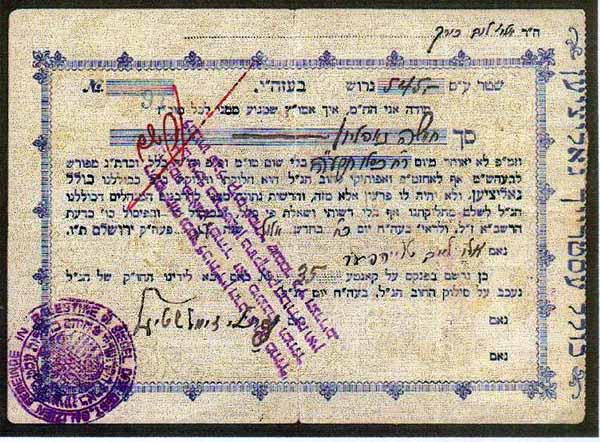
Politics could sit on a kitchen shelf. Zionist activists remembered visiting Sara Lustig, who kept two charity boxes in her home—one associated with Zionist fundraising and another with Hasidic or traditional causes. The Zionist box was full while the other was empty. When challenged, she joked that perhaps the Zionists had emptied the Hasidic box into their own. [3]
The joke turns ideological competition into domestic life. Movements raised money not only at meetings but coin by coin inside private homes.
Bina Nussbaum goes door to door for Akiva
Bina Nussbaum Binder remembered helping establish Akiva, a Zionist youth movement, during the interwar years. She was given time away from her bank job and went with Yosef Zlinkofsky from house to house and school to school recruiting young people. [3]
Some parents welcomed the new organization; others worried about a youth movement that was not centered on traditional religious authority. The group’s Lag BaOmer outing—Lag BaOmer being a springtime Jewish festival traditionally marked by outings and celebration—became one of Binder’s vivid memories, with children arriving either in their best clothes or Akiva uniforms.
A shoemaker becomes a workers’ representative
Herschel Weingil was remembered not as a professional politician but as a shoemaker working beside his sons. From that workshop he became a forceful workers’ representative and municipal councillor, opposing the town’s more conservative religious leadership. [3]
His politics grew from occupation and class. The man arguing in council still belonged to a family workshop, and people who sought his help knew where to find him.
Schools, loans, and institutions
Organizations also built things. Agudat Yisrael—the traditionalist Orthodox political movement—supported Bais Yaakov, the Orthodox religious-school movement for Jewish girls. Zionists organized youth groups and fundraising. Merchants and artisans formed bodies to protect professional interests. The kehilla managed religious and welfare responsibilities. [3] [4]
The labels mattered because they represented competing visions of Jewish life. But institutions survived only when someone rented rooms, paid teachers, collected dues, raised loans and persuaded neighbors to contribute.
Interwar politics offered several Jewish futures
The 1973 memorial book's organizational section makes the town's ideological diversity unusually visible. Zionist organizations existed beside Agudat Yisrael, religious-Zionist groups, Akiva, Hashomer Hadati, Hashomer Hatzair, and other cultural and youth initiatives. [3]
These were not merely names on a roster. Organizations competed for rooms, books, dues, leaders, and above all young people. Political arguments entered homes, study houses, streets, and friendships. Modern organization therefore did not map neatly onto secularization: observant young Jews could organize politically, and religious Zionists tried to combine traditional practice with a national future in Palestine.
Public life included culture and recreation
The same organizational world sustained a library, amateur theatre, and sports clubs. [3] These activities broadened the meaning of Jewish public life. A meeting hall could host a political discussion one night and a cultural program another; a youth organization might combine ideology, Hebrew study, excursions, and social activity.
Seen together, the institutions show a community building many forms of collective life at once. The traditional kehillah, the organized Jewish community, did not disappear, but it now shared public space with parties, banks, schools, charities, youth groups, cultural societies, and athletic clubs.
Sources cited on this page
- Dzikoviana VII (2021), Tarnobrzeg municipal-government history and Jewish representation. PDF.
- Pinkas Hakehillot Polin, “Tarnobrzeg-Dzików”, Yad Vashem / JewishGen translation.
- Ḳehilat Ṭarnobz’eg-Dziḳov (1973), especially Zionist history, Sara Lustig’s charity boxes, Akiva, Agudath Israel and interwar communal figures. JewishGen partial translation/synopsis.
- Interwar Tarnobrzeg Jewish communal records, including governing-committee and institutional expenditure documents preserved in the site’s records collection. Genealogy & Records.