Jewish Life
Jewish Tarnobrzeg
Jewish Tarnobrzeg was made in the market, at the Sabbath table, in municipal offices, in poor alleys, and on roads leading far beyond town. These stories introduce a community woven into the life of Tarnobrzeg and Dzików.
For centuries, Jews were part of the fabric of Tarnobrzeg and neighboring Dzików: raising families, keeping shops and workshops, studying and praying, serving customers and employers, arguing politics, celebrating holidays, and building institutions that connected the town to a much wider Jewish world. In Jewish memory the community is often called Dzików, after the adjoining Tarnowski estate and the Hasidic court that became famous under that name, even though much of everyday Jewish life unfolded in Tarnobrzeg itself.
This overview begins with ordinary moments—a crowded market day, the approach of Shabbes, the Yiddish word for the Jewish Sabbath, preparations for Passover, a municipal election, a family setting out for another town. Together, these scenes offer an introduction to how Jewish Tarnobrzeg worked, sounded and felt before the community was destroyed in the Holocaust.
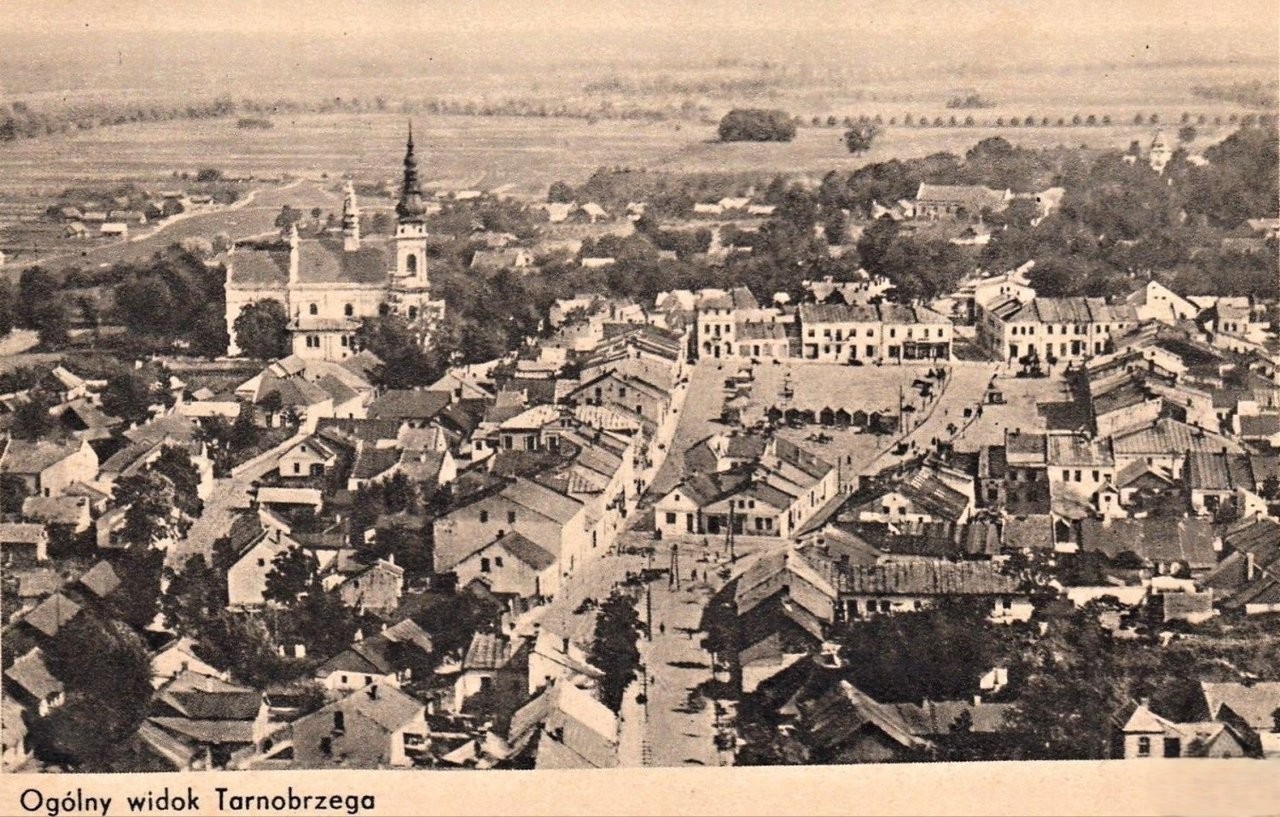
Market day: where town and countryside met
On market day in the later nineteenth century, Tarnobrzeg filled with people arriving from Dzików and the surrounding villages. Jan Słomka, a Catholic farmer and longtime local official born in Dzików in 1842, remembered Jewish shopkeepers, tavernkeepers, brokers, and craftsmen as part of the ordinary machinery of the town. Villagers came to sell produce, buy cloth and household goods, arrange transport, and meet the people who could connect them with work. [1]
For a village child, the fair might end with waiting late into the evening for parents to return with a roll or bun bought in town. For Tarnobrzeg’s Jewish merchants, those same parents were customers. The market therefore tied Jewish households to Catholic farming households week after week: money, food, clothing, labor, and gossip all moved through the same square.
Friday afternoon: the town changes pace
By Friday afternoon the same commercial town began to change. Shabbes—the Yiddish word for the Jewish Sabbath, from Friday evening to Saturday evening—required work, shopping and travel to end before sundown. Słomka remembered carters and Jewish merchants planning journeys around the Sabbath rather than treating Saturday as an ordinary business day. [1]
That weekly pause was visible even to non-Jewish neighbors. A shop that had been open during the market week closed; food had been prepared in advance; families turned toward home, prayer, and the Sabbath meal. The change in tempo was one of the ways Jewish time became part of the town’s public rhythm.
Before Passover, the Rulkis came alive
The 1973 Tarnobrzeg-Dzików memorial book remembers the Rulkis, a poor Jewish neighborhood of a main street and narrow alleys, as especially transformed before Pesach, the Hebrew name for Passover. Houses were cleaned and whitewashed, and tradesmen such as Laibush Salzman suddenly had work everywhere. [2]
That memory gives us a different town from the market square. Jewish Tarnobrzeg was also cramped houses, seasonal cleaning, neighbors borrowing and helping, and the approach of a holiday becoming visible on walls and doorways before it was heard in synagogue.
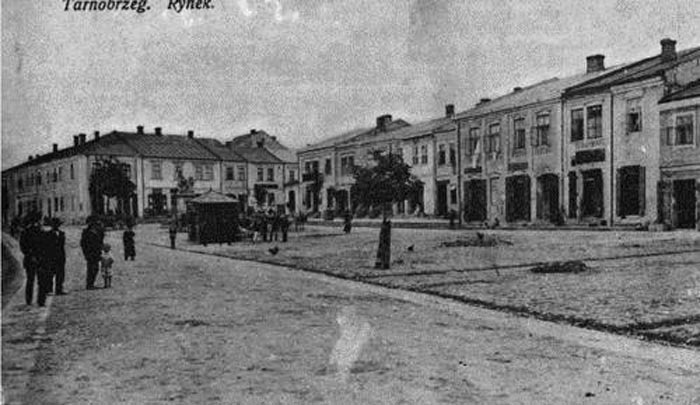
A town of many kinds of Jews
Religious commitment, wealth, and social position varied enormously. Rav Haim Blitzer was remembered as the only Jewish family living far out toward the railway station, respected even by local roughnecks. Doctor Levi stood at another edge of communal life: thoroughly integrated into Polish society and distant from organized Jewish observance, he nevertheless closed his house and saw no patients on Yom Kippur, the Day of Atonement. [2]
These men make the community harder to flatten into a single type. Tarnobrzeg contained Hasidim, traditional householders, secular intellectuals, merchants, artisans, laborers, poor teachers, Zionists, and people who belonged to Jewish life in ways that did not fit neatly into any organization.
A Jewish mayor in the town hall
Jewish life also entered the civic center of town. Local municipal scholarship reports that in 1873 the council selected the Jewish councillor Lejb Hauser as mayor. Later political histories differ on the exact chronology of his tenure, but the episode itself captures how deeply Jewish residents had entered Tarnobrzeg’s nineteenth-century public life. [3] [4]
A Jewish mayor did not erase conflict over taxation, leases or representation. It shows instead that Jewish-Christian relations were not confined to buying and selling. Jews argued over the town’s future from inside its governing institutions.
The town opened outward
Tarnobrzeg was never self-contained. Commercial routes ran along the Vistula; marriage connected families to Rzeszów, Leżajsk, and Lwów; Hasidim traveled to and from Dzików; and by the late nineteenth and early twentieth centuries emigrants were carrying Tarnobrzeg family names to Vienna, New York, and beyond.
The pages in this section follow those lives at close range. The point is not to assemble a catalogue of institutions. It is to recover the experience of a Jewish town: the market before noon, the doors closing on Friday afternoon, a poor alley turning white before Passover, a political argument, a synagogue melody, a child beginning school, and a son or daughter eventually leaving home.
Sources cited on this page
- Jan Słomka, Memoirs of a Peasant, expanded 1929 edition, trans. William F. Hoffman (PGSA, 2020), especially his descriptions of Tarnobrzeg markets, trades, transport and Jewish-Christian economic relations. Open Polish text.
- Ḳehilat Ṭarnobz’eg-Dziḳov (Tel Aviv, 1973), especially Yaakov Fleisher and David Weissler’s recollections. JewishGen hosts a partial English translation/synopsis; the original Hebrew/Yiddish book has also been consulted. Partial translation.
- Dzikoviana VII (Tarnobrzeg museum annual, 2021), municipal-government context. PDF.
- Pinkas Hakehillot Polin, “Tarnobrzeg-Dzików”, Yad Vashem / JewishGen English translation.