Jewish Life
Family & Household
House 114 lets us enter one family home. Gitla and Majer Wahl can be placed inside the documented rhythms of Tarnobrzeg around 1880: market days, Shabbes, cheder, Passover, High Holidays, marriage and children eventually leaving home.
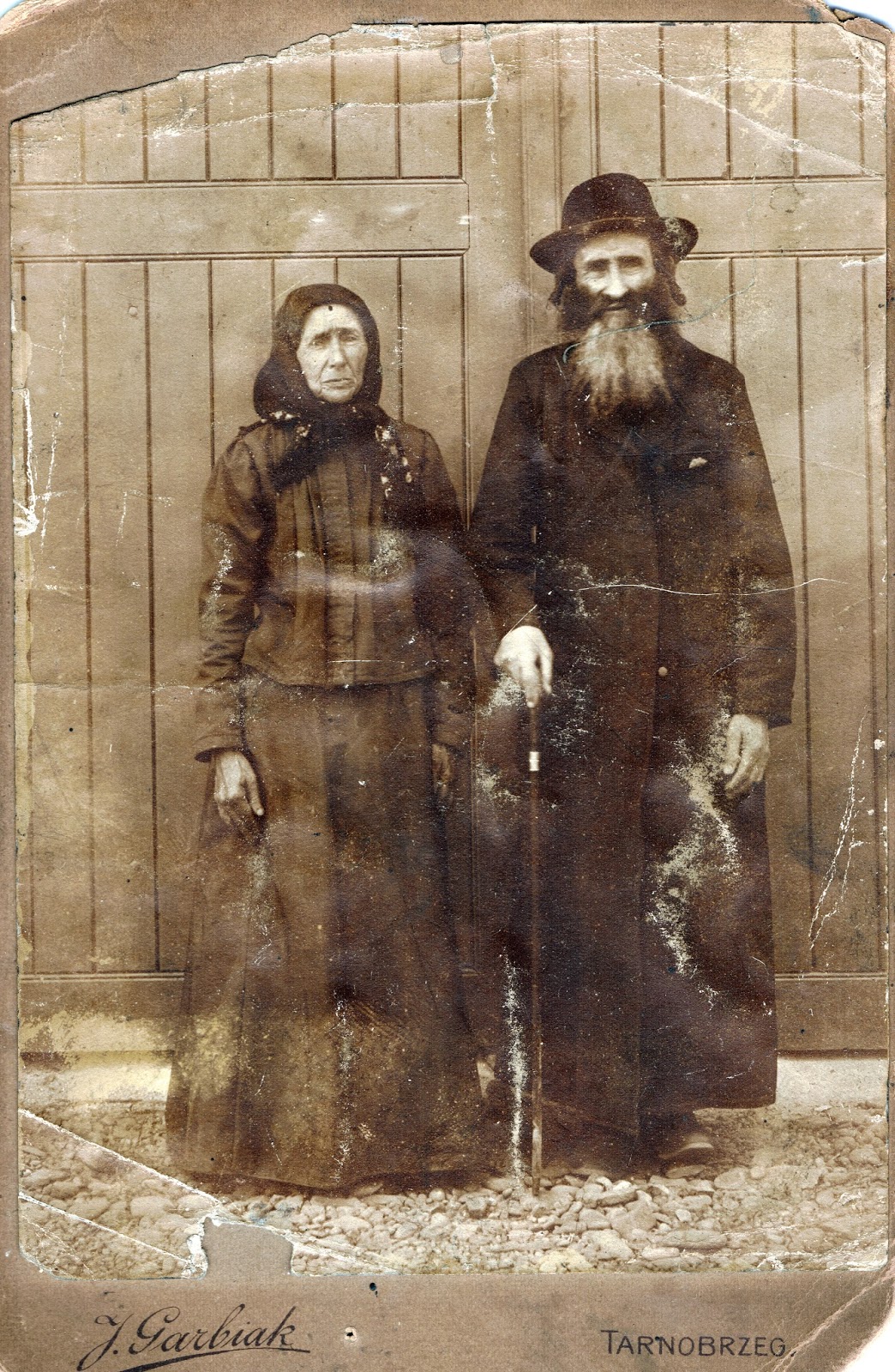
House 114: Gitla & Majer Wahl, 1880
The 1880 census places Majer Wahl, born about 1825 in Tarnobrzeg, and Gitla Wahl, born about 1824 in Nisko, at house 114. With them were Mojżesz, Estera Bluma, Sane and Brucha Wahl, as well as an older Sara Wahl. Later records identify Majer and Gitla—also recorded as Hena—as parents of Brucha and Estera Bluma. [1]
By 1880 Majer and Gitla were in their mid-fifties. Mojżesz was about twenty-five, Estera Bluma twenty-two, Sane nineteen and Brucha fourteen. This was not a young family beginning life together. It was a mature household with adult children already approaching marriage, work, and departure. The photograph above gives that household faces.
Friday at house 114
Friday would have been the busiest domestic day of the week. Shabbes—the Yiddish word for the Sabbath—began at sundown, so cooking, shopping and ordinary work had to be finished beforehand. Bread and the main Sabbath foods were prepared; clothing was made presentable; lamps were readied; errands had to be completed before the town’s Jewish businesses closed.
Gitla and the daughters would have carried much of that domestic preparation. A dish such as cholent, the slow-cooked Sabbath stew prepared before Friday night, could be left with a baker to remain warm without cooking on the Sabbath itself. A later Tarnobrzeg story about a woman leaving home on Saturday to collect her family’s cholent shows how established that routine had become. [2]
Before sundown the women of the household lit Sabbath candles. Majer and the older sons turned toward prayer in a synagogue, prayer room, or beit midrash, a Jewish house of study also used for worship. The meal that followed separated sacred time from the workweek: blessings over wine and bread, food cooked in advance, family conversation, rest and perhaps the rabbinic stories that later Dzików residents remembered telling after Sabbath meals.
The children’s educational world
The Wahl children grew up before Tarnobrzeg’s modern Hebrew school, founded in 1910, and before the later Bais Yaakov girls’ school. The sons belonged to the older world of cheder, the traditional elementary religious school for boys. Gutwein remembered mothers bringing boys of about three to a melamed, their cheder teacher; boys capable of further study could later spend increasing time in the beit midrash. [3]
Mojżesz and Sane would have learned Hebrew reading, prayer, and religious texts in that male educational world. Estera Bluma and Brucha would have learned primarily within the household and through whatever informal instruction their family arranged. Their daughters’ generation would live through the transformation: by the early twentieth century, Tarnobrzeg girls could encounter organized schooling and eventually institutions such as Bais Yaakov.
Market day outside the door
The household was religious, but it was not sealed off from the town economy. Market day brought villagers, carts, livestock, food, cloth, and news into Tarnobrzeg. Słomka’s memoir describes Jewish tailors working in Christian homes, furriers buying old coats, brokers recruiting Vistula laborers, tavernkeepers and merchants dealing daily with the surrounding countryside. [4]
Whatever Majer’s own occupation, Gitla’s household depended on that market world. Food and fuel had to be bought; clothing repaired; children found work; marriages required money. A few house numbers away, other Wahl households were participating in the same town economy. To grow up in house 114 was to grow up with the rhythms of both Jewish sacred time and a busy Galician market town.
Passover: the whole house changes
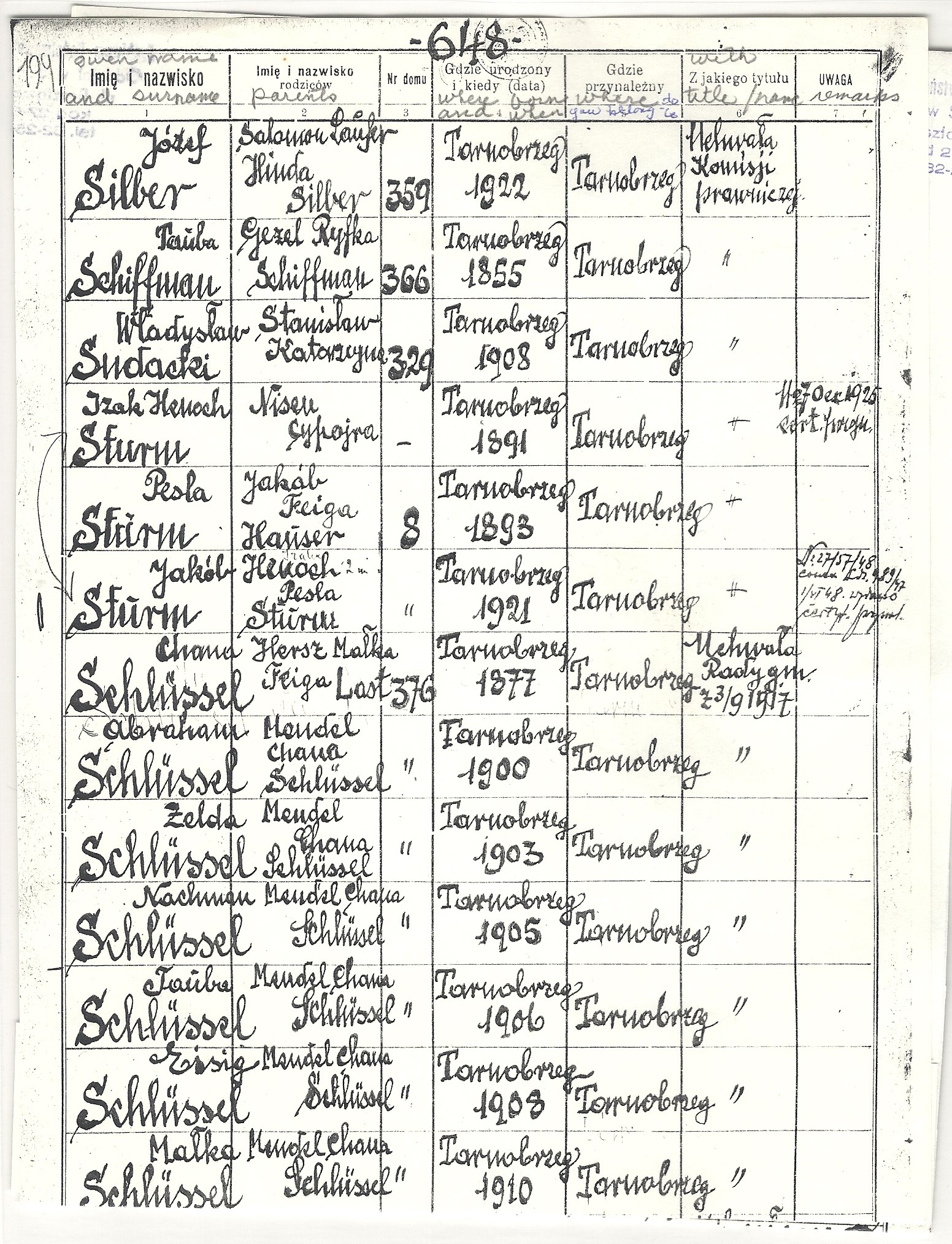
Before Pesach, the Hebrew name for Passover, ordinary household routines intensified. The holiday required the removal of hametz, foods made from the five grains that had leavened or fermented, so kitchens, utensils and storage spaces had to be prepared. The memorial book remembers the poor Rulkis neighborhood coming visibly alive with cleaning and whitewashing before Passover. [2]
At house 114, Gitla and the daughters would have been at the center of that transformation. The work culminated in the Seder, the ritual Passover meal at which the story of the Exodus is retold through a set order of foods, questions, blessings, and readings. For children, Pesach was therefore both household labor and one of the great storytelling nights of the year.
The High Holidays and the Dzików court
Rosh Hashanah, the Jewish New Year, and Yom Kippur, the Day of Atonement, changed the public atmosphere again. The synagogue filled more heavily on holidays, prayer lengthened, and the sound of the shofar—the ram’s horn blown on Rosh Hashanah—marked the season. [2]
Dzików’s Hasidic court stood nearby. Visitors traveled from other towns for the rebbe and the holidays. Majer and Gitla did not have to belong to the Horowitz court for its presence to shape the streets around them: visiting Hasidim, followers of the Hasidic movement, needed places to eat and sleep, melodies and stories circulated, and holiday crowds made Dzików a regional religious destination.
A few weeks later came Sukkot, when families ate in a temporary booth called a sukkah, followed by Simchat Torah, the celebration marking completion and renewal of the annual Torah—the Five Books of Moses—reading cycle. Winter brought Hanukkah, with lamps kindled in the home; spring brought Purim, a festival remembered for the Book of Esther, gifts of food, charity and a more playful public mood. The Jewish calendar repeatedly remade the same household.
Children become adults
The census captures one year, but family life kept moving. Brucha, fourteen in 1880, later appears in records naming Majer and Gitla/Hena as her parents. Sane eventually left Tarnobrzeg and built a life in New York. Other Tarnobrzeg Wahl records show the same outward pull: in 1897, Ruchel Hendel Wahl married Abraham Taube in Lwów, where their daughters were subsequently recorded. [6]
A daughter marrying elsewhere changed more than an address. It created new in-laws, new economic ties, and new routes for siblings and cousins. A son emigrating overseas could transform the family’s possibilities again. By the turn of the twentieth century, the household that had looked stable in 1880 was becoming a network spread across cities and countries.
Family reputation could outlive a person
Bet David, published in 1911, preserves a Dzików marriage story in which a rabbi asked about the family of a prospective match. When told that the young man descended from R. Yoski, remembered locally as a martyr, the ancestry itself became a recommendation. At the engagement, the rabbi reportedly celebrated joining the family of a man who had died al kiddush Hashem—Hebrew for “sanctifying the Name,” traditionally used for martyrdom undertaken rather than abandoning Judaism. [5]
That episode reminds us that a household inherited more than property. Names, reputations, religious memories and stories could shape a descendant’s marriage generations later.
One household inside a larger town
Gitla and Majer do not stand for every Tarnobrzeg family. Their neighbors included prosperous merchants, struggling teachers, artisans, Hasidim, secular Jews, widows and families living at the edge of town. But house 114 gives us a place from which to watch the Jewish week and year unfold.
Imagine the household repeatedly changing character: noisy and practical on Friday morning; quieter after the Sabbath candles; stripped and cleaned before Passover; solemn during the High Holidays; crowded when adult children returned or a marriage was discussed; diminished when a son or daughter left. The census gives us the names. The rest of Tarnobrzeg’s records and memories let those names inhabit a home.
Sources cited on this page
- 1880 Tarnobrzeg census, house 114 Wahl household and nearby Wahl entries, preserved through the JRI-Poland Tarnobrzeg PSA census index and site materials. JRI-Poland Tarnobrzeg.
- Ḳehilat Ṭarnobz’eg-Dziḳov (1973), local recollections of synagogue attendance, Sabbath routine, Passover in the Rulkis, schooling and family life. JewishGen partial translation/synopsis.
- Yitzchak Gutwein, A Zacher Fun Mein Shtetl Dzikow (Paris, 1948), Yiddish memoir, especially the section on melamdim and cheders; complete scan consulted.
- Jan Słomka, Memoirs of a Peasant, trans. William F. Hoffman (2020), for the market, trades, transport and the economic world surrounding Jewish households. Polish text.
- David Schlissel, Bet David / בית דוד (1911), family traditions concerning R. Yoski, Passover charity and descendant status in a shidduch. HebrewBooks scan.
- JRI-Poland Tarnobrzeg exact-town search, Tarnobrzeg-linked marriage and birth records in Lwów and other Galician towns; JRI-Poland credited as source.