size=0 width="84%" align=center>
SHEBOYGAN,
WISCONSIN
Copyright © 1997 - 2010 by Joel Alpert
Below is the stained glass window from the "White Shul" donated
to the Wisconsin Historical Society by David Schoenkin.
Under that is a photo of that building and under that is a 1934 photo by
William Alpert of a group of young men from the Sheboygan Jewish community that
includes Nate Schoenkin, father of David Schoenkin. For
the full story on the site of the Wisconsin Historical Society click here.-
Sept, 13 2007
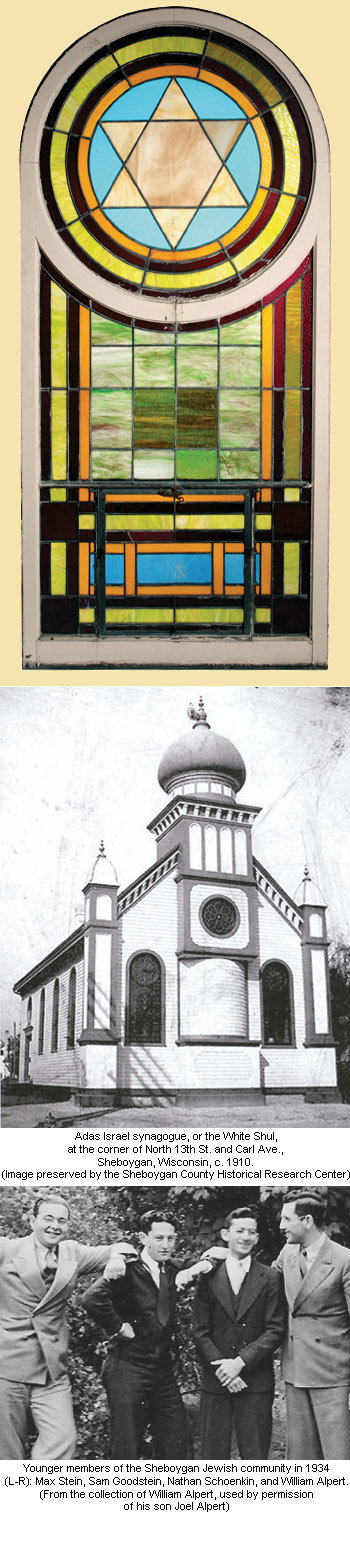
Photo above used by permission of the Wisconsin Historical
Society
If interested in the Bensman Family
contact Allen B. Saxe
The Second Sheboygan Jewish Community Reunion -
was held on August 24-26, 2001
Click here for further information or
email to:
bethelsheboygan@juno.com
to be put on the Sheboygan email list
Sheboygan Jewish Community Reunion
August 20-22, 1999
"Reunion
of the Jewish Community ofSheboygan"
We declared
the reunion a success with 230 people in attendance at this sellout event!
Click
here for photos of the event
Email
bethelsheboygan@juno.com
to be placed on the list for emailing and let us know whenyou
think we should have another reunion.
Sheboygan Jewish Community Photo
from1924
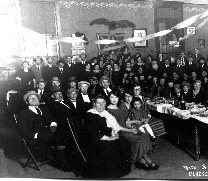
Photograph taken March 23, 1924 on theOccasion
of Rabbi Leib Kaplun and his Wife's 50th Anniversary
Courtesy of Evelyn Solkovitz
CONTENTS:
- Location
- Information on Sheboygan
- "A Large Number of Russians from
the Province of Lithuania also Arrived During These Years ......"
by Susan Alpert Drazen
- The Synagogues of Sheboygan
- From the booklet commemorating the
20th anniversity of the dedication of Beth El
Temple
- Sheboygan Jewish Families
- Other Sheboygan Researchers
- What Happened to the Jews of Sheboygan?
- The Jewish Cemetery of Sheboygan
- Information on Sheboygan From Other Sources
- Story
of Immigration from Europe NEW June
23, 1999
- Other Resources
- Other Related Links
Location
Sheboygan,
Wisconsin
Sheboygan, Wisconsin is
located on the western shore of Lake Michigan, 50 miles North of Milwaukee,
Wisconsin and 140 miles North of Chicago, Illinois. It is a city of about
50,000 people today (1997) and was about that size for at least the past 50
years. It was settled in the 1800s primarily by Dutch and German immigrants. In
the 1880s, the first Jews arrived from an area about 100 miles east of Vilna,
Lithuania. Over the next 30 years, or more, the word spread back to that part
of "Russia" that there was relative freedom and good opportunities in
this small town, and a number of Jewish families immigrated to Sheboygan. These
were religious Jews, who brought their Orthodox ways with them, established at
least three synagogues, religious schools, etc. In a sense they reestablished
their Eastern European shtetl life in this town in the upper Midwest. Most of
the Jewish families came from a small area to East of Vilnius (Vilna), North of
Minsk, and West of Vitebsk around the towns of Lepel, Boriosov, Kamen, Krasnoluki, Karalina, Beshenkovichi, Kublichi, Polotsk, Ulla, Vitebsk
and Dokshitz in the region that today is Belorus. (Sallyann Amdur Sack, co-editor of the Jewish Genealogy quarterly Avotaynu, wrote in March 1999 that "most
of the [Sheboygan] settlers were from Vitebsk guberniya [now Belarus] from Polotsk, Disna, Drissa, Kublichi.")
Interestingly it was recently discovered that a group of Jews from the same
region went to and helped form the Jewish community London, England, so there
are many relatives in the two communities.
The community prospered,
with the immigrant generation becoming workers in the towns factories, and also
trades people. The first American generation became shop owners, many becoming
grocers, and spreading out into the Wisconsin countryside. They prospered and
had families. Their numbers grew to several hundred families, and supported a
vigorous communal life. Their children, those who grew up in the 1940s and
1950s, became more Americanized and sought higher education. Many eventually
moved to the nearby larger city of Milwaukee and beyond. Many of us who have
fond memories of our youth in Sheboygan and trace our roots there, are active
citizens in cities both close to and far removed from that quiet clean little
city on the shores of Lake Michigan. Today, there remains only one conservative
synagogue, Beth El, with a small and shrinking older Jewish community with an
average age of about 70. This seems to be the fate of many of the Jewish
communities in smaller towns, and is repeated all over the United States.
Today, as the Milwaukee
Jewish community moves into Northern suburbs of Milwaukee including Mequon,
Sheboygan does not seem so far away anymore (less than a 40
minute drive). There are a few young Jewish couples moving to Sheboygan,
and so the future looks brighter for the Jewish community of Sheboygan.
People
came to Sheboygan from the following towns in Belorus
- family names listed after the towns:
Click on the town names for more information a nd location of the towns
You may need to click on the right of the map to get a more
detailed view
Beshenkovichi - Lepel Uezd ,
Vitebsk Gubernia , Latitude: 55º03' Longitude: 29º27'
Bensman,
Holman
Borisov
-Borisov Uezd, Minsk Gubernia , Latitude:
54º15' Longitude: 28º30'
Dokshitz - Borisov uezd , Minsk gubernia ,
Latitude: 54º54' Longitude: 27º46'
Kaplan, Kohn (Kushenitz), Fiedelman
Kamen
- Minsk Uezd ,
Minsk Gubernia , Latitude: 55º01' Longitude: 28º53'
Swerdlow,
Holman, Raffelson, Sussman, Axel
Karalina - Latitude: 54º48' Longitude: 28º11'
Alperovitz
Krasnoluki - Borisov Uezd , Minsk Gubernia , Latitude: 54º37' Longitude: 28º50', now
in Lithuania
Aronin
Kublichi - Latitude: 55º10' Longitude: 28º20'
Hoffman, Perlman
Lepel - Lepel Uezd , Vitebs k Gubernia , Latitude: 54º53' Longitude: 28º42'
Bensman,
Kristal, Golman, Pashkoff, Zaidins
Polotsk - Polotsk Uezd , Vitebsk Gubernia ,
Latitude: 55º29' Longitude: 28º47'
Miringoff,
Shulkin
Ulla
- Lepel Uezd ,
Vitebsk Gubernia , Latitude: 55º14' Longitude: 29º15'
Blackman, Libman, Raskin
Vitebsk
- Vitebsk Gubernia , Latitude: 55º12' Longitude: 30º11'
Miringoff,
Blachman
For information on
other Shtetlach of Belorus click here
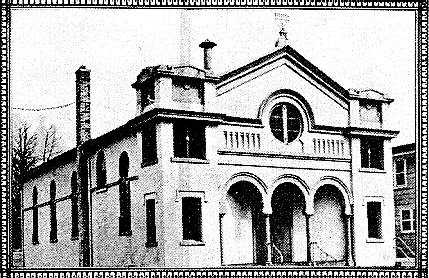
AHAVAS SHOLEM (The Brick
Shul)
At 13th and Geele Avenue
Occupied as
a synagogue in 1903, raised in 1975.
First built as St. Mary Magdalene, the first Catholic Church
in Sheboygan sometime before 1871, it became the home of the first Jewish
synagogue in 1903.
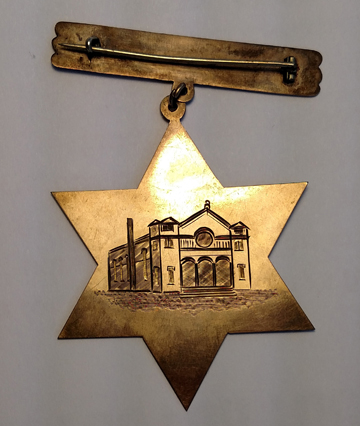
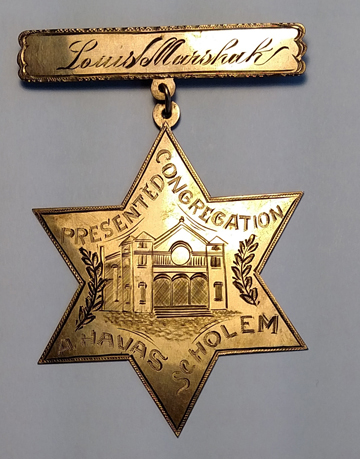
Metals from
the Ahavas Sholem presented
to Louis Marshak, courtesy of his great-grand
daughter
The Holman Shul in Sheboygan - -
To be included when a photo is located.
Please notify Joel Alpert (email at the top of this page) if
you can help!
OHEL MOSHE (The Holman Shul)
At 13th and
Marie Court
Built in
1918, raised in ??
"The Ahel
Mosche temple was constructed in 1918 at its present
location, N. Fifteenth street and Marie court. The Rabbi Aronin
was the first to be in charge and the Rabbi S. J. Barenholtz
serves the temple at the present time." (from a
1942 article in The Sheboygan Press)
[According to Howard Moeckler, Rabbi Barenholtz was
the Rabbi at the Brick Shule only.]
Can
you help supply this photo? please contact Joel Alpert
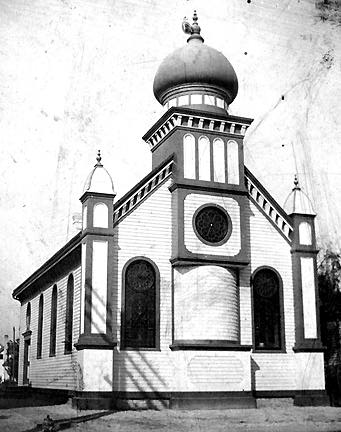
ADAS ISRAEL (The White Shul)
At 13th and
Carl Avenue
Built in
1910
"This congregation was
organized about thirty years ago, with A. Aaronis,
Rabbi. The first services were conducted in the synagogue then located on North
Eighth Sreet between Superior and Lincoln Avenues. In
1910, this house of worship was moved to its present location on the corner of
Carl Avenue and N. Thirteenth street." (from an
article in The Sheboygan Press - date unknown)
From Historic Sheboygan County by
Gustave Buchen page 307-309, published in 1944, and
updated and revised in 1975.
Aaron Zion, probably
the first Jew to settle in Sheboygan, opened a millinery shop on North 8th
street. Shortly afterward Sol Rosenbaum, a clothes peddler and Joseph Buntmann, a fruit merchant were the next Jews to settle in
the town. Nearly all the Jewish immigrants to Sheboygan came from a region of
Russia that is today part of Belorus, where they
lived in small towns and were merchants, tailors, shoemakers, money lenders,
and dealers in grain, cattle , furs and hides. They
came mainly to improve their opportunities and economic conditions. Usually the man of the family came first by himself, and
then earned enough money to bring the rest of his family. Many started their
lives in Sheboygan as itinerant peddlers with packs on their backs and
ultimately opened small businesses.
Herman J. Holman who
came to Sheboygan in 1890, together with his uncles Nachsun
and Michael, who immigrated in 1889, first worked as tailors. Herman opened his
own shop for tailoring, cleaning and pressing in a building on North 8th
Street. Several years later he opened a junk peddling business on the south
side. Ultimately he had a building erected at South 14th
Street and Broadway and started a dry goods business, with his wife operating
the store, and he continued with the junk business. In a small shed next to the
store he opened a small factory and installed a
cutting table and a number of sewing machines to make pants that he sold to
local retail stores. In 1902 he and his brothers Aaron and Harry started an
overall manufacturing factory on Michigan Avenue,
however the venture was closed after a year. In 1906 he opened a factory on
Calumet Drive, which he named H. J. Holman & Sons. In 1925 the business was
moved to a large factory at South 14th Street and Alabama Avenue and renamed
the Lakeland Manufacturing Company. Aaron Holman founded the Reliable Shirt
& Overall Company on North 15th Street and Harry Holman started the Holman
Manufacturing Company on N. 13th Street.
Sheboygan Jews
remained strictly orthodox in terms of their religious practice, in compliance
with the practices that they brought from Russia. This was in contrast to the
reform Judiasm practiced by some Jews of German
descent in nearby Milwaukee (50 miles south of Sheboygan). There were three synagoges, Adas Israel, Ahavas Sholem and Ohel Moshe. Adas Israel, the oldest congregation, which was started in
the home of Nachsun Holman on North 8th street near
Bluff Avenue in about 1890. The first synagogue building was a small house, and
then moved to a larger building both located on North 8th street. The building
was moved to North 13th street and Carl Avenue in 1907 and was used by the
congregation until about 1975. Ahavas Sholem was first located in a wooden building on Michigan
Avenue just east of North 8th street and in 1903 was moved to 13th street and Geele Avenue, where it remained until 1975 (see photo
above). Ohel Moshe, founded in 1920 had its synagogue located at North 15th
street and Marie Court.
The Jews of
Sheboygan created an amazing number of social and fraternal organizations. The
oldest was a mutual benefit society, called the Western Star. The Jewish
Workman's Circle (Arbeiter Ring) was founded in
1914(?) (30 years before this publication) There also is a chapter of the B'nai
B'rith, one of the largest Jewish organizations in the US and the world. This
chapter is called the Davis Lodge, after Herman Davis, one of it founding fathers, and was created in 1919. In 1925 a
junior Jewish organization for young men, called A.Z.A., was formed.
From the founding of
the Jewish community until the 1960s most of the Jews lived in a neighborhood
ion the north-west side of Sheboygan in the vicinity of Geele
Avenue (see map above). This was because William Schaetzer,
the original owner of the subdivision, who encouraged them to settle there and
offered them favorable terms of purchase. There were about 175 Jewish families
in Sheboygan at the peak there were about 150 familes.
Within the decade before this publication, many have started to move to Milwauk ee and some to northern
Wisconsin.
Information provided
mainly by George Paykel, George Holman and David Rabinovitz.
From: HarvestWind97@aol.com
Date: 29 Dec 2001
Subject: "The White Shul"
Dear Mr. Alpert,
I just discovered the Sheboygan
website and enjoyed it thoroughly. I live on North 13th street in the heart of
what was once the Jewish neighborhood. I'm writing about the section entitled
'Synagogues of Sheboygan." There is a picture of a synagogue on 13th and
Carl called Adas Israel (The White Shul) with the
legend "built in 1910,raised in?" I believe
that the building currently on that site, now a church, is the original
synagogue, at least in part. It may have been remodeled or built on to. I say
this for the following reason, I notice that their is a large circular window on the building in
the picture. The church still has a large circular window with a nondescript,
nonreligious stained glass window. However
on the west side of the church facing the neighborhood and 15th street is a
stained glass window containing a Star of David. The room upstairs in the
church that has the Star of David window was being used as storage,and in that room is a large circular stained
glass window with another Star of David on it that I was told used to be in the
front of the church. I was also told by a former minister from that church that
the building was originally a synagogue. I hope this information is useful to
you.
God bless.
John Drobka
Sheboygan
Jewish Families
List of the Original Jewish
Families of Sheboygan
Use Hypertext Links
below to access further information on these families
Refer to the Booklet commemorating the 20th anniversity of the dedication of Beth El Temple for
photos of many of the original families.
Other Researchers of Sheboygan, Wisconsin
Please enter your family names andyour name on the JewishGenFamily Finder (JGFF) for Sheboygan,Wisconsin
and the shtetl from which they came (if you know it). Youcan
find other reserachers below by searching JFGG.
JewishGen Family Finder
Do
you have roots in Sheboygan, Wisconsin? Would you like to connect with others
researching the same community? Then click the JGFF button below to
search the JewishGen Family Finder database,
Family Name - Researcher - email or
Postal Address
What
happened to the Jews of Sheboygan?
Here is the story of one
families' members
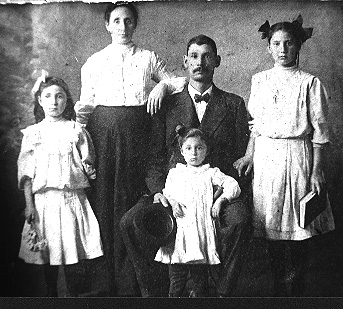
The Max and
Sarah Gollman Family
(photo taken in Sheboygan, in 1906)
This family photo of Mordechai Moshe (Max), and his wife,
Sarah Riva, and their daughters, Simcha Hana (Sophie), Leah (Lee), and Frieda, Gollman, was taken shortly after their arrival in
Sheboygan, for the purpose of proving to the grandparents
that the family was live and well in the new world.
Today the great-grandchildren of Max and Sarah Gollman
live in Milwaukee, Omaha, Boston, Fairbanks, Alaska, San Diego, and Los
Angeles.
The Jewish Cemetery in Sheboygan
Click below
to access the List of Headstones supplied by Penny Deshur
Thanks too
to the late Mayer Alpert for helping.
Go to Part 1 of the Cemetery List ( A
- Hoffman)
Go to Part 2 of the Cemetery List (Hoffman -Nichol)
Go to Part 3 of the Cemetery List (Nemzoff
- Z)
For further informationabout the Cemetery, please contact the Beth El
Synagogue inSheboygan.
Address: BethEl
Synagogue, 1007 North Ave., Sheboygan, WI 53083
Phone: 920-452-5828 Monday and Thursday. Answeringmachine at all other times
Text and
photos of the cemetery are planned to be included.
Photos of
Sheboygan Residents from the 1930s
From the
Photo Collection William Alpert
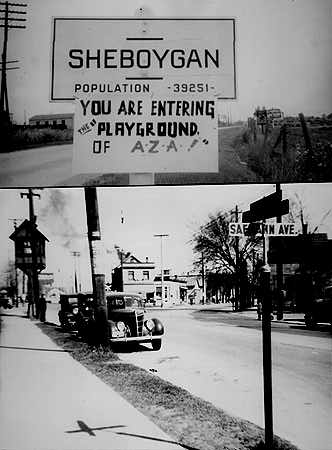
Top: About 1933, Self-explanatory
Bottom: "The
Playground"
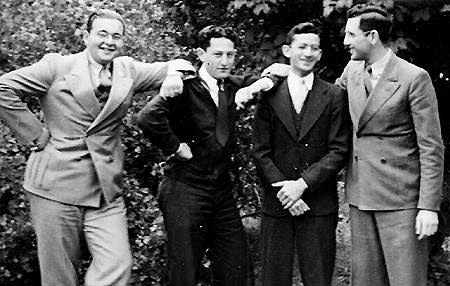
Max Stein, Sam Goodstein,
Nate Schoenkin and Bill Alpert
Sheboygan
1934
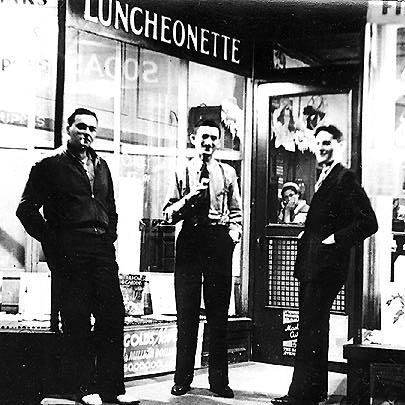
Max Stein, Nate Schoenkin and Sam Goodstein
At the
Liberty Ice Cream Palor - Summer 1937
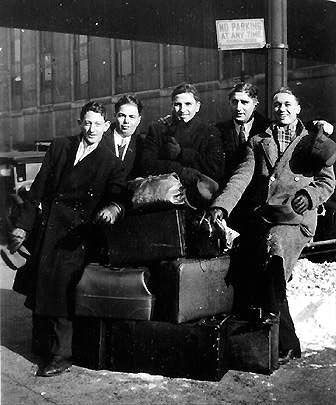
Sam Goodstein, Sam Stein,
Richard and Ray Alpert and Herman Stein
The AZA Boys
in Chicago - 1934
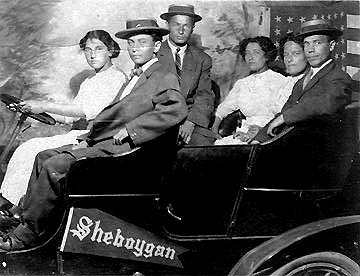
The Early
Days, probably about 1915
Just having
fun:
Sophie Gollman, John Alpert, Bill (Velvel)
an Dora Kohenitz and Rose
and Jacob Libman
Photos from
Other Sources
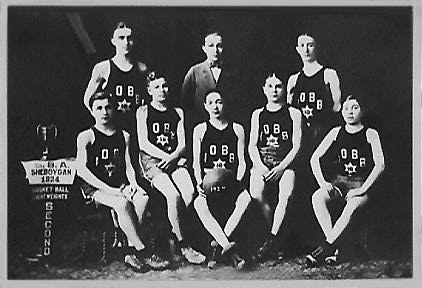
1924
Sheboygan AZA Basketball Team
Front row L-R Herman Bassewitz - Bill
Lock - Maury Lock - Sam Belinke - Chubbie
Petasnick (Carol Bensman's
husband). Second row: Julius Bassewitz - Charles
Locke - Larry Axel
Photo supplied by Allen Saxe
Other
Resources:
Registrar
of Deeds at the Sheboygan County Building in Sheboygan
Researchers should note that they
have a rare opportunity to research their own family histories by going into
the Registrar of Deeds at the Sheboygan County Building in downtown Sheboygan.
You will have direct access to the doucments of
Birth, Death, Marriage records of your ancestors and can make copies of the
original materials. The clerks in the office are most helpful and courteous (as
we would expect from Sheboygan folk). Next time you are in Sheboygan, make this
stop and take advantage of a great opportunity to do original genealogical research
on your family.
Related
Links
Many Sheboygan Jews came from Dokshitz
and Lepel, Belorussia and the surrounding area:
Since a number of Sheboygan families
came from Lepel and Kamen, Belorussia, we include the following information
here (courtesy of Eliyahu Tavger and Allen Saxe):
Subject: List of Lepel Jews Killed
by Nazis
From: Rav
Eliyahu Tavger <eliyahu@tekhelet.co.il>
Date: Wed, 15 Mar 2000
I received from Leonid Guryevitch, a citizen of Lepel (tel. +375-213248293) a list
of the Jews of Lepel who were killed by the Nazis. The Germans took over Lepel
July 3, 1941. A ghetto was made on the outskirts of the town for all the Jews
who were left. On February 28, 1942 the ghetto was liquidated.
A memorial stone was put up at the
site, next to the town of Chernorutchye, 8 km. south
of Lepel, on the right side of the road Vitebsk/Minsk.
Sincerely
Eliyahu Tavger
Israel
......................
List of Lepel Jews Killed by Nazis
Abezgauz Mendel, age 65
Abezgauz Genya, age 65
Abezgauz Marisa, age 25
Abezgauz Shlema, age 27
Alloy Yessin,
age 65
wife, age
60
daughter Bella, age
29
Sofya, age 29
daughter, age
25
baby, age 2
Amchir Liba, age 35
Amchir Motta, age 45
wife
Anikulov, age 50
wife, age
40
son, age 7
daughter, age 6
Asinovski, Semyon
Asinovski, Chyena
Afrayimkovitch, Zalman, born 1910
Afrayimkovitch, Dora, born
1910
boy
girl
girl
Afrayimkovitch, Freda,
born 1910
Afrayimkovitch, Sheyna, age 60
Afrayimkovitch, Abram, age 70
3 children ages 1-10
Bellinki, Girsha, age 35
Mariyasa, age 35
Girsha, age 15
Leizer, age 9
Manya, age 3
Bensman, Berka, age 50
wife, age
45
daughter Riva, age
20
baby, age 2
Bensman, age 70
wife, age
65
Tzadra, age 20
baby, age 2
Bensman, Leiba, age 70
Simcha, age
80
Bliachman, Berke, age 40
Sara, age
34
Sioma, age 12
child, age 8
child, age 4
Bord, Yevel,
born 1910
Sara, born 1910
children age 10
age 6
age 3
Bord, Tzipa,
age 80
Sima, age 80
Michel, born 1918
Sonya, born 1924
Mendel, born 1926
Vasserman, Peisach, age 50
wife, age
40
son, age
10
son, age 5
Veisman, Zusya, age 45
wife, age
40
son, age
16
da ughter,
age 15
Vinter, Moisei, age 40
wife Mera,
age 30
son, age
15
son, age
13
Volf, age 65
wife, age
60
Viazmer - entire
family
Gelfand, Aron, age
65
Gelfand, Musya,
age 58
Gelfand, Zachar
son of Victor, born 1897
Gelfand, Gita, born 1895
Generson, Yosif, age 70
Generson, Mira, age 70
Genkin, Roman, age 55
wife, age
50
Genkin, Mendel, age 13
Genkin, Chaim, age 10
Genkin, Chosya, age 7
Gershman, Shmunya,
age 60
wife, age
55
Gillerson, Gilya, age 40
Gillerson, Malka, age 40
Gillerson, Tzipa, age 10
Gillerson, Zelda, age
8
Gillerson, Michail, age 12
Gisman, Nechama, age 58
Gitlin, Shmuel, age
50
wife, age
45
children, age
18
age 10
age 7
Gitlina Zina, age 28
Glazman, age 50
wife, age
40
son, age
16
son, age 14
Glazman, Beilya, age 17
Feiga, age 14
Glazman, Berta, age 42
Luba, age
35
Mosya, age 4
Glazman, Girsha, age 24
Glazman, Nachim, age 60
wife, age
60
Glonman, Elka, age 68
Eska, age 60
Golusova, Manya, age 3
Anatoli, age 2
Gordon, Zalman,
born 1887
Gurevitch, Abram, age 50
wife, age
40
Matus, age 13
Leiba, age 12
Mosya, age 7
Gurevitch, Yessil, age 45
son Vella, age
19
daughter, age 5
daughter, age 7
Gurevitch, Lusya, age 60
Gutkovitch, Zusya, age 70
Bunya, age
50
Gutkovitch, Zlata, age 58
Velka, age 60
Gutkin, Lazar,
born 1901
Malka, born 1903
2 children
David, age
60
wife, age
50
Dechtyar, Boris Sholomovitch, age 35
Dvosya, age 30
two children Dechtyar, Movsha, age 65
wife, age
60
Sofia, age
20
Chava, age 18
Dechtyar, Chaim Yuda, age 50
wife
Zaidanya, Riva, age 28
Luba, born 1918
Rachilya, born 1935
Yoffe, Berk, age 52
Rachil, age 50
Yoffe, Dveira (Dvosya), age 80
Gita, age
35
Yoffe, Zalman, age 45
wife, age
40
Zalman, age 14
Leiba, age 11
Nema, age 9
daughter, age 2
Kagan, Volf,
age 50
wife, age
47
son, age
16
son, age
13
Kagan, David, age
50
Mariasya, age 45
Chanya, born 1918
Berke, born 1926
Siman, age 35
Deveira, age 35
Beilya, age 13
Zina, age 6
Katz, age
35
wife, age
30
two children
Katzeva, Luba (Motya), age 35
son, age 6
daughter, age 2
Katzeva, F ruma, age 65
Katzman, Elya,
age 55
Rachil, age 55
4 children from age 3-10
Katzman, Yankel,
age 75
Masya, age 45
Kirzon, Shonok, age 45
Breina, age 35
Kolbanovsky, Aron (Volodarsky St.)
Levina, Basya, age 70
Genya, born 1920
Sonia, born 1918
Levina, Breina, born 1900
Levin, Velka,
age 60
Basya, age 60
Beinya, age 25
Tzipa, age 24
Genya, age 17
Levitan, Abram, age
60
Dveira, age 65
Boris, age 4
Levitan, Benya,
age 60
wife, age
55
Motya, age 25
wife, age
20
daughter, age 3
baby, age 2
Levitan, Leiba,
age 40
Chaim, born 1926
Leiba Im., age 40
Edya, born 1931
Levitan, Moisei
(Proletarskaya St.)
wife
son, Chaim
Levitan, Shlema
(Traktornaya St., 6)
wife
daughter, Doba
Leitman, Sara, age 35
daughter, age
18
son, age
17
son, age
16
daughter, age 8
son, age 5
Leitman, S. (f), age 30
S. (f), age
25
Luba, age 2
Liberman, Boris, age
50
Sonia, age
50
Manya, born 1928
Lobok, Berka, age 65
Chana, age
60
Manevitch, Riva, age 50
Tanya, born 1926
Raya, born 1918
Misha, age 2
Manevitch, Riva, age 50
Gala, age
18
Malkin, Leizar,
age 45
wife, age
40
son, age
16
son, age 14
son, age
13
daughter, age
10
daughter, age 8
Malchin, Yevel, age 40
Chaya, age
40
Elya, age 12
Leiba, age 15
Malchin, Sima, born 1930
wife, born 1932?!
Malchin, Sonia, age 31
Ida, born 1928
Melnikov, age
45
wife, age
40
Melnikov, Emanuil, age 55
wife, age
45
daughter, age
25
daughter, age 5
daughter, age 3
Mirkin, Isak, age 38
Chana, age
32
daughter, Chaya, age
16
daughter, Emma, age 5
son, Boris, age 8
Marduk, Abram, age 48
Enta, age 40
Idik, age 3
son, age 2
Nedmen, Rachim, age 55
wife, age
45
daughter, age
12
daughter, age
10
daughter, age 7
Nedmen, Samuil, age 40
wife, age
35
daughter, age
15
daughter, age
10
son, age 8
Nedmen, age 60
wife, age
65
Nemtzov, Solomon, age 40
Basya, age 35
daughter, age 8
daughter, age 7
son, age 5
Nemtzov, Ester, age 65
Shiffa, age 35
Nisnevitch Lev Isakovitch, age 70
Nost, Yuda, age 65
Musya, age 60
Motya, age 30
Gita, age 30
Nina, age 5
Sonia, age 3
Plavnik, Riva, age 65
Pasha, age
32
Dora, born 1918
Potashkin, Vichna, age 17
Berko, age 15
Tzupa, age 13
Genya, age 10
Potashkin, Mosa, age 50
Abram, age
65
Shlema, age 48
wife, age
45
son, Abram, age
19
Prigozhin, Zalman, age 50
Sara, age
50
Lina, born 1924
Raya, born 1928
Tzipa, born 1922
Abram, born 1930
Puchovitski, Aba, age 55
wife, Chosa,
age 50
daughter, Bella, age
22
daughter, Lusa,
age 19
daughter, Raya, age
16
daughter, Pesya,
age 13
son, Borya,
age 10
daughter, Genya,
age 6
mother, Tzilya,
age 80
Pshonik, age 45
wife, age
50
son, age
16
son, age 14
daughter, age
10
Pshonik (father)
age 70
Rakshnel, age 60
Rapoport, Braina,
age 65
Katya, born 1918
son, age 2
Rolbant, Sima, age 65
Laya, age 60
Rozba, Polya, born 1910
Royan (Royak), age 45
wife, age
40
son, age
17
Rubin, age
58
wife, age
50
Girsha, age 22
daughter, age
20
daughter, age
16
Ruchman, Gila, age 38
Roche, age
80
Rivkin, Leiba,
born 1890
Sara, age
50
Menya, age 10
Sioma, age 11
Fira, age 3
Sverdlova, Dusya, born 1915
son, age 4
daughter, age 2
Sverdlova, Chanya, age 35
son, age 7
daughter, age 4
Svidler, Zalman, age 65
Dveira, age 65
Sonia, age
16
Skudazhnik, Yan, age 35
wife, age
35
son, age
13
son, age 3
daughter, age 7
Slavin, Yesel, age 45
wife, age
55
daughter, age 12
daughter, age
10
daughter, age 9
son, age 6
Slavin, Moisei, age 70
wife, age
60
daughter, age
25
Son, Gita, age
30
girl, age 7
girl, age 5
girl, age 2
Son, Itzka,
age 40
Shulka, age 35
Fruma, age 25
Leiba, age 60
Basya, age 50
Sholom, age
25
Son, Sara, age
35
Elka, born 1918
Chaya, age
12
Abram, born 1918
Son, Shlema,
age 40
wife, Chava,
age 35
daughter, Ida, age
15
daughter, Sonia, age
25
Soskina, Mariasha, age 60
Sonia, age
25
Soskina, Marisya, age 65
Soskina, Sonia,
born 1918
Manya, born 1937
Veba, born 1939
Taubin, Laya, age 42
Ruvan, age 15
Chaya, age
10
Tozbin, Fruma, age 75
Sara, age
45
Berka, age 45
Grisha, age 12
Feigelman, age 35
wife, age
30
son, age
15
daughter, age
13
mother, age
60
Musya, age 35
Feigelman, Sonia,
born 1915
Edik, age 30
Aiva, born 1910
Misha, age 2
Danya, age 58
Fanya, born 1920
Berke, born 1930
Chaikina, Rosa, age 40
Maya, age
13
Lena, age
13
Chamarner T., age 55
wife, age
40
Naum, age 25
Yessil, age 20
Chatz, Chasya, age 40
Izrail, age 40
son, Nochum,
age 8
son, Chaim, age
11
daughter, Manya,
age 4
Chodus, Moisei, age 40
wife, age
34
Tzeirefman, Girsha, age 45
wife, age
40
son, age
17
son, age
15
Tzilman, age 48
wife, age
40
daughter, age
15
son, age
10
daughter, age 8
Tzipa?!, age 50 Tchuchman, Genya, age 45
son, age
12
son, age
10
daughter, age 7
Shapiro, Liza, born 1907
Schvartzberg, Chelya, age 30
Shleifer, Ida, age
60
Sima, age 60
Raya, age
25
Shpilman, Riven (Ruvim), age 70
Genya, age 45
Shtelman, age 6
months
Shtenbok, Berke, age 40
wife, age
36
son, age
13
son, age
10
daughter, age 6
Shteingardt, Chaya L., age 40
son, Shlema,
age 13
daughter, Mira, age
18
Yazmer, Anna, born
1919
Zachar, age 40
Doba, age 40
Manya, age 8
Yachkind, the entire
family
----------------------------------------------------------------------
Subject: Nazi Victims from Kamen
From: Rav
Eliyahu Tavger <eliyahu@tekhelet.co.il>
Date: Thu, 16 Mar 2000
The
following is a list of Jewish victims of the Nazis from the shtetl, Kamen
(distance of 18 km. from Lepel), which I received from Leonid Guryevitch, a citizen of Lepel (tel. +375-213248293). They
were shot on October 17, 1941 on the outskirts of the town of Borki. A monument was erected on the site.
Sincerely,
Eliyahu Tavger
Jewish
victims of the Nazis from Kamen, Beelorussia
(distance of 18 km. from Lepel)
ABEZGAUZ
Doba Chaimovna, born 1879
ABEZGAUZ
Morduch Davidovich, born 1882
AKSEL
Abram Mirovitch, born 1921
AKSEL
Doba Abramovna, born 1921
AKSEL
Risa, born 1926
AKSEL
Faiga Leibovna, born 1901
AKSENTZOVA
Dasha Mostovna, born 1923
AKSENTZOVA
Manya Mostovna, born 1927
AKSENTZOVA
Sara Mendelevna, born 1869
AKSENTZOVA
Eska Mostovna, born 1918
AKSENTZOVA
Yandel Mostovna, born 1931
BOSEVITCH
Dora Michalovna, born 1914
BOSEVITCH
Minya Abramovna, born 1888
BOSEVITCH
Mendel Yaroitayevitch, born 1885
BINYAMINSON
Boris Benyaminavitch, born 1936
BINYAMINSON
Benyamin Chaimovitch, born 1902
BINYAMINSON
Malka Yeliseyevna, born 1880
BINYAMINSON
Manya Benyaminovna, born
1931
BINYAMINSON
Rosa Menovna, born 1907
BINYAMINSON
Riva Zalmanovna, born 1877
BINYAMINSON
Yankel, born 1886
BARASHMAN
Basya, born 1874
BARASHMAN
Benyamin Ulnovitch, born 1876
BARASHMAN
Braina Sh., born 1921
BARASHMAN
Rosa Yelizarovna, born 1902
BARASHMAN
Shaya Chaimovitch, born 1889
GURYEVITCH
Bosya Menovna, born 1889
GURYEVITCH
Berk Elkovitch, born 1921
GURYEVITCH
Doba Elnovna, born 1920
GURYEVITCH
Zlata Shlemovna, born 1992
GURYEVITCH
Manya Zalmanovna, born 1934
GURYEVITCH
Samuil Samuilovitch, born
1876
GURYEVITCH
Tamara Zalmanovna, born 1936
GURYEVITCH
Chava Berkovna, born 1887
GURYEVITCH
Chana Elkovna, born 1939
DVORKIN
Zalman Naumovitch, born
1875
DUBMAN
Abram Chaimovitch, born 1874
DUBMAN
Zlata Mendelevna, born 1876
YOFFE
Bella, M., born 1877
YOFFE
David Chaimovitch,
IRZAK
Masya Abramovna, born 1890
IRZAK
Rosa Chanovna, born 1928
IRZAK
Chan Abramovitch, born 1886
IRZAK
Chana Chanovna, born 1933
KATZEVA
Chasya Naumovna, born 1918
KOZINETZ
Aba Chaimovitch, born 1904
KOZINETZ
Rosa Abovna, born 1934
KOZINETZ
Chaba Abovna, born 1931
KRASLOV
Zusya Menovitch, born 1880
KRASLOVA
Rosa Zuslovna, born 1922
KRASLOVA
Riva Zuslovna, born 1917
KRASLOVA
Chana Zuslovna, born 1937
LIBERMAN
Besya, born 1869
LIBERMAN
Mendel, born 1867
LIBERMAN
Chana Berkovna, born 1875
LIBERMAN
Shaman Chaimovitch, born 1873
LIVSHITZ
Abram Yefimovitch, born 1929
LIVSHITZ
Sonia Chaimovna, born 1906
LIVSHITZ
Chaim Berkovitch, born 1872
LIVSHITZ
Yefim Berkovitch, born 1907
NEMTZOV
David Leizerovitch, born 1897
NEMTZOV
Boris Davidovitch, born 1929
NEMTZOV
Zyama Davidovitch, born
1937
NEMTZOVA
Raya Davidovna, born 1940
NEMTZOVA
Bella Zalmanovna, born 1938
NEMTZOVA
Manya Zalmanovna, born 1936
NEMTZOVA
Masya Chaimovna, born 1902
NEMTZOVA
Chana Yangelmovna, born 1916
NANOS
Zalman Berkovitch, born
1894
NANOS
Riva Z almanovna, born 1934
NANOS
Fanya Berkovna, born 1896
PLOTKINA
Riva Chaimovna, born 1874
PLOTKIN
Shalom Berkovitch, born 1867
RAICHELSON
Boris Kukovitch, born 1869
RAICHELSON
Chana Kukovna, born 1882
RATNER
Doba Davidovna, born 1888
RATNER
Zyaba Leibovna, born 1885
RATNER
Izrail, Tzilkovitch, born
1884
RATNER
Itzka Chaimovitch, born
1872
RUPA
Bella Michailovna, born 1902
RUPA
Doba Simonovna, born 1903
RUPA
Zyama Sh.,born 1936
RUPA
Tamara, born 1936
RUPA
Tamara Sh., born 1903
RUPA
Shaya Mendelevna, born 1900
RIGERMAN
Basya Mendelevna, born 1972
RIGERMAN
Mendel S., born 1867
SVERDLOVA
Basya Izrailevna, born 1876
SVERDLOV
Itzka Leibovitch, born 1872
SVERDLOVA
Chana Kukovna, born 1924
FUTERMAN
Rosa Berkovna, born 1935
FUTERMAN
Tamara Berkovna, born 1920
TZADIKMAN
Peisa M., born 1872
TZADIKMAN
Shlema Berkovitch, born
1867
SHAPIRO
Girsha Itzkovna, born 1915
SHAPIRO
Dora, born 1930
SHAPIRO
Ginda Itzkovna, born 1905
SHMOTKINA
Genya Abramovna, born 1872
SHMOTKINA
Ida Simonovna, born 1907
SHMOTKINA
Masha Shlemovna, born 1897
SHMOTKIN
Simon Chaimovitch, born 1869
SHTEINGARDT
Rivka Mendelevna, born 1937
SHTEINGARDT
Basya Mendelevna, born 1934
SHTEINGARDT
Breina Mendelevna, born
1928
SHTEINGARDT
Mendel Mendelevitch, born 1926
SHTEINGARDT
Dora Chaimovna, born 1869
SHTEINGARDT
Chana Chaimovna, born 1902
SHTEINGARDT
Itska Zalmanovitch, born
1866
SHTEINGARDT
Luba Shlemovna, born 1902
SHTEINGARDT
Chaim Simon Shlemovitch, born 1897
SHTEINGARDT
Matlya Itzkovna, born 1902
SHTEINGARDT
Shlema Itzkovitch, born
1869
SHUCHMAN
Abram Israilevitch, born 1876
SHUCHMAN
Braina, born 1880
ESKIN
Boris Borisovitch, born 1934
ESKINA
Glika Chaimovna, born 1869
ESKINA
Dora Mendelevna, born 1905
ESKIN
Mendel Yevnovitch, born 1902
ESKINA
Riva Mendelevna, born 1939
ESKINA
Chasya Mendelvna, born 1938
This site is
hosted at no cost to the public by JewishGen, Inc.
and is part of the ShtetLinks Project. If you find
this site of value, your Jewish
Gen-erosity is greatly appreciated.
If
you found this Shtetlinks site helpful, we would urge
you to help support the work of JewishGen by
contributing.
Go to: ShtetLinks
Home Page | JewishGen
Home Page
Please send Joel Alpert
E-mail with your comments and suggestions for improving this presentation
Copyright ©
1997 - 2016 by Joel Alpert
Created
September 25, 1997
Last
modified September 18, 2016 by JA