
Bielsk Podlaski
Memoirs of Nahum Freidkes
· The Freidkes family from Bielsk Podlaski in Siberia
· The Jewish fighters in the World War
· For the Memory and Honor of Jokers
The Freidkes
family from Bielsk Podlaski in Siberia
My name is Nahum Freidkes (in Polish Frejdkes). I was born on
June 3rd, 1931, in Bielsk Podlaski where I spent my first ten
years. The following is a testimonial of my memories as well
as on behalf of my sister, Gita Kogos, who was born in Bielsk
on July 25, 1933. Nowadays we both live in Holon, Israel.
Our father’s father, my grandfather Moshe-Nahum (Moses)
Freidkes was born in Bielsk as well. He married Ms. Gita
Kaplan of Bialystok and they had seven children. Our
grandfather Moshe -Nahum died during the First World War
(probably in 1916) from the Typhus epidemic. A few months
later our grandmother died as well. The family made a living
by selling fabric in nearby villages and towns. Our
grandfather would pass through the villages with a horse-drawn
carriage and sell his goods. After a while he opened a shop in
the city.
After the passing of our grandfather, our father, Kalman, the
youngest of the seven children, along with his brother Jankel
took on the family textile business. They ran the store which
was located at 68 Mickiewieze, opposite the city square and
the city’s municipality. My father’s brother Jankel with his
wife Ester and his two children (Misha and Bella) resided
above the store. On the roof of the house, our father built
another apartment where my parents, my sister and I lived
until 1939 when the house was burned down, in August 1939
before the war when we were on summer vacation and only my
father was at home. Over time, additional buildings were built
in the long courtyard that ran from behind the house to the
parallel street. These were used as storage spaces and
apartments for rent. Among the tenants were the branch of the
Beitar movement and the HeHalutz Hazair (a Zionist youth
movement) branch in the city.
Our father, Kalman, got married in 1930 at the age of 32 to
Shejna (born 1903), daughter of Benjamín Kowienski and Nehama
from Lida. Our mother’s father (our grandfather) Benjamin was
a textile merchant as well who owned a large store in the
city. Our mother Shejna, had two brothers: Zorach and Abraham.
Both were married with children: a girl named Raja was born to
Zorach and his wife Sara; Abraham and his wife Frida had a
baby boy who was born just before the war started.
In addition to his business, our father Kalman, was a very
active public figure. He was a member of the city council as a
representative of the Jewish community. He was an activist at
the Zionist movement and served as Chairman of Keren Hajesod
in the province. Among other things, our father Kalman
established, together with others, a social-cultural club of
the Jewish community for mutual aid institutions in the city.
The World Zionist Movement, in its early days, established a
company called "Hachsharat Hayeshuv" which served as a
financial instrument to finance its activities. On the list of
founders of the company appears the name of our father and the
name of our grandfather Benjamín Kowienski. Apparently, both
were among the founders of the Zionist Movement at the
beginning of the twentieth century.
Our family was very socially active, accepted and respected by
the Jewish community in the city.
For example, on Friday nights, our family hosted students from
a local yeshiva at our home for Shabbat dinner. On other
weeks, members of the He chalutz Zionist Group, who held very
different ideas, would be our guests for Shabbat dinner. Our
family had close relationship with Christian community as
well. I remember, for example, that when I returned from
school, I saw people from ND (a nationalist-anti-Semitic
party) holding a sign saying, "Do not buy from the Jews." But
that evening a Polish neighbor from the Maziuk family, who
also had a shop by us, came to apologize and explain that the
sign holders were strangers and that the residents of the area
had nothing to do with them.
In Bielsk there were two Jewish schools: a Hebrew school of
the national Tarbut schools chain, established by the Zionist
movement in Poland where the language of instruction was
Hebrew; and the Yavne school of the Bond movement where the
teaching was in Yiddish. My sister Gita and I studied at
Tarbut. The schools chain operated schools and kindergartens
in most Polish cities and high schools in the big cities. In
Bielsk there was an elementary school and a kindergarten by
Tarbut. Tarbut's nearest high school was in Bialystok. The
Bialystok Tarbut high school, established by the Kaplan family
of our grandmother Gita, was the first Gymnasium in Poland to
teach in the renewed Hebrew language. By the outbreak of the
war, I had just completed my 2nd grade of elementary school
while my sister graduated the Tarbut kindergarten, which was
located in the same building as the Tarbut school.
Our family would travel every summer to Nowojelnia and then,
on the way home, visit Lida at our maternal grandparents. On
September 1, 1939, the war caught us in Lida. But even before
this visit, in April 1939 when we visited Lida for Passover,
we all felt the winds of the approaching war. I remember how
everyone talked about the approaching danger, while the Polish
authorities carried out civil defense maneuvers. During
Passover holiday dinner in 1939, while I, as a youngest
grandson, got up to ask the traditional questions, the
electricity suddenly went out and instead a siren sounded. The
darkness was illuminated only by the papers lit by grandmother
Nehama. A few minutes later there was a lull and the Passover
Seder continued as usual. Later that week, as I was walking
down the street with my uncle Abraham, another siren sounded
and this time, gas grenades were thrown on the street to
demonstrate to the population the possibility of a chemical
attack. After that, I remember that my uncle purchased gas
masks for the whole family and demonstrated at home how to
wear them.
September 1st, 1939, The Germans attacking Poland
The bombing blast was very strong so the windows of the room
opened wide. I fell out of bed and woke up. It was still a
dark night, but the black threatening horizon was illuminated
by the explosions from the military airport near the city.
Ammunition and fuel went up in flames and the air filled with
heavy smoke which we felt from a distance.
At the time, my parents, sister and I were at LIDA at our
grandparent’s house, where we stopped on the way home from
vacation in Nowojelnia. I was eight years old and my sister
Gita was six years old. My uncle called to hurry down to the
shelter in the basement. We all gathered together: my sister,
my parents, my grandparents, two uncles with their spouses and
my cousin. Our maid sat down on the stairs and did not want to
join us at the bomb shelter saying she was not afraid. Only
when my uncle shouted that the Germans might use gas she
complied and joined us at the cellar where we closed the door.
All day long there were bombs and sirens. All day, while the
Germans invaded Poland from the west and from the north (from
Prussia), the Polish radio broadcast made desperate pleads and
appeals to the allies of Poland (England and France) who
pledged to stand by it and help it fight against the Nazi
invaders.
The airport continued to burn all day and in a short distance
from our house, the city's train station was destroyed as
well. Through the window, I saw two soldiers with bayonets
carrying a man who was raising his hands. They turned around
the corner and shots were heard. The adults told us that a
German spy was caught signaling the German bombers where to
bomb from the roof of one of the buildings. Most of the day we
ran to the shelter and in the evening, there was no
electricity. Only paper was lit.
Two days later, my father had managed to get a taxi for a trip
to Bielsk which was hundreds of miles away. On the way, we
heard the bombardments. When we passed on a bridge full of
vehicles and people near Grodno there was another siren so the
driver turned the car into a side alley and stopped. We heard
explosions. As the siren ended, we returned to Main Street. I
clung to the rear window of the car and saw the bridge where
we had passed minutes ago, destroyed, sinking into the river
with all the vehicles, horses and people on it.
In the evening, we arrived to Bielsk. We did not have a house
because it was burned down earlier and so we lived in a small
apartment that our parents rented. The war continued and when
we looked up at the sky we saw the Messerschmitt bombers over
us again and again. The radio was open all day and night, and
it gave information and instructions to the people. About two
weeks later, we heard artillery shelling and approaching
echoes of battle. A Polish officer in a torn uniform knocked
on the door and asked for "water and civilian clothes." My
mother gave him to drink and my father opened the wardrobe for
him. He parted from us with a blessing "Szczesc Boze" (God
bless you) and disappeared. A short while after, Germans
entered the city on a victory parade. From the basement
window, I saw the tank chains and German boots marching and
singing: "Today only Germany is ours, but tomorrow the whole
world." A curfew was imposed and it was forbidden to walk
around the streets except during defined hours. The Germans
remained in Bielsk for about two weeks until they transferred
the city to Soviet rule under the Ribbentrop-Molotov agreement
known for the partition of Poland. During their stay, they
searched our apartment where there was a safe belonging to the
owner. A German officer demanded to open it but our parents
did not have the key. He shouted: "If you do not open in ten
minutes I will shoot." My father ran for the keys and came
with them at the last minute. On another day, German soldiers
broke the locks of the freight cars at the railway station
with merchandise that arrived for our parents' shop on the eve
of the war and had not yet been unloaded. They called the
villagers from the area and passed through the street and
handed them the fabrics they had stolen from the cars. When
they told my father, he stopped a military police patrol in
the street and told them in German that their soldiers were
robbing at the train station. The patrol took my father to the
station when the robbery was almost over and they wrote a
report to several soldiers. The officer then turned to my
father and said: "We did not come here to defend Jewish
property. I write a report only because I do not want a German
soldier to be a robber."
Two weeks later the Germans left and the Soviets arrived. I
saw the Germans again only when they arrived to take the
bodies of their soldiers killed in the battle to conquer the
city whom were temporarily buried in a churchyard. After a
while, during the period of Soviet rule, a German delegation
arrived to Bielsk to transfer the bodies for burial in
Germany.
Soviet occupation period
The Soviet regime had been in our region for almost two years
and our lives have changed in every way. My school, like all
other institutions of the Jewish community, was shut down and
I went to study in a government school where the teaching was
in Russian and Belorussian. Before the occupation our mother
was busy working in the family store, and so when we were
born, my sister and I were cared for by a hired nanny named
Anna Klimowska. Anna lived and spent most of her time with us.
Anna was Russian, a widow of a Pole who was a railway station
manager who was murdered during the October Revolution. She
was very educated and knowledgeable in Russian literature.
From her we learned Russian, which was my first language. My
parents spoke Yiddish and when I grew up I started speaking
Polish as well. At kindergarten and later in the "Tarbut"
school, the studies were taught in Hebrew and Polish. After
the occupation and the partition of Poland I moved to a
government school where Russian returned to be my principal
language.
Our parents and relatives and all their friends were
persecuted by the Communist establishment. For the communists,
my father was persona non-grata as he was a rich merchant and
an active Zionist. His business property was confiscated and
his brother, my uncle Jankel, was arrested by the police
shortly after the Russians arrived because they found goods
from the store that he hid in the house. He was in a prison in
Bialystok until our deportation to Siberia. Nevertheless, our
father was given a decent job most likely because the Russian
authorities needed his expertise. He knew Russian well and had
excellent organizational and managerial skills and experience.
Therefore, he was employed as an accountant in a construction
unit that worked on the construction of a new border between
Russia and Germany on occupied Polish soil. This job, however,
did not last long; at the beginning of 1941 the communists
informed my father that he was let go and that soon a
replacement worker of "their own" would come from Russia. This
was an alarming sign and so my father decided to look for a
way out of the Soviet Union.
At the time, my mother’s parents lived in Wilno after they
moved there from Lida. The Soviets gave Wilno as a "gift" to
independent Lithuania before they took control of the three
Baltic countries. During the interim period, Grandpa and
Grandma thought that Lithuania would belong to the free world,
and therefore fled from Lida to Lithuania. Unfortunately, it
turned out that this was a deception of the Russians and
Lithuania soon became a Soviet republic. During the interim
period, in Wilno there was a Japanese consul who helped many
Jews leave and stay away from Nazi danger. He issued thousands
of Japanese visas and many traveled through Russia to
Manjuriya and from there to Japan. Our grandfather informed
our parents that in Wilno a group of Jews had managed to rent
a Russian plane that flew them all through Russia to Manjuriya
and from there they arrived in Tokyo and later to Israel.
There were also Jews who went to Manjuriya by train through
Siberia. It was illegal and extremely dangerous under a
communist regime that oversaw the movement of every citizen.
(Incidentally - I met a person who was on that plane, in
Israel). Right after Passover in April 1941, our parents left
my sister and I under the supervision of a family member and
went to Wilno to organize another group that will fly out. But
things got complicated and dragged on for too long so our
mother decided to return to Bielsk to take care of us, the
children, while my father stayed with her parents in Wilno to
continue trying to organize a group to leave the Soviet Union.
Deportation to Siberia and war again
On June 20, 1941, early in the morning, NKVD people appeared
at our door steps and asked about my father. My mother gave
them a wrong address in Lida, they wrote a protocol and then
told us to pack everything we could. My mother was in shock
and couldn’t function. The young soldiers helped us pack and
then took us by a truck to the train station. There, we met
many other Jewish and Poles families. We were all put on a
freight train that was guarded by the NKVD. Each car, had
three level plank beds installed, as originally it was
intended to transport animals and goods. The cars were packed
with dozens of people and were locked from the outside. The
train was very long and in every car there were 30-40 people.
On June 22, the train passed through Minsk city of Belorussia
and stopped at a side station to obtain drinking water and
food. But suddenly we heard another siren and saw, through the
narrow, barred windows, people running in all directions. We
tried to communicate with them and they told us that the
Germans attacked Russia that morning and we are back in the
war. Nevertheless, the train, its passengers and guards kept
on its way.
No one told us where we were heading, and for several weeks we
were riding east. People on train managed to read only through
the narrow windows the names of the stations we passed along
the way. Luckily, when the Russian soldiers took us from our
home, I took my school bag which had my atlas. In the atlas I
found the map with the names of the places we passed. This is
how I figured we were going to Siberia. I remember sitting on
the floor of the car and explaining to everyone that the train
was heading to Siberia. On its long way, the train stopped in
several stops but we were not let off. Only a few people whom
from time to time, went under guard, to bring water and some
food were allowed to leave and quickly return. The wagons were
very crowded and the sanitary conditions were very poor. Our
journey to Siberia lasted several weeks.
As noted before, our father was not with us on the train and
we never saw nor heard from him again. Only after the war we
learned that our father had returned from Wilno to Bielsk by
foot through the front lines, during the war and risked his
life to return to us. He did not know that we were sent to
Siberia because two days after our deportation, the war broke
out. We learned that he was in a ghetto in Bielsk and his fate
was like that of other Jews. Recently we were told that his
name appears in German archives on the list of Jews murdered
in Treblinka in November 1942.
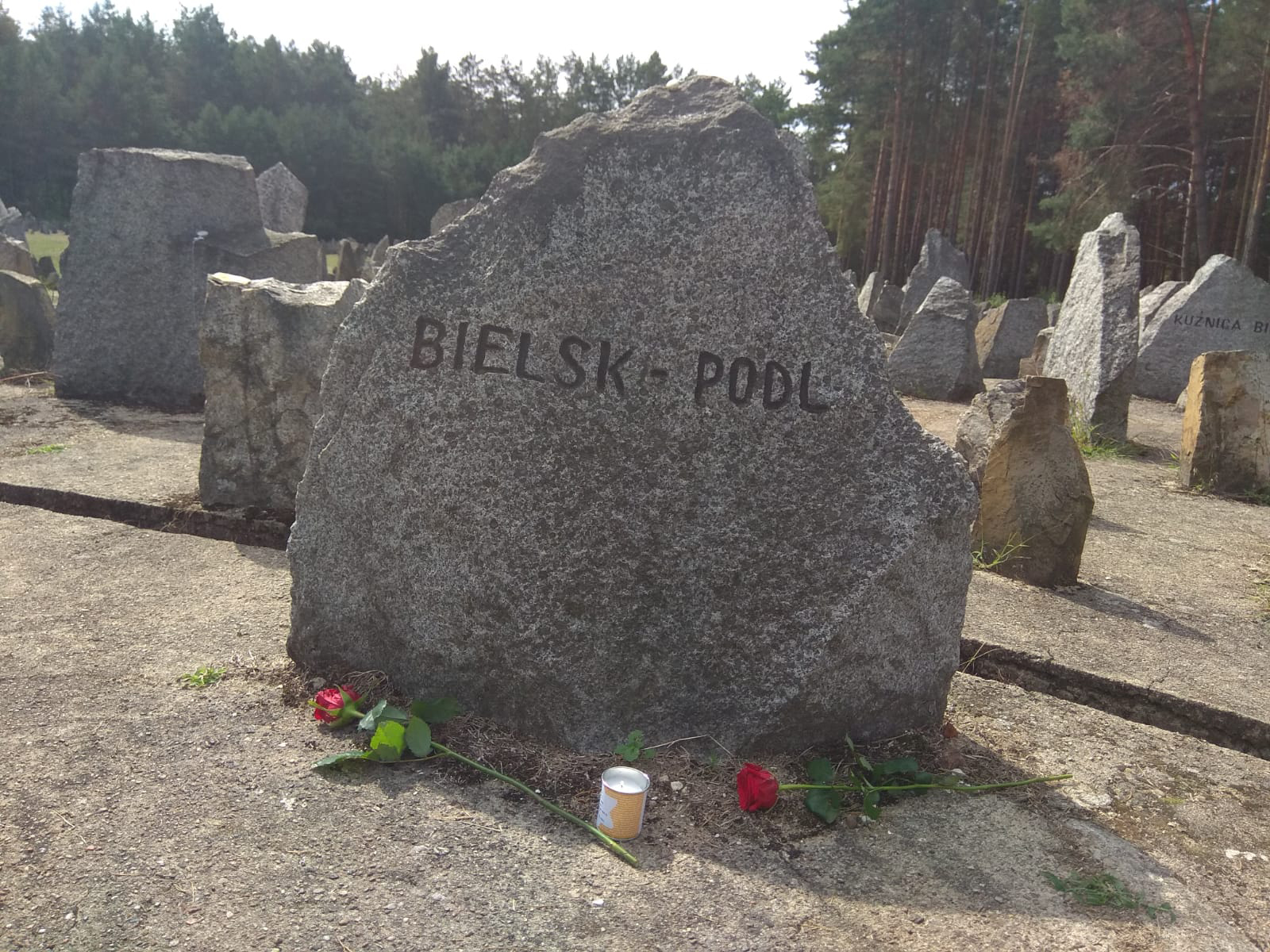
Memorial stone in Treblinka for the
Victims of the Treblinka Extermination Camp from the Bielsk
community
In Siberia - the
beginning
Our train arrived at its final stop in Biysk, Altayskiy Kray.
From there began a mountainous area without railway lines.
From the station, we were transported hundreds of kilometers
by wagons on rough roads in the mountains, the valleys and
forests, through bridges and in places without defined paths.
A few days later we had arrived at a detached from the world
village named Solonowka among the high mountains of Altay. We
lived in a two-room house where two families resided in each
room. We shared our room with the Pomerantz family (Bella and
Mina and their mother) while two Polish families from Bielsk
whose names I do not remember, shared the other. Each family
consisted of a woman and children. We did not know what was
Mr. Pomeranz’s destiny. Mr. Pomerantz owned a flour mill in
Bielsk and from what we knew, he was arrested by the Soviets.
The families in the other room were families of officers of
the Polish army who did not return to their homes after the
war in 1939 and their fate was unknown.
Our mother was forced to work in physically hard labor at a
factory which made bricks. However, at the end of August all
were mobilized to harvest the grain. Our mother, who grew up
in the city, failed in tying the wheat. When one of the
Russian workers from the kolkhoz company asked her: “So, what
did you do in your home”? One of the Poles responded: “They
did not do anything. Others worked for them.” That day, my
mother returned from work exhausted and very upset as she did
not expect a Polish woman who was in the same situation to
make such an anti-Semitic remark.
Luckily the situation did not last for long. At the end of the
summer the Polish government-in-exile in London signed an
agreement with the Soviet Union and joined the war against
Nazi Germany. As Polish citizens, we were released from
detention to the place we were originally sent to and were
given permission to move to another place.
The cow ate the photographs
To use our rights as Polish citizens we had to obtain identity
cards with pictures. A photographer arrived to photograph the
adults and promised pictures for the next day. But the next
day, my mother received a photo from him that was not hers.
She asked for her own photo but the photographer replied that
"That's what was left, and he does not have her photo as the
cow ate it all." It turned out that the photographer hung the
negatives to dry at the yard and a cow that was nearby, ate
some of them. The process of issuing the IDs was delayed but
eventually we received them along with the rights of being
free citizens.
In Solonesznoie
We were happy to leave Solonowka and move to a larger village
called Solonesznoie. Life there was also very difficult.
Freedom of movement was practically challenging even for
residents. There simply were no means of public transportation
and everyone had to manage by themselves. Our one-room house
had a large brick oven in the center. Inside the stove, we
would light a fire from trees and dry branches. During the
winter the oven was used for cooking and baking as well. Above
it was a large surface, about two meters long and very wide
that was a bed for the whole family. We used a ladder to go up
to bed. In the corner of the room was a cooking facility for
the summer, when the central oven was not lit. A "samovar"
that boiled drinking water was there as well.
In the yard of each house was a bathhouse called Banya. It was
a round or square structure built of wood, with a tiny
dressing room and a central wash room with a bench next to the
wall. In the center of the Banya there was a place to light a
fire and above it hung a large pot with water. There were no
windows and the smoke would come out through a chimney in the
center. After a while of burning, we would pour water on the
fire and the room would be filled with steam. Next to the
Banya, we stored the logs we would collect and kept it for the
winter. The houses were heated with these logs as well.
Life in Solonesznoie was difficult and there was a shortage of
food. The terrain was mountainous and hard to walk. In winter,
we did not see the paths and we all walked in the deep snow.
In the summer, there were plenty of snakes and predatory
animals that would reach the houses.
Like us, most of the families’ deportees, after becoming "free
citizens," left the rural areas and moved to the cities.
Leaving was challenging as there was no transportation and so
all needed to exploit random opportunities. Eventually, my
mother, sister and I left Solonesznoie and set off for the big
city, Biysk.
Altayskiy Kray and the city of Biysk
Altai is an area in southwestern Siberia bordering Mongolia
and Kazakhstan. Most of its territory is mountainous and is a
continuation of mountains from Mongolia and China to Tibet.
Biysk is located at the edge of the mountainous region on the
banks of the broad river Biya. The river descends from the
mountains and is one of the water sources of the river Ob. The
Ob crosses all Siberia from south to north and eventually
spills into the Arctic Sea. This is where the railway lines
end. From there, to reach Mongolia, there is only one mountain
road that leads up to Ulan Bator (the capital of Mongolia). To
reach this mountain road, one must cross the river to the
other side of the river. The distance to Mongolia was hundreds
of kilometers, but the area across the river, where the
mountain road was, was declared a "border area" and a special
permit was required to cross to the other side of the river.
A wooden bridge of several kilometers long was built across
the river Biya. Each year before winter, the bridge’s central
part was dismantled and then reconstructed after the winter
and the thawing of the ice. In the winter, transportation was
conducted only on ice. In the spring and autumn when the
bridge was still dismantled and the ice was only partially
melted, it is impossible to cross the river. In 1941, after
the outbreak of the war, no one was available to dismantle the
bridge before the frost. Consequently, it was destroyed by
floating ice floes after the winter, during the thaw. As a
result, for many months the passage to the other side of the
river and the road to Mongolia were cut off. Biysk also had no
public transport and most of its streets were unpaved. The
main street paves were made from partly rotten wood on which
we walked everywhere. In spring and autumn everything was
covered with deep, difficult to pass mud.
In winter, the temperature would sometimes drop to as low as
minus 44 degrees. On such days, a municipal siren would be
activated in the morning to let all know that on that day, all
should stay home and not leave the house for any reason be it
work, school or otherwise. Up to when the temperature reached
minus 40 schools and work places were open. The most difficult
month was February. Around that time, the temperature would
drop to around minus 30 degrees accompanied by strong winds
and snow storms known as "PURGA." The wind stormed and the
snow would rise and turns in the air. It was impossible to see
anything at a meter’s distance and it was extremely difficult
to find one’s way. There were stories about people who froze
to death just a few meters from their houses because they did
not find its direction. In the summer (July - August) the
temperature would reach 25 ° C and higher. But even then, the
high mountains remained covered with snow. The local
agriculture adapted to the climate. For example, there is a
certain type of wheat that is seeded in autumn. The seeds
remain frozen in the soil all winter and the wheat grows only
in the spring.
At the end of every summer, in August there were
electromagnetic storms. The air was full of static electricity
that would break up with lightning day and night even when
there were no clouds in the sky and no rain fell. The animals,
especially the cows and the dogs, would feel the electricity
in the air a few days before the storm and they would make
loud noises.
During winter, all wore special clothes. Our boots were made
from especially compressed wool as were the rest of the
clothes such as coats, hats with earmuffs and gloves. One had
to make sure to tie and close every garment well before going
out into the street. At the time, I met at least two people
whose ears had frozen and fallen.
Most of the houses in the city were wooden houses of one or
two floors. All entrances had double doors where one had to
enter the outer door, close it behind, and only then, about
half a meter away, open the inner one. All windows were double
windows as well, and were protected by an external shutter.
There was no running water at the houses so residents would
bring water from the river in buckets. In the winter, a window
would be opened in the ice to reach the running water. People
would store the water in the house in a barrel and replenish
it every few days. Once a week we would bathe in a public
bathhouse, not far from our house. There, every bather would
get a metal bowl and fill it with hot water that was used for
washing.
Every apartment had a radio or, rather, a speaker that had
only two stations: the Moscow station and a local station that
would announce local events, the weather forecast, and so
forth. The Soviet Union was disconnected from the world and it
was impossible to listen to foreign stations, to receive
newspapers or any information from abroad. The authorities
made sure the citizens knew and heard only what they were
permitted to know and hear. It was permissible to correspond
with people abroad but all letters went through strict
censorship. Therefore, we had to write that in Russia all is
well and especially that there is everything one might need
and there is no need for anything else. Nevertheless, we wrote
to our relatives in Israel (Palestine then) and South Africa ,
and hinted gently, sometimes using a word or two in Hebrew and
symbols and codes that we needed help and what was our real
situation. Our relatives understood, and sent us packages
mainly of clothes that we sold or replaced for food. (Our
father's sister, Sheva, married a resident of Lithuania and
they emigrated to Cape Town in South Africa after World War I.
My cousin Tanchum Arieli (a son of my father's other sister
named Shcerbaty from Lutsk) immigrated to Palestine. He was
one of the founders of Kibbutz Negba. He was a commander in
the fights to save the kibbutz during Israel’s War of
Independence in 1948.)
In Altay, there is
an autonomous region of Oyrotim. The Oyrotim live in tribes
and are mainly engaged in hunting as well as in some
agricultural activities. Some of them are nomadic. Externally
Oyrotim are very similar to the Mongols and are in fact a
mixture of many peoples who have wandered for hundreds of
years between mountains, countries and regions of government
such as China, Mongolia, Kazakhstan, Kyrgyzstan and even
Turkey. A small number of them settled over time in the cities
and engaged in conventional professions. I only knew one of
them. He was a sports teacher at our school after he was
wounded in the war and was discharged from the army as a
cripple.
The population in the city of Biysk was mostly Russian. An
Altai population concentrated mainly on villages and high
mountains. During the war, the city absorbed many refugees
from European Russia and other Soviet republics. Industrial
enterprises (mainly military) and their workers were
transferred from the center to Siberia. I especially remember
ELEKTROSTAL, a large factory from Leningrad that was
transferred with its employees and their families.
Many of the city's residents during the war were Poles and
Jews who had been deported to Siberia by the Soviet
authorities before the war and who, like us, had been able to
move from where they were originally sent to, to the
relatively large city.
During the war there was a severe shortage of food. Bread, for
example, was not seen at all during the first years. At the
end of the war, in Biysk, bread was distributed according to
coupons. At the local stores the shelved were empty. Most of
the shopping and especially food could be bought only in the
market. What could be obtained were mainly potatoes and
sometimes other vegetables like carrots, beets, cucumbers and
dairy products. Luckily for us in the Altai area there were
lots of bees and therefore we could sometimes get honey. In
the winter, frozen blocks of milk that could be cut into
pieces and thawed, were sold in the municipal market. Honey
was sold in frozen blocks as well. In the summer, we collected
berries and some apples. We would also get fish from the
river. It was customary to buy a large amount of food that was
available that season and to store it in the basement of the
house. For example, potatoes were bought in bags and stored
for the whole winter.
Night of the Wolves
It was a full moon night at the end of March. My mother rented
a two-sled wagon harnessed to cows (because all the horses had
been taken by the army) with a sled driver and a boy to assist
him. The driver was supposed to take us from Solonesznoie to
another residential area where the road began, and trucks
would travel to Biysk. The sleds carried our belongings while
my mother, my sister and I, walked by foot behind it. Sledding
was the only means of transportation in our area. We walked
all day long and continued at night by the light of the moon
and stars. We walked about 60 kilometers in three days on the
curved road between snow-covered mountains and forests. In the
background, we saw a peak of the Altai Mountains named
Belukha, which is over 4,600 meters high.
The night was clear and along the sides of the road we saw,
from time to time, skeletons and bones of animals. The driver
explained that these were beasts devoured by the mountain
wolves. The mountain wolves are very large and always hide in
the high mountains. The driver tried to calm us down by
telling us that the wolves live in large groups and go hunting
at night but usually do not attack people. We moved step by
step on our long journey surrounded by frozen waterfalls that
freeze in the fall and resume their flow in spring, rocks of
all shapes and colors and shadows of various pine trees
shadows of reflected light of the moon from the endless snow.
We saw no one around except for us.
We were very tired walking in a place where we did not see any
village or house where we could rest until suddenly, on the
side of the road not too far away, we noticed a very large
construction built entirely of uncut trees and without
windows. The structure was surrounded by a high wall made of
large tree trunks with an iron gate that enclosed the
entrance. It was a winter cattle pen with food for the animals
when there was no grass or other food outside. The farmers
gathered the food for the animals before the snow and stored
it in such pens. Inside this structure, a few people lived
with the animals, cared for and feed them while big dogs
guarded it.
We were very tired, so my mother asked the wagon driver to go
into the winter farm that we saw so that we could rest until
morning. He refused claiming that he didn’t have enough food
for the animals for a longer journey. Nevertheless, we just
could not walk anymore.
Suddenly we heard from a distance a growing howl and saw, in
the light of the moon, wolves descending in a long line from
the mountain in our direction. The driver pulled out a shotgun
and fired two shots into the air. The wolves were not
impressed and continued in our direction.
The driver then turned the sled carts and we all ran to the
winter farmhouse and knocked hard on a gate that opened and
closed right behind us. The wolves remained outside but did
not give up and continued attacking the winter farm. The guard
dogs made their voices heard from the inside, and the dialogue
between them lasted all night. The wolves continued to turn
around trying to break through the fence. Needless to say,
there was no way anyone could sleep not to mention there was
no place for it. We sat crowded in a corner that was allotted
to us until morning. The farmers lit a bonfire, and to no
avail threw burning torches over the wall from time to time in
an attempt to drive the wolves away. They repeatedly explained
to us that the wolves did not attack people during the day.
Indeed, when the sun rose, the wolves went back to the
mountains.
As we emerged from the farm, we saw a wide path around the
farm that the wolves had created. That night we must have
disappointed them and they remained hungry. We continued to
our destination very tired but relieved. When we finally
arrived at the village, it turned out that the snow that had
begun to thaw had destroyed a bridge on a river and that the
trucks could not continue. We stayed in the village for about
a month until the traffic was renewed.
Our mother fell ill
Our mother got sick - she had gall bladder stones. One night,
she had such a painful attack that she sat very weakly and was
unable to talk. At a certain point, the village women who were
standing around her bed thought that she had stopped
breathing. They talked among themselves about needing to
inform the authorities of her death, and how they would take
my sister and me to an orphanage. My sister and I held hands,
unable to cry, thinking it would be our end. But, after a few
minutes, one of the women started shouting that my mother
resumed breathing and is back to life. A doctor was
immediately called and he concluded that the crisis was behind
us and that our mother would just need to rest. My sister and
I resumed breathing as well.
Life at Biysk
At the end of the journey, we arrived to Biysk where we lived
at Oziornaja 4a in one room of a two-room apartment (the
owners lived in the other room) until our return to Poland in
the summer of 1946. Many refugees, Poles and Jews, among them
from Bielsk Podlaski, were gathered in the city. The common
past and similar fate connected between all of them. Our
mother was in contact with many of the people of Bielsk, both
Christians and Jews, through the membership and activities of
Zwionzek Patriotuw Polskich, a national organization of Polish
immigrants with branches in most of the refugee concentrations
in the Soviet Union. Among other things, the organization
provided some information about what was happening in Poland.
It distributed a Polish newspaper printed in central Russia
under the supervision of the authorities, of course. Living
closely with neighbors under difficult life conditions led to
solidarity and mutual assistance among the Polish, Jewish and
Polish exiles. We especially remember our mother and a wife of
a Polish officer who often visited each other.
Life was difficult in every way. Our mother tried to get a job
as a librarian in the municipal library, but during the
interview she was asked how come she knew Russian so well. She
said she had finished school in Lida during the time of the
Czar's rule. Unfortunately, this was a trick question. My
mother was placed on a list of suspects disloyal to the Soviet
government. Consequently, she was refused any sort of office
work. Due to health issues, our mother was unable to do
physical work, so we made a living by selling the objects we
had managed to take during our exile to Siberia and from the
help we got through packages sent by relatives in South Africa
and Israel.
Some of the Jews and the Poles could make a living from their
profession. Such were tailors, shoemakers, bakers (who baked
in their homes and sold the baked goods on the market),
doctors, dentists and more. There was someone who created
wooden spoons and sold them. There were musicians who
performed in halls. Next to us lived a musician from Riga who
played the saxophone. He had a son name Alek. Many worked in
various factories in the city. A Yiddish writer named Jasny
who could not publish his works, found a different "cultural"
job and worked as a guard at the theater.
My school in Biysk
In Biysk there was a small Polish school where several grades
were taught together. But since my sister and I knew Russian
well, we attended Russian governmental schools. I attended
high school number 3 (FOR BOYS) and my sister attended school
number 1(FOR GIRLS).
Other schools were of single gender schools, boys or girls
only. There were great differences in the schooling level
among the different schools. Fortunately, I studied at Urban
School Number 3 which was intended for the best students who
passed challenging admissions exams.
There was only one other Polish boy in my class, a student
named Gonorow (not from Bielsk), and the rest were Russians.
The school was located 4 kilometers away from our home, but I
insisted attending it and walked there every day. There wasn’t
public transportation that got there, so it was especially
difficult during winter. In this school, however, we studied
more hours per week than what was customary in the others. We
also studied extra subjects such as technical scribbling,
agrobiology, world literature (in addition to Russian
literature and Soviet literature taught in all other schools),
the constitution of the Soviet Union and more that were not
part of the curriculum in other places.
The teachers in this school were also better than the ones in
less challenging schools. I especially remember the
pedagogical director, who was a refugee from Estonia and
apparently knew the world even outside the Soviet Union. There
were two principals in the school: the pedagogical director
who oversaw the teachers and the political indoctrination, and
next to him was an administrative director who was in charge,
among other things, of discipline which was very strict. I was
a good student and always helped the others. In the past year,
I was chosen by the students to be the secretary of the
school’s student council. I was also the editor of the student
newspaper. The pedagogical director suggested that I join the
Komsomol. He told me that usually one could get accepted after
turning 16, but because I was an outstanding student, even
though I was only 15 years old (the only one in the class), he
was willing to approve my joining. I did not want to join and
excused it by claiming that we are Polish citizens and will
return to Poland after the war. A few days later, he came to
speak with me again and said that he had inquired about it in
the "high windows" and he was told that since after the war
Komsomol would also be in Poland, I could join. I dodged again
and he must have understood that it was just an excuse.
Nevertheless, he accepted it and I was off the hook.
During the war it was impossible to print textbooks.
Therefore, at the end of the school year, the books from each
class were collected and where handed over to the next
entering class. In a history book of the Soviet Union that I
received, I noticed that several pages were glued together and
that other pages were missing. I turned to my classmates but
apparently, the same pages were missing and the same pages
were glued. My friends advised me to ignore this and not ask
questions. But I couldn’t resist and carefully and secretly
opened the glue and found pictures of former heroes and
leaders presented to us in classes as traitors. Apparently,
their status changed in the eyes of the authorities after
these books were printed. The policy change required an update
and it is likely that an instruction has been received to
update both the books and the history retroactively.
At the time, there were not enough notebooks as well, so and
the teachers had found a method to whiten and erase printed
text from newspapers and use it instead of notebooks. It was
done in the school lab with Calcium oxide. The resulting paper
was of very poor quality and could only be written on in
pencil as ink would stain it too much. Still, it was better
than nothing.
During the summers, we, the students, were required to come
and help with the school’s maintenance. We arranged logs for
the school’s winter irrigation, fixed and painted the fences
in the yard and the like.
The students decided there was no God
One day a lecturer from an organization of "young atheists"
arrived in the city. Students from all the city’s high schools
gathered in a cinema to listen to his lecture. He spoke
against the church and religion, quoted from newspapers of the
czar period and presented examples of "miracles" that modern
science can explain today as natural phenomena. At the end of
his lecture he turned to the students and asked that if there
was still someone who believed in God to raise his hand.
Everyone were silent and I heard him say to the secretary
sitting next to him: "Write down unanimously." The following
day I read at the Chronicle of the City section of the local
newspaper: "The schoolchildren of the city gathered for a
special meeting and after listening to a lecture and holding a
discussion, decided unanimously that there was no God."
The Typhus epidemic
The health care system has worked to prevent various
epidemics, mainly through vaccinations. Health nurses would
occasionally come to the schools to vaccinate all the
students. Unfortunately, for some diseases there wasn’t a
vaccine. A severe plague of typhus spread in the city and many
who fell ill, died. At the beginning of 1943 I became ill and
as a result stayed home in bed for almost six months. I was
exhausted, could not eat or stand on my own feet. Given that
the conditions at the city’s hospital were unbearable, and was
not very sufficient in caring for the sick, it was decided to
keep me at home under the care of a doctor who was a refugee
from Leningrad. At the time, there were no cure for Typhus, so
the doctor’s advice was just to hold on. After many months of
being home, my mother had found a Polish doctor who lived
across the river and went to seek his advice. Despite the
danger of crossing the river when the ice was already moving,
the doctor came and after checking me concluded that the
crisis was over and that I needed to eat to get better.
According to his recommendation, we got a fruit called
"kaluquva" and I began to drink its juice in large quantities.
A few weeks later I gradually started walking. After almost
six months of absence, I was finally able to return to school.
The teachers suggested that I would be held back a year as in
any way I was younger than the rest of my class. Nevertheless,
I insisted on not losing the school year and made a
significant effort to complete what I had missed. Thankfully,
at the end of the year, I passed the exams successfully.
Victory Day, May 9, 1945
On May 9th, 1945, early in the morning, I heard loud knocks
on the window shutters. My friend from the Piotr Arbusov
school, a local Russian boy who lived close by so we used to
walk to school together, was outside, knocking and shouting:
"Nahum, wake up! The war is over!" I opened the window. It
was still dark, but the lights in the houses along the
street started lighting up one by one. Their windows opened
and we heard the radio broadcasts Germany's surrender. The
radio broadcast was filled of cheers and enthusiastic songs.
People went out into the streets, yelling, laughing, dancing
and crying. A war cripple without a leg was waving his cane;
a truck driver was honking. We got dressed quickly and went
out to the street.
In the morning, a celebratory service took place in the
school. We sang the Soviet anthem and the principal spoke
and promised that the students' fathers would soon return
home from the front. Everyone was extremely excited. I,
however, already knew that my father would not come back.
Many months before the end of the war, when Polish soil was
gradually liberated, we received bitter news about the fate
of the Jews. In a Polish newspaper that we obtained, we read
Julian Tuwim's article, "We are the Jews of Poland," that
described the Holocaust. We read more news and articles and
collected information on what was happening in Poland. We
tried to contact family members and everyone we knew. We
sent many letters to the Red Cross, which compiled lists of
survivors, as well as to the different municipalities and
institutions. The municipality of Bielsk Podlaski had passed
our letter to our childhood caregiver Anna Klimowska. Anna
had written back to us that she saw my father during the
German occupation while he was held at the ghetto.
Apparently, she spoke with him several times through the
ghetto fence. She told us that the ghetto was demolished by
the Nazis and that all the Jews were sent to their deaths.
She told us that all our relatives and acquaintances were
murdered by the Nazis. The victory on Germany was too late
for them, and for us.
Preparing for another war
In the summer of 1945, a few months after the war with Germany
had ended, a partial curfew was suddenly declared in the city.
It was forbidden to go out into the street from a certain hour
in the evening until morning, and the shutters of the windows
facing the street had to be locked. Every night there was
noise of heavy traffic passing through. It turned out that the
authorities had begun to transfer military units from Europe
to Mongolia, preparing an attack on Japan. Tanks, cannons and
trucks would arrive at the train station where they would be
unloaded and transported at night through the city and across
the bridge towards Mongolia. And indeed, the attack on Japan
began soon after. The Soviets, however, did not manage to
conquer everything they planned. The Russians stopped their
advance after the Americans bombed Hiroshima and Nagasaki.
Japan surrendered and the war ended.
Back in Poland, 1946-1950
Poland and most of Europe were badly damaged and destroyed in
the war. Therefore, the repatriation was carried out gradually
and for long. My mother, sister and I, returned to Poland only
in the summer of 1946 together with other repatriates. We took
a special train from Biysk - with all the Polish and Jewish
refugees who were with us in Altai. This time we traveled as
free citizens. After the train crossed the border to Poland,
we met with representatives of the Jewish aid organization
"Joint" and the Red Cross. Some of the passengers, who had a
place to go back to, descended on the way at various stations.
Most of the Jews, however, no longer had a home to return to
nor a family to reunite with, along with some Poles, landed at
the final train stop in Szczecin city. It was a former German
city annexed to Poland as part of a new international
arrangement according to which part of East Germany was
annexed to Poland. The German population fled or was deported
to Germany. At the same time parts of eastern Poland were
transferred to Soviet Union. In Szczecin we were housed in the
empty apartments the Germans had left behind. The city was
largely destroyed. I remember how the authorities continued,
more than a year after the war, to remove the rubble of
buildings and to discover and remove hundreds of skeletons of
people (probably Germans) killed in the bombing.
After a short while we moved to Lublin where our cousin Raja
Kowienski lived with her uncle Leon Lewinski. The uncle, who
fought as a partisan in Jewish partisan’s organization FPO, in
the Wilno forests, managed to smuggle her out of the ghetto
when she was 5 years old and thus saved her life. Her parents
and all the rest of her family were murdered. We were told
that her uncle Abraham Kowienski and his wife Frida lived in
Wilno outside the ghetto with false papers. Once when they
were walking down the street with their baby someone
recognized them as Jews and turned them over to the Lithuanian
police. The policemen killed them in the yard of the house and
the teller received three kilos of sugar in return (yes - for
the baby as well). This was the price the Nazis set for every
Jew.
Sometime after Lublin, my mother, sister and I along with Raja
and her uncle, moved to Lodz where we stayed for three years
until my mother, sister and I immigrated to Israel while Raja
and her uncle left for Berlin, Germany where she lived until
her death. In Lodz, we lived on 64 Piotrkowska Street until
our immigration to Israel in March 1950.
Toward the end of the war, while we were still in Siberia, the
terrible picture of the Nazis extermination of the Jews began
to uncover. The shock was great and unbearable. There were
lists, articles, radio broadcasts and stories about what the
Germans have done. Many institutions such as the Red Cross
continued to update and publish lists of survivors and lists
of seeking relatives. We continued to search but found no sign
of our father, grandfather or grandmother, neither my father's
brothers nor their children nor my mother's brothers. No one
survived. Jewish extermination camps survivors, as well as
Jews that were hidden and those who returned from Russia,
concentrated in the city of Lodz. The city became the main
national center for Polish Jews. Many social, political and
cultural institutions and organizations were established
there. I joined the Hanoar Hatzioni (Zionist youth) movement
where I served as a instructor and the secretary of the
movement's branch in Lodz. I participated in summer camps, and
held various positions organizing, training and lecturing in
various branches of the movement throughout Poland on behalf
of the national leadership in Lodz.
At the time, I had also worked at the National Bureau of the
Jewish National Fund in Poland (Keren Kayemet) and was
appointed secretary of the Coordination Committee of all the
youth organizations of the Zionist parties.
In Lodz two newspapers of the Zionist movement were published
in Polish. An editor of one of them, the monthly magazine
Opinja, asked me to write a youth section called Kolumna
Mlodych. I told him that my knowledge of Polish was not good
enough for writing in the newspaper, but he replied that the
language issue was his problem and not mine. I shell write and
he will correct and edit. So, I did. I published the section
several times and in March 1949, when I turned 18, my editor
granted me a press card of PAP (Polske Agenctwo Prasowe). The
magazine was closed by the authorities a short while after,
and I immigrated to Israel. Thus, ended my journalistic career
in Polish but was renewed a few years later in Hebrew in
Israel.
During the last year of our stay in Poland, the Communist
authorities prohibited the existence of Zionist movements and
organizations. Nevertheless, we continued to operate
illegally.
My sister Gita studied in the evenings at a Hebrew school
named after "Ghetto Fighters" that opened in the city but was
closed by the authorities after a while.
While lived in
Lodz, our mother once visited Bielsk where she met the
Blumenthal (Beryl and his brother and their mother) and Kam
families, with whom she was in Siberia. She had also met with
our Polish neighbors from before the war.
We made a firm decision to immigrate to Israel, but there were
all sorts of difficulties made by the government which
occasionally changed its policy toward Israel and the Polish
Jews. At one point, we already had passports for the journey,
but one morning police officers appeared at our doorstep and
confiscated them, apparently according to the changing
directives of the Soviet Union towards Israel.
In Israel
On March 30th, 1950, we finally arrived at Israel via Italy.
We took a special train organized by the Jewish Agency from
Warsaw to Venice, where we were transferred to an Israeli ship
called Kommiut that transported us to Haifa port. The ship was
very old and used to transport coal for the British navy. For
the transport, three-story beds and ladders to the deck, were
installed in it. The journey continued for a few days. On the
way, near Crete island, a storm broke out in the sea. An alarm
sounded and everyone was required to go up to the deck. The
high waves reached the deck and we almost drowned. This was
the last voyage of that ship after which it was dismantled for
scrap because it was not suitable for sailing. I remember the
burning lights of Haifa in the early morning when we reached
the shores of Israel. There was a great excitement and many
wept. From the port, we were taken to shacks in a transit camp
at Haifa called Sha'ar Ha'aliya. Two weeks after, we were
moved to a different camp of shacks called the "Israel camp."
It took many months before we moved to a one-room apartment of
23 square meters in size. In Israel, my sister Gita and I
worked and studied in different places. Gita graduated Tel
Aviv University in economics and married to Leon Kogos, a
Holocaust survivor from Moldavia. They have two sons Benjamin
and Noam and five grandchildren. I have attended Tel Aviv
University as well and received my degree in accounting and
law. I am married to Rivka from Schreiber family, a Holocaust
survivor who was born in Antwerp, Belgium. We have three
children Dina, Anat and Itamar and nine grandchildren. Years
ago, I established an accountancy firm in Tel Aviv and was
active in various public and professional organizations. I
served as the President of the Certified Public Accountants
Organization in Israel, as a lecturer at Tel Aviv University
and in many professional and social organizations in the
fields of accounting, economics and business management. I
have published over a thousand articles in the economic and
general press, mainly in Haaretz, where I edited a regular
weekly section for almost twenty years. I was the editor of
the Certified Public Accountants Organization magazine for
seven years, as well as published another professional
independent journal.
Our mother, Shejna Freidkes died in Israel in January of 1989.
Others from
Bielsk who arrived in Israel after the war were the Pomerantz,
Barchat, Kam, and Blumenthal families.
My visit to Bielsk
In 1996 My wife and I visited Poland. Naturally, I visited
Bielsk as well. I could only identify the Cinema building and
the train station from which we traveled to Siberia, but not
the buildings or streets. In the town square, across the place
where our house used to be, in the old town hall, a municipal
museum was opened with a permanent exhibition on the history
of the city. I asked to see exhibits of the Jewish community
as before the war, half of the city's residents were Jews. To
my great disappointment, the two young workers of the museum
did not know what I was talking about. They tried to help but
could only find a postcard with a photo of a Polish officer
who fell in defense of the city, and said they thought he was
a Jew because his name was Levi. They also found an old sketch
of the synagogue that was once there and is gone. That's all
that was left from the Jews in Bielsk.
Fortunately, there are people in Poland who have not forgotten
the role and contribution of the Jewish community to Poland
during the nearly 1,000 years of its existence on Polish soil.
One of them is the historian Mr. Wojciech Konończuk, who has
made a continuous effort collecting, editing, and publishing
testimonies. We are grateful for his contribution. I was also
very happy to hear from him that in November 2017 a square in
the heart of Bielsk was officially given a new name: "Plac
pamięci zydów Bielskich" or "Square in memory of Bielsk's
Jews".
As a member of the Jewish community I am grateful for
initiatives taken by some museums and other institutions
around Poland who act to commemorate its Jewish citizens.
Nahum Freidkes
_____
Seder night from 1939
A large and bright dining room. The long table set for the holiday is covered with a white tablecloth and many Passover dishes are on it. Grandparents (Benyamin and Nechama Kubinski), my parents (Sheina and Kalman) and my sister Gita, my mother's two brothers (Zorah and Avraham) and their partners and my little cousin Raya sat around him. We are all festively dressed and ready to welcome the holiday.
I was 8 years old and got up to ask the questions when suddenly the light went out and alarm sounds were heard throughout the city. Only the candles lit by Grandma Nechama illuminated the table and us sitting around it. We all froze for long minutes until a calming siren sounded and the electricity came back on.
No. It was not (yet) a war, but the atmosphere was very tense and the writing was on the wall. It was in my hometown (Lida) in Poland, where our grandparents and uncles lived. We came there, like every year, from our city of residence in Bielsk Podlaski to spend the holiday week together.
Germany did not hide its intentions and openly declared its "Aspiration to the East" (Drang nach Osteen). After the Austrians also "united" with Nazi Germany and they annexed Czechoslovakia, Poland was marked as their next target. The Poles decided to fight, and the authorities conducted civil defense maneuvers. The time they chose as the most appropriate for testing the alarm horns was when all the Jews (about a third of the city's residents) were sitting at the holiday table. And so the scourge of darkness was brought down upon us. This moment became for me symbolic and a harbinger of the great darkness that soon followed.
And when I was walking, on the holy day, with my uncle Avraham in the street, we heard an alarm again and from a military car passing by, tear gas grenades were thrown. My uncle quickly pulled me into the yard and we moved away from the place. He explained to me that Poland is afraid of a gas attack on it and is examining the preparedness of the population for such a case. That day my uncle purchased gas masks for our whole family and showed us at home how to wear them.
This is how we spent the last joint family Passover. Six months later, on September 1, 1939, the Germans attacked Poland, occupied and divided its territory between them and the Soviet Union. Our place was in the part controlled by the USSR.
Two years later, in 1941, we held a limited Passover Seder. This time it was just the four of us, my parents, my sister and I, in a small, half-dark room in a rented apartment. Our house burned down even before that. On the table was a bottle of wine and a small packet of unleavened bread that my father obtained secretly, since the authorities forbade baking them as a religious custom that is not acceptable to them. From that evening I mainly remember the conversation between my parents that took place at the table. My father then says that Yitzhak Greenbaum (Zionist leader and Israel's first interior minister) and Ze'ev Jabotinsky were right in their call for the "evacuation" (evacuation and rescue) of the Jews from Poland even before the war broke out. That evening I saw my father for the last time. He was murdered by the Nazis in Treblinka in November 1941, while my mother and sister and I survived in Siberia.
Shortly after that Passover (on June 22, 1941) the Germans attacked again. This time Russia and the Second World War broke out in full force.
Nahum Freidkes
_____
The Jewish fighters in the World War
I refer to Vicky Idzinski's article "Where did the Russian speakers go" from January 3, 2020 and would like to add that the media and the Israeli establishment ignore both the fate of Soviet Jewry during the comparative period and its part in the war against the Nazis.
On May 9, 1945, the remnants of Hitler's forces surrendered and the World War ended. The whole world celebrated this victory achieved by brutal fighting, with a tremendous effort and with close cooperation between many countries and peoples. We, the Jews, also celebrated our victory and survival.
The countries raised their flags and also counted their heavy losses. We, the Jews, did not have a country or a flag to raise, but we also counted our martyrs and the members of our people who were murdered with so much brutality by the Nazis and their helpers.
The nations of the world took pride, each in their part, in fighting and winning. Whereas we remember every year and keep in our memory the partisans and ghetto rebels, who bravely fought their last war, and the volunteers of the Haaretz-Israel Brigade. But in addition to them, many Jews participated in the war of existence as soldiers in all the allied armies. Their contribution and their share in the victory far exceeded their relative share in the Allied populations.
The media and institutions in Israel, for some reason, ignore their share in the victory and are content to celebrate the heroism of the partisans and ghetto fighters only. But the Jews also fought the Nazis as soldiers in the allied armies and their relative share in the fighting was much greater than members of other nations.
The time has come to remind ourselves and the world that about a million and a half Jewish soldiers also served in the armies of the countries that fought against the Nazis, and about a quarter of a million of them fell in battle. This is in addition to the six million of our people who were murdered. At the time, the Soviet Union published data and analysis on the participants of the World War. Among the recipients of the title "Hero of the Soviet Union" in the Red Army, the Jews were in second place (in absolute numbers and not in percentages). Whereas relative to their part of the population they were in first place. And when soldiers returned from German captivity - Jews were not among them because the Nazis spared others and murdered them.
Many of the elderly immigrants from the former Soviet Union still living with us have signs of heroism and excellence. They don't always get the treatment and respect they deserve in our country. A state initiative is urgently requested to collect and preserve their testimonies as they preserve the testimonies of Holocaust survivors, because soon it will be too late. Israel celebrates many holidays and memorial days. One of the most important should be May 9, the day of victory over Nazi Germany and its allies. We all live thanks to this victory and thanks to it the State of Israel was also established. The Soviet Union awarded about 12,000 of its soldiers the "Hero of the Soviet Union" badge, according to their publication about 2,500 of them were Jews. The population of the Soviet Union during the war was about three hundred million, of which about three million were Jews, i.e. about 1% of the population, but their proportion among the recipients of the badge of heroism was, as mentioned, over 20%. The time has come to publish and emphasize this to the public and the whole world. This is extremely important for our image in our own eyes and in the eyes of our friends and enemies alike and for future generations.
The government decided back in 2002 to establish a "Museum of the Jewish Warrior" near Latrun, but the matter is still "under treatment" until there are no more witnesses left alive. To the best of my knowledge, no action was taken to collect evidence either.
The duty of the state authorities is to check the omission in the establishment of the museum and the publication and dissemination of news about the part of our brothers as fighters in the war and victory in it. We must also include the subject in our education system.
Nahum Freidkes, Holon
_____
For
the Memory and Honor of Jokers
Humor has always been the weapon of the weak. Of those who
could not express their distress and could not change their
situation.
During World War I was in Siberia for about five years.
Despite being a young student at school, I was well aware of
what was happening around me, the culture, the atmosphere and
the reality of life and memories from those days that
accompany me to this day.
The years pass, the times change and the folklore of the past
is not always understood by our children and grandchildren.
That is why I decided to compile, tell and explain some of the
jokes from that far-off period when "The Sun of Nations"
(Stalin's nickname) shone above the Great Power from the East
and threatened to burn our world of the West.
Life was difficult. There was a lack of essential necessities,
individual rights were limited, and the dictatorship of the
government was felt in all spheres of life. Many Soviet
residents at that time tried to comfort themselves and their
friends by word-of-mouth jokes. "The songs help live" - says a
popular Russian song. And the stories and jokes even more. The
humor helped the Soviet Union residents to live and survive in
difficult times, but it also posed a great personal danger to
both storytellers and listeners.
Every joke was a ten (years in prison in Siberia...) and its
tellers were among the "Gulags" (forced labor camps) who built
the land of socialism, its developments and factories.
Comedians Gigan and Schumacher (in Yiddish) were among those
at the Gulags for their sense of humor and joke-telling, and
therefore "earned" their reputable contribution to the
construction of socialism.
We remember the great vision of the "International" anthem:
"The old world we will destroy to the ground -and a new will
be built in its place." Indeed, the first part of their vision
was fully fulfilled in the Soviet Union and even beyond
their borders.
There is a story about foreigners who met around a roundtable
to entertain each other by telling jokes about their
governments, its governors, and leaders. All participated but
the Russian, who was silent. The others asked him: “Are there
no jokes about your government that you can tell us?” So the
Russian replied: “There are! But it’s not worth telling them.”
“And why not?” The Russian replied, “did you hear about the
dug trenches, paved roads, bridges built, and towns settled in
the distant tundra and other remote places?” “Sure we heard
and admired the huge enterprises of the Soviet state,” they
answered. “And do you know who built these magnificent
projects?” “No, we haven’t heard.” “All these were built
by the jokes tellers.”
In another meeting, the representatives of the various
countries talked about the commonly used vehicles in their
country. The German said that in the city they travel in
Volkswagen, while for special events they take BMW. For
visiting the neighboring countries, it is common to use
Mercedes. The French said that within the city they usually
use Renault, for official visits, Citroën, and for other
countries, Peugeot. The Russian explained that for travel in
the immediate vicinity, the commoners use Zis ,more important
people use Volga model cars, while visiting neighboring
countries, we travel only with… tanks.
The Constitution of the Soviet Union stated that the elections
for its institutions would be general, direct, proportional,
and secret. In Kolkhoz the day of the election, a long queue
of voters was formed on a ballot box. The foreman saw his
employees spend working hours for what he considered a
non-productive cause, and therefore decided to streamline and
shorten the process. He pre-filled all the envelopes in the
ballot papers and distributed them to the people waiting in
the queues, who then only had to send them to the ballot box.
And then he sees one of the voters turning aside, carefully
opening the envelope he received from the foreman, and peering
into it. “What are you doing?” - asks the manager. “I just
wanted to know who I am voting for” - the employee answers.
“What, don't you know that the elections are secret?” - The
manager scolds him.
As for free speech - An American tells A Russian: With us in
the US, I can stand in front of the White House and shout to
the President: "You are crazy!" And nobody will do anything to
me. The Russian replies: for us it’s even better: I too,
can stand in Moscow in the Red Square before the Kremlin and
shout: "The American president is crazy!" For that, I will get
a bonus and a promotion at work.
A new immigrant from the Soviet Union arrives in Israel.
People ask him: “What is the economic situation in the Soviet
Union?” “You can't complain” - he replies. “And how is the
general feeling of citizens?” You can't complain. “And the
conduct of the government?” And he continues: “You can't
complain.” “And how does the situation in Israel seem to you?”
“Oh, in this place, I can already complain about that.”
In order to convey and explain to the public everything they
need to know, a special role was created in the Soviet Union
called "agitator-propagandist". Those in this position
underwent special training and would travel from one place to
another, convene meetings and lecturers and explain various
topics such as the “Five Year Economy Plan” of the country's
economic development for the next five years. The lecturers
were instructed how to explain and illustrate to the listeners
the bright future they should expect. For example, guide the
listeners - if you see in the distance a person driving a car,
point to it, and tell your listener that after the upcoming
"Five Year Plan" we will all be driving cars, like him.
Following the instructions, a lecturer reached his audience
and started lecturing. During his lecture he opens a
window and sees a beggar leaning on a walking stick. He
addresses his listeners, points to the beggar and says: See
him? After the completion of the new "Five Year Plan," we will
all look and feel like him.
Another lecturer explains to his listeners how good it will be
after the government plans are fulfilled and new horizons are
opened to everyone. The broadened horizons promise happiness,
wealth, and a good life. At the end of the lecture, during the
questions phase, one of the participants asks the lecturer to
explain to him what these “horizons” of which he spoke are,
because the word "horizon" is unfamiliar to him. "Horizon,"
the lecturer responds, "is something you see at a great
distance and, as you try to get closer and reach it, the
farther it gets from you".
In another case, a lecturer explains to kolkhoz members that
at the end of the first Five-Year Program, each will win a
bicycle, at the end of the second Five-Year a car, and at the
end of the third Five, each will get an airplane. One listener
asks the lecturer "Why would a kolkhoz member need an
airplane?" The lecturer then gives him an example: "Suppose in
your kolkhoz there is a lack of matches and you can't get them
in the nearby city. But you heard that in Moscow you can
get everything. In this case, you can get in your plane and
fly to Moscow to buy matches".
I personally remember a lecturer from the "Young Atheists"
organization who lectured to us at the high school students'
meeting in town. He spoke of and cited newspapers from the
Czarist era that described phenomena defined by the church as
"miracles", whereas today science can explain them as ordinary
natural phenomena, without "miracles" and without relying on
supreme power. At the end of his lecture, he asked us all
whether there is anyone in the lecture hall who still believes
in God. Everyone was silent and he dictated to his secretary
for the record: "Write unanimous." The next day, I read in the
local paper the important news: "The city's school students
gathered for a special assembly and, after hearing a lecture
and a discussion, they unanimously decided that there is no
god."
The Soviet Union authorities claimed that their technology was
superior to the Americans’ in all areas. When the Soviets
learned that in the US an electric chair is used for the
execution of criminals, the Soviets decided to install such a
device. Comrade Beria (head of NKVD) invited guests to demo
the new device. A prisoner was brought into the next room and
guests were asked to check how fast and efficient the Soviet
process was. Indeed, a few minutes later a cry of pain was
heard from the room, but the shouting continued for long
minutes. Beria angrily turned to one of his assistants and
asked why the process was taking them so long. Comrade, the
assistant explained, our facility is fine, but as usual, the
electrical power shut down…. so we use papers.
The lack of various commodities meant that instead of buying
what was needed and when people needed it, people bought what
and when products were available. (or "what is
being shared today.") There is a tale of a man walking through
the street and seeing his friend standing by a door of closed
shop, followed by a long line of people. The man went to him
and asked what is being sold ("shared") here today. His friend
replied that he did not know. “So why are you standing here?”
His friend replied that as he walked down the street, he felt
unwell and slept on the door of the store that was closed.
When he woke up, he saw the long queue that had formed behind
him." And if I have already managed, once in a lifetime, to be
the first in line, why should I give up my place?"
The shortage of goods led to many thefts from factories by
their employees. At a particular construction site, a guard
stood by the gate and checked the passers whether they removed
anything from the factory. One morning he saw an employee with
a wheelbarrow full of garbage coming out of the gate to spill
it outside. The suspicious guard checked to see whether
something was stolen and hidden under the garbage and only
then let it pass. This procedure repeated the next day and the
day after, and again every day. The worker would pass with a
wheelbarrow full of junk and the guard checked it repeatedly
without finding anything. After a few days, he turned to the
employee and swore that he would not betray or harm him
in any way, but he was very curious to know what the employee
was stealing. "The wheelbarrows" answered the employee.
In the Soviet Union, two newspapers circulated nationwide:
"Pravda" ("truth") which was a Communist Party newspaper and
"Izwiestia" ("news") government newspaper. There was a clear
separation between them and so they said in "Pravda" there was
no "Izwiestia" while in "Izwiestia " there was no
"Pravda" (in "truth" there was no news and in "news" was no
truth).
The kindergarten teacher asks the children to tell them
something about what they do at home. One child says: “Our cat
gave birth to little kittens. They are still blind, evidently
very loyal communists …” “Stop,” says the kindergarten
teacher, “the supervisor of the Ministry of Education will
come tomorrow, and you will tell the story so that he will
hear too.” The next day the supervisor comes in and the
teacher asks the child to tell the story again. The boy
starts: “Our cat is breeding little kittens…” “Is that all?”
“they weren’t anymore” - says the boy - “they had already
opened their eyes.”
A new district governor is conducting a tour with his
secretary at various institutions in his district. They get to
a hospital and he asks: “How much does it cost you to
hospitalize a patient?” “A thousand rubles per day,” says the
hospital manager. “That is not reasonable,” the governor says,
“this is excessive and we must all save.” They also visit a
school and, again, after being told how much its upkeep costs,
the governor demands to reduce expenses and save. The same
goes for the kindergarten and every other institution. They
end up at a prison. “Holding the prisoners does not cost the
state anything” - explains the prison manager - “they work
hard and the prison profits from large surpluses in return for
their work.” “That is not reasonable” - says the governor -
“we must improve their conditions and make them work a little
less.” When the governor and his secretary return to their
office, the secretary asks the governor why he has demanded
that everyone cut expenses, but that the prisoners' situation
be improved. “What do you think comrade” - the governor
replied - “when our turn comes, will we be put in
kindergarten?”
A Russian was asked how Soviet citizen felt in their country.
And his answer was: "Like being on the bus, some site and all
others stumble and tremble.”
Stalin was a pipe smoker. He once entered his office and
couldn't find his pipe. He activates a red communication
button with Beria (the head of the NKWD) and says: “Beria, my
pipe was stolen.” We will deal with them immediately - Beria
responds. Stalin sits down and sees the pipe. He calls again:
“I found the pipe.” “Too late,” Beria answers, “they have
already pleaded guilty.”
The authorities, for some reason, attach great importance to
the fact that the defendant explicitly states that he is
guilty. In his book "Keep Forever", journalist and author
Joshua Gilboa talks about his imprisonment and interrogation
for his Zionist activities. After several days of continuous
investigation, the tired investigator (also a Jew) gives him a
suggestion: “Sign the plea that you are guilty, and I will
recommend a light sentence for your actions.” “But explain to
me what I am accused of” - the defendant asks. “Don't you
trust the intelligence of our people?” “Sign your admittance
and I will find the appropriate law for an accusation.”
Molotov (the foreign Secretary) and Stalin await a
conversation with the president of the United States. Stalin
coaches Molotov: “The American will probably make all kinds of
suggestions. No matter what he offers, you will always answer
‘No’.” The call arrives and Molotov answers: “No ... No ... No
... Yes ... No ... No …” The call ends and Stalin punches the
table: “What did you say yes to?” “He just asked me if I could
hear him” - Molotov answered.
The children were taught that Stalin is their father and that
mother Russia is their homeland. Ask a child what he wants to
be when he grows up. “Orphan” - will be their answer.
A tourist lands in Russia after a long flight and says: "We
have arrived, thank God." A Russian who stands next to him
corrects him: "Here we say thank Stalin." His hosts ask how he
is doing and he says "everything is fine, thank God." And
again someone fixes it "Thanks to Stalin for us". When this
repeats for the third and fourth time, the tourist gets upset
and says: "Stalin is just a human, and what if he dies?” So
someone answers, " then we say thank God.”
The Soviet Union strictly enforced isolation, preventing
contact and flow of information between its residents and the
outside world. There were only two stations on the standard
radio - one from Moscow and one local broadcasting station
that would announce the weather and local news. It was not
possible, and explicitly banned, to hear foreign broadcasts,
and residents also could not travel abroad. Strict isolation
and restrictions helped convince the public of the benefits of
the regime and that, in capitalist countries, life was much
worse. This isolation broke during the World War when the Red
Army and other Russian officials entered Europe. While
everything was devastated, signs of life that preceded the
World War could be identified and did not match what Soviet
citizens knew and had been told to think about life across the
border.
People who visited foreign countries in the military or other
jobs were briefed in advance by the authorities to praise the
Soviet regime and to tell foreigners that Russia has no
shortage of anything and everything is plentiful. A Russian
was asked abroad whether or not Russia had oranges. He did not
know what those were but replied: "Certainly, in Moscow there
are huge factories that produce oranges."
There is a story told of a Russian citizen who returned from
Europe to his country and was prosecuted for spreading
anti-Soviet propaganda. What do you blame me for? He asked.
And the prosecutor explained: This man dares to argue that
there, across the border, there is life before death.
The flow of information that reached the USSR about the
possibility of living differently and having a "life before
death" was one of the main causes of the decline of the Soviet
Union. Knowledge is power, and the gradual process of its
infiltration and impact on the population lasted for years and
only in December 1991 did the Soviet Union finally fall.
Knowledgeable people say that even the one who dismantled it,
Mikhail Gorbachev, was exposed to Western culture on his
visits abroad for a few years before finally deciding and
causing its decline. Detaching the population from information
sources and controlling what citizens know is characteristic
of dark regimes in those days and times. What's more -
advanced technology opens up amazing and threatening
possibilities for rulers. Although formal democracy, which is
still in our world, allows citizens to speak as they wish, it
gives too much power to the government to act as it wishes in
the area of information distribution and supervision of its
use.
The Soviet regime is now gone. Many important changes have
caused this, but telling jokes made also a modest contribution
to its collapse.
And so we will remember and honor the men telling jokes,
Nahum
Return to table of contents
Back to the Bielsk Podlaski home page
Updated
February
25, 2025
Copyright
© 2025 Andrew Blumberg
JewishGen Home Page | KehilaLinks Directory
This site is hosted at no cost by JewishGen, Inc., the Home of Jewish Genealogy. If you have been aided in your research by this site and wish to further our mission of preserving our history for future generations, your JewishGen-erosity is greatly appreciated.