



Some Facts
Osjaków, Central Poland
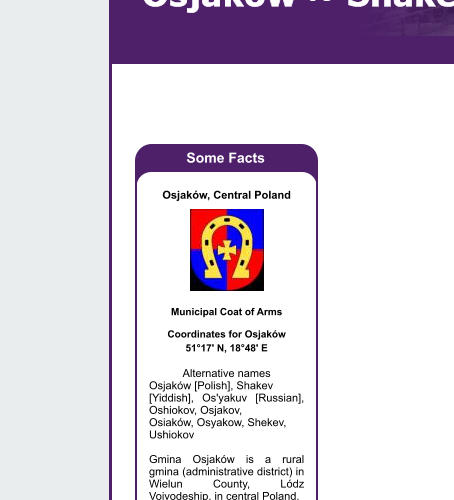
Municipal Coat of Arms
Coordinates for Osjaków
51°17' N, 18°48' E
Alternative names
Osjaków [Polish], Shakev
[Yiddish],
Os'yakuv
[Russian],
Oshiokov, Osjakov,
Osiaków, Osyakow, Shekev,
Ushiokov
Gmina
Osjaków
is
a
rural
gmina
(administrative
district)
in
Wielun
County,
Lódz
Voivodeship, in central Poland.
The
municipality
administrative
centre
is
the
village
of
Osjaków,
which
lies
approximately
17
kilometres
(11
mi)
north-east
of
Wielun
and
73
km
(45
mi)
south-west
of
the
regional
capital Lódz.
The
gmina
covers
an
area
of
100.74
square
kilometres
(38.9
sq
mi),
and
as
of
2006
its
total
population is 4,780.
Compiled by Martin Davis © 2017
This site is hosted at no cost to the public by JewishGen, Inc., a non-profit corporation. If you feel there is a benefit to you in accessing this site, your
JewishGen-erosity is appreciated.

Thanks &
Acknowledgements
The information contained
in these KehilaLinks pages
have been compiled from a
number of sources but a
special mention should be
made for the help given by
Artur Nowojski and his
Osjaków information
website which has been of
enormous help and which
makes an invaluable
contribution to today’s
‘Osjakówie’.
Web pages updated
January 2014
The majority of the Jewish population of the area lived within the village itself and
before 1939 the Jewish population constituted around 60% of the total population
(that is approximately 700 adults) of a population of around 1,400. There are
small indications that the relationship between the Christian and Jewish
populations was close, but undoubtedly it was historic.
Two examples go to illustrate this apparent closeness; the one being the local
Christian defence of the Jewish right to land ownership in the area in the 1860’s -
commented on in a little more detail later; the other being the following
commentary which was a criticism by a Mr Rabenda of a section of the non-Jewish
Prior to the Shoah, the most notable time in Osjaków’s history was during the
January Uprising against the Imperial Russian overlordship of the country (1863-
1864); when there were a number of battles fought in the area between the
Imperial Russians and Polish insurrectionists. The persecution and exile to Siberia
of some of the leading Christian citizens and the apparent defence of Jewish rights
by leading Osjaków citizens appears to be linked but too little is know to provide a
reliable narrative at this time.
In many ways Osjaków was touched by the ebb and flow of history but because of
its relative isolation and farming links it seems to have remained quintessentially
an urbanised but rural village, which had seen better days, and in which its Polish
Christian and Jewish population coexisted and worked toward making their living
from agriculture, trade and crafts.
To quote from the Osjaków information website:
"So sleepy Osjaków lived a poor life, a Polish-Jewish settlement. It was slightly
different from the surrounding countryside because of the nature of its buildings;
its architectural lay-out, and the employment activities of the population. In terms
of the its layout, Osjaków was more like a town, with its centrally located market
place and brick built houses, roofed with shingles and roofing felt; in contrast to
the surrounding villages; with their wooden houses roofed with straw."1
1. Osjaków Information website

Introduction
These pages are a basic introduction to the rural village of Osjaków and to aspects of its former Jewish life and history. Today it is an administrative centre for the villages and hamlets of the area and is one of a cluster of towns, villages and hamlets at the southern reaches of the River Warta which, before the Second World War, had long established mixed Jewish and Christian communities. Close to the ancient border between Lower Silesia and the Kingdom of Poland, Osjaków’s early history was bound up with the extraction of iron ore, farming crafts and trading between the two areas. The local Jewish community’s involvement in both the trade and agriculture of the area helped shape the village.
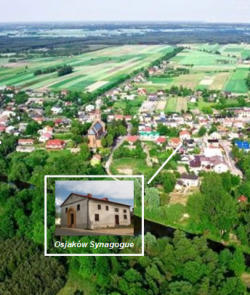
Panorama of Osjaków
Osjaków population and its failure to attend church and follow the instructions of the local Catholic priests:
"Well the main reason is that some men, instead of going to church on Sundays to hear Mass and the
sermon, go quietly with arms to the forest or on the field and there steal someone else's game (while others
choose to be true to the church) and instead of listening to the devotion, they spend all the rest of their spare
time in the tavern or inn with a Jew.”
A Rural Market Village
The village itself first appears in records around the period of 1260. It gained a formal town charter in the 1400’s and was know for iron ore extraction and iron production as well as agricultural produce and its associated monthly chartered market. The village lost its town charter in the late 1700’s after a fire virtually burned down the whole of the village but it continued to hold its market, which was held on the first Monday of the month, for local merchants as well as those from Wieluń, Działoszyn, Szczerców, Widawa and Belchatów.