
- Yizkor Book
- Lists of Names of the Martyrs
- Nezo's Book about Kisvarda's Jews
- Kisvarda Jewish Census of 1848
- Gabriel Erem's Memoir
- Photos of Kisvarda
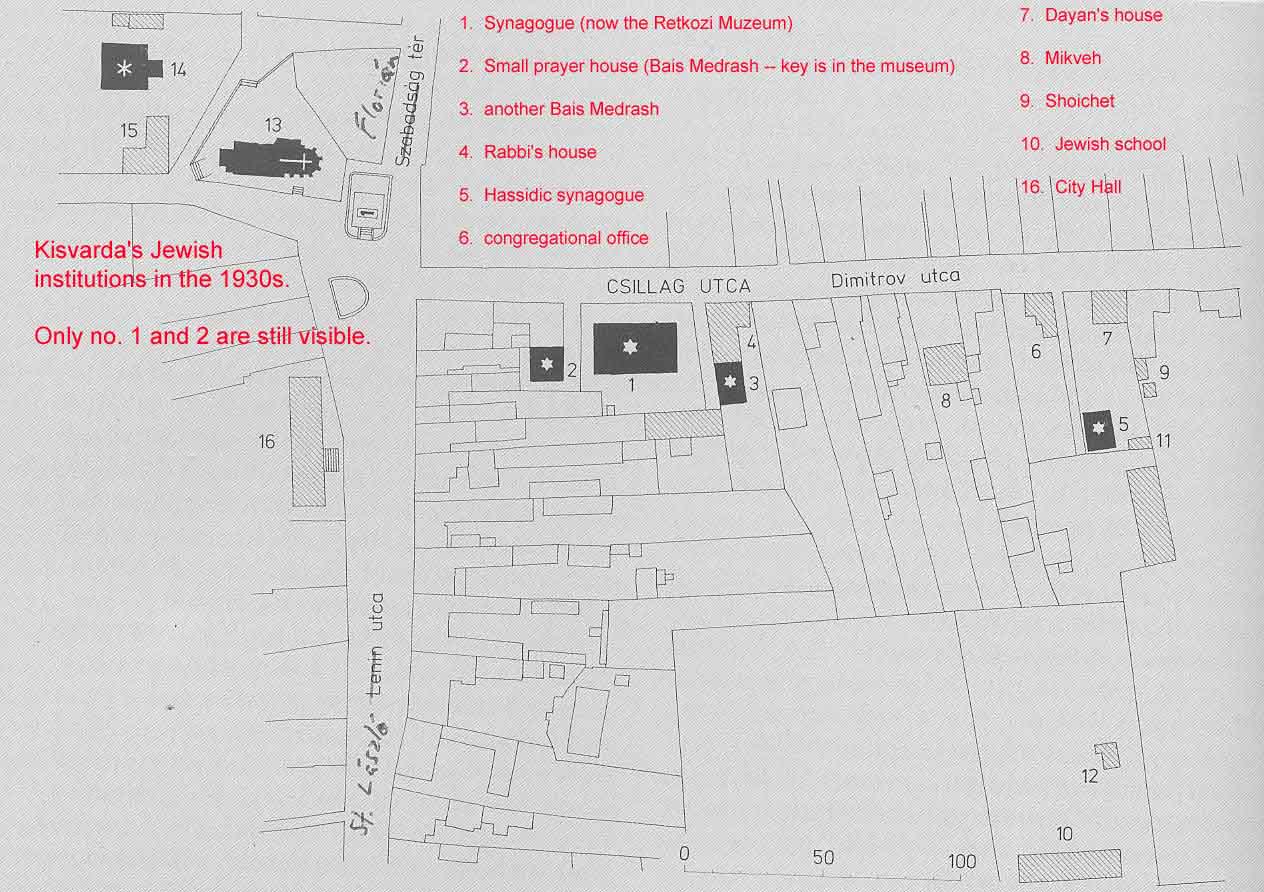
- Map of Kisvarda's Old
Jewish District
- List of Jewish names and addresses in 1944 prior to deportation
- A Memoir of Deportation and Survival by Zsuzsanna Fischer Spiro
- Burial
list of Names in the Kisvarda Jewish Cemetery,
1875-1968 (42 MB file)
Kisvárda, Hungary
קליינווארדיין
48°13' N, 22°05' E
Kisvarda Home Page Contents:
Sources of
information about Kisvarda’s Jewish History
What Visitors Can See in Kisvarda Today
Alternate Names and Pronunciation
Unlike many other towns in this region of
wandering borders, Kisvarda has always stayed part of
Hungary, and its official name has always been Kisvárda
(pronounced Kishvarda – the first a as in “far,” the
second as in “ball”), but it is sometimes abbreviated to Varda. “Var” is Hungarian for a castle, and the
ruins of a medieval castle can still be seen here. The Yiddish-German translation, often used by
the more hassidic elements of the community, is Kleinwardein or Klaynvardayn. “Kis” in Hungarian
means small, which is “klein” in German. Hence, it is translated into Hebrew as Virdayn Katan.
Historical
Background
Kisvarda is a small city in
north-eastern Hungary, with a population of about 18,000 as of 2005. It is located where Hungary becomes quite
narrow, and it is close to the border with Slovakia, Ukraine and Romania. Today, there are only a handful of Jews left
in Kisvarda, but in the early decades of the 1900s,
they made up close to a third of the town’s population. Perhaps even more remarkably, Jews made up 10
to 20 percent of the population in the villages scattered around Kisvarda, and in many cases these Jews were farmers, which
is quite unusual in European Jewish history.
Kisvarda was the business centre of a large agricultural region, with industries such
as distilling and milling that were related to agriculture. It was located on the main rail line from
Budapest to points east, which helped spur the growth of commerce. Jews were important in all the forms of
business, including running most of the small shops in the town. Indeed, there were very few stores open in Kisvarda on the Jewish Sabbath. Almost all the Jews of Kisvarda
were Sabbath observant. The central
synagogue was mainstream Orthodox, while there was also a substantial community
of ultra-Orthodox hassidic Jews who maintained their
own bais midrash and school.
Following the Nazi
invasion of Hungary, in the spring of 1944, the Jews of Kisvarda
and the surrounding villages were confined to a ghetto in the area around the
synagogue. After a few weeks, they were
deported to Auschwitz and various labour camps, where
the majority of them perished. The German soldiers were few
in number, and the actual incarceration of the Jews was mainly
undertaken on their behalf by the cooperative Hungarian gendarmerie. Arguably, the Hungarian collaborators did
not know what fate awaited the Jews at the other end of the line. However, putting innocent old men, women, and
children, fellow citizens for many generations, into crowded boxcars should by
itself be considered quite an atrocity, even without knowing what would happen
to them at Auschwitz.
A few hundred
survivors returned to Kisvarda after the war, but
many of these left in 1956 during the anti-communist revolution, especially the
younger ones. When I first visited Kisvarda in 1973, as I backpacked across Europe, there were
a few older cousins still living there, and I was able to join them to make a
minyan for Sabbath services in the bais midrash. They are all gone now, and the congregation
is no more.
While the Jews are
gone from Kisvarda, there are some important physical
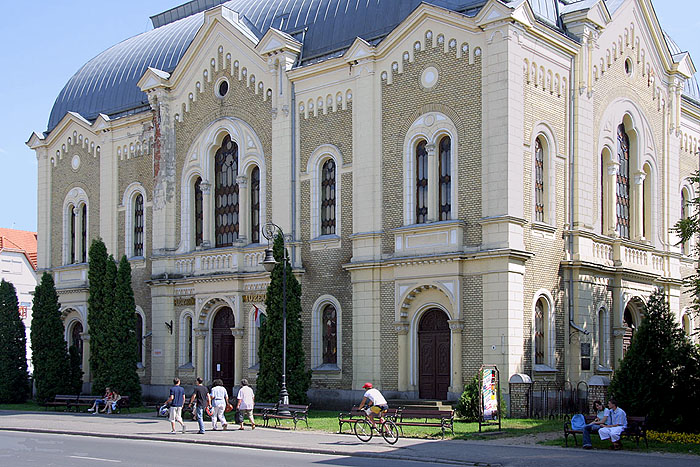
relics. The former main synagogue, now
converted into a museum (shown in the photo above, as of 2007), is still the
most impressive building in the town. A
large Jewish cemetery, with several thousand graves, remains well preserved. Among the loss of everything else, even
that is something to be grateful for, because in many other places
(particularly in Slovakia, just across the border) even the gravestones from
the cemeteries are gone.
Kisvarda’s Jewish community lasted for
about 250 years. It was not a transient
community. The vast
majority of the Jews were settled by the early 1800s, as can be seen in
the census of 1848, which found that almost all the Jews resident in Kisvarda had been born in Kisvarda
or its vicinity. Therefore, by the
1900s the Jews there had a strong family association with the town. Most Jews in Kisvarda
spoke Hungarian rather than Yiddish as their primary language,
and identified themselves as Hungarians.
The Jewish
relationship with the national majority in Hungary was generally more congenial
than in most of the other east European countries. Throughout the European diaspora, the Jews
have been seen as alien wanderers and interlopers, and
were rarely perceived as legitimate citizens of their countries. In Hungary, historically the Jews were often
better accepted than in other countries.
During the Crusades, Jews were slaughtered in western Europe by
marauding crusaders; by contrast, King Kalman of Hungary brought out his army,
and successfully defended the Jews against foreign Crusaders (around
1096). A unique feature that sets the
Magyars apart from other nations is that they identify themselves as immigrants
to their own country within recorded history.
The Magyar nation has a known year, 896, when their previously nomadic tribes
settled in the territory of what is now Hungary. By contrast, most of the other nations of
Europe are the products of gradual ethnic evolutions whose origins are lost in
the mists of time.
To a medieval Magyar,
a Jew might have been different, but he could hardly claim that he was more of
a foreigner on the soil. Indeed, Jewish
gravestones dating back to Roman times have been found in Hungary, so Jews were
actually there before the Magyars.
In the 1500s, most of
Hungary was conquered by the Turks (who ruled until they were expelled by the
Austrians in 1690). In the process, much
of Hungary, including the area of Kisvarda, became
severely depopulated, and the country was very underdeveloped
economically. In the 1700s, the great
landowners of the Hungarian nobility who had reconquered the land were eager to
encourage immigration, particularly by literate Jews who could carry on
commerce. Whereas in most countries the
Jews had to beg entry, in Hungary, for a time at least, they were actively welcomed
by the authorities. Kisvarda
and the surrounding areas were owned by the Eszterhazy
and Karolyi families, who each held vast estates encompassing hundreds of
villages. Count Sandor Karolyi's lands stretched from the southern outskirts of
Kisvarda down into Transylvania, and there are
records of him bringing in Jews from Austria to help populate his estate. In fact, so keen was he on encouraging Jews
to live on his land that, in 1724, he had a rabbi brought from Bratislava to
live in his capital city of Nagykaroly (now Carei in Romania).
According to most
historical opinions, Jews were not legally entitled to own land in Hungary
until 1867. (This is not completely
verified, and in any event, prior to the land reforms that took place in 1867, almost
all the land was owned by the nobility.
Very few Christian Hungarians owned land either.) However, many Jews leased land from the
nobility. Often, these were small
pieces of land used for a shop or a mill.
However, some Jews in the vicinity of Kisvarda became prosperous agricultural entrepreneurs,
leasing hundreds or even thousands of acres, which they would in turn sub-lease
to smaller farmers.
While there were no doubt always some Hungarians who didn’t like the
Jews, relations were generally quite good for most of their history in this
region. My father, growing up in a
small village near Kisvarda in the 1920s, had many
non-Jewish friends, and has no recollection of antisemitism. In the early part of their history in
Hungary, Jews were almost the only members of the middle class. However, as an ethnic Magyar middle class
emerged, economic rivalry with the Jews increased, and this contributed to
anti-Jewish measures, particularly as economic conditions severely deteriorated
following Hungary’s defeat and loss of territories after World War I.
In World War I, both
of my grandfathers were loyal Hungarian soldiers. In World War II, their wives and many of
their children were murdered, at the hands of the Germans, but with the
collaboration of some Hungarians. They
were deported from their homes, and the few survivors who returned found that
their possessions had been stolen or discarded. One consequence is that relatively few
photographs of Jews have been preserved from pre-war Kisvarda. In my family, the few photos we have left
exist only because they were preserved by relatives in Budapest or the United
States. A few older photographs can be
seen here.
On both my mother's
and father's side (born in 1925 and 1922, respectively), most of my known
ancestors, traced back to the late 1700s, lived in or near Kisvarda. My father's family lived in the farming
village of Gemzse, which I have written more about here. The people from these surrounding villages
depended on Kisvarda for many of their central
religious services, and in some cases the records of births, deaths and
marriages for people in the villages were recorded in the books of the Kisvarda congregation.
Quite often, people who were from the surrounding villages would say
that they were from Kisvarda. This sometimes causes confusion for their
descendants trying to trace their roots.
I was born in
Budapest, and brought as a small child to Toronto, Canada in 1956. I have never lived in Kisvarda,
and yet I have a strong sense of nostalgia for a place with a tight-knit
community, where my family lived for generation after generation. Those were days of large families. First cousins were so numerous that people
hardly kept track of their second cousins.
My mother tells of how she used to go out for walks with her family on
the Sabbath, and everywhere they went, there would be a house full of relatives
where they could drop in and visit. Of
course, the world has changed, and this kind of nostalgia for the small town life that is gone can be found among people in
many countries that have become urbanized in the past few generations. However, for people like this whose roots are
in Canada, England, France, etc., there will still be some remnants of the old
community left that they can revisit.
Sources of
information about Kisvarda’s Jewish History
A memorial book (yizkor book) was prepared by a committee of survivors
living in Israel and North America, and published in
Israel in 1980. I have translated
sections of that, which can be read by clicking here.
The lists of martyrs’
names that were included in that yizkor book can be
seen by clicking here.
Records of births,
deaths and marriages, microfilmed by the Mormons, cover the period from about
1850 to 1900, and have been collected into JewishGen’s
various
Searchable
Databases
- JewishGen’s Hungarian Special
Interest Group page is the first place to look, as it contains
numerous links to useful resources.
- JewishGen Family Finder (for KISVARDA)
Would
you like to connect with others researching Kisvarda?
Click the button to search the JewishGen Family
Finder database, which lists the contact information of others who are
researching Kisvarda, and the family names they are
interested in.
You
may find a long-lost relative. I’ve found a few third and fourth cousins
through JewishGen. (You must be registered and log in
as a member of JewishGen to use this service. Membership is free, but charitable donations
are welcome, as indicated below.)
Of particular
interest is the 1848 census of the Jewish population. An HTML version of it that I have compiled
can be found by clicking here. A spreadsheet version that transcribes the
original Hungarian, including the occupations of the individuals (which is not
in the HTML version) can be obtained by clicking here. The information from these censuses is also included
in the JewishGen databases, but for somebody
researching Kisvarda specifically, it is useful to
have the whole census in one piece.
A detailed history of
the Jewish community was published as a book by Mr. Istvan Nezo,
a librarian in Kisvarda’s public library. Mr. Nezo is not Jewish, but has devoted a considerable amount of effort to
that research, and we owe him a debt of gratitude. The book was originally published in Hungarian,
but an English translation (unfortunately, without the illustrations) is
available. More information about it can be found here.
Gabriel Erem (formerly Eichler) of Toronto, my cousin’s husband, is
a prominent member of the small post-war generation of Jews who grew up in Kisvarda in the 1950s.
A moving personal memoir that he has written about Kisvarda
can be accessed here.
What Visitors Can See in Kisvarda Today
The former synagogue
is now a municipally owned historical museum of the region, known as the Retkozi Muzeum. It has general exhibits of old furniture,
local crafts, and agricultural implements.
However, its interior preserves the main features of the synagogue, with
the original painted ceiling, stained glass windows, and balcony of the women's
section. One large room is a memorial to
the Jewish community, with a large wooden menorah and marble plaques on the
wall inscribed with the names of the martyrs of the Holocaust. An annual memorial service is held here each
spring. The museum has a website, but at present it is mainly in
Hungarian. As of late 2017, the museum was closed for renovations.
The museum's hours
were normally: April 1 to October 15,
8:30 to 4:30 (closed Mondays). October
15 to December 1, Monday to Friday, 8:30 to 4:30. From December 1 to March 31, it is only open
by appointment. Tel.: (45) 405 - 154.
Next to the main
synagogue is a smaller building that houses the former Bais
Midrash. It has been restored and
preserved as a small synagogue, but it is not in regular use. The museum staff have a key to it, and will take visitors to it on request.
The synagogue is
right in the center of Kisvarda, across the street
from the main square with the library. A
map showing where the main Jewish institutions in Kisvarda
were located can be seen by clicking here.
The other main
destination for Jewish visitors is the cemetery, which has been well preserved
and contains several thousand gravestones.
The cemetery has been cleared of underbrush, but there is no listing
available of grave locations. There is a
caretaker who lives on the premises, or did when I visited in 2007, and who
will open the cemetery’s gates for visitors.
(I have also heard that there is a key kept at the Vulkan metals
factory, which is located nearby.) The
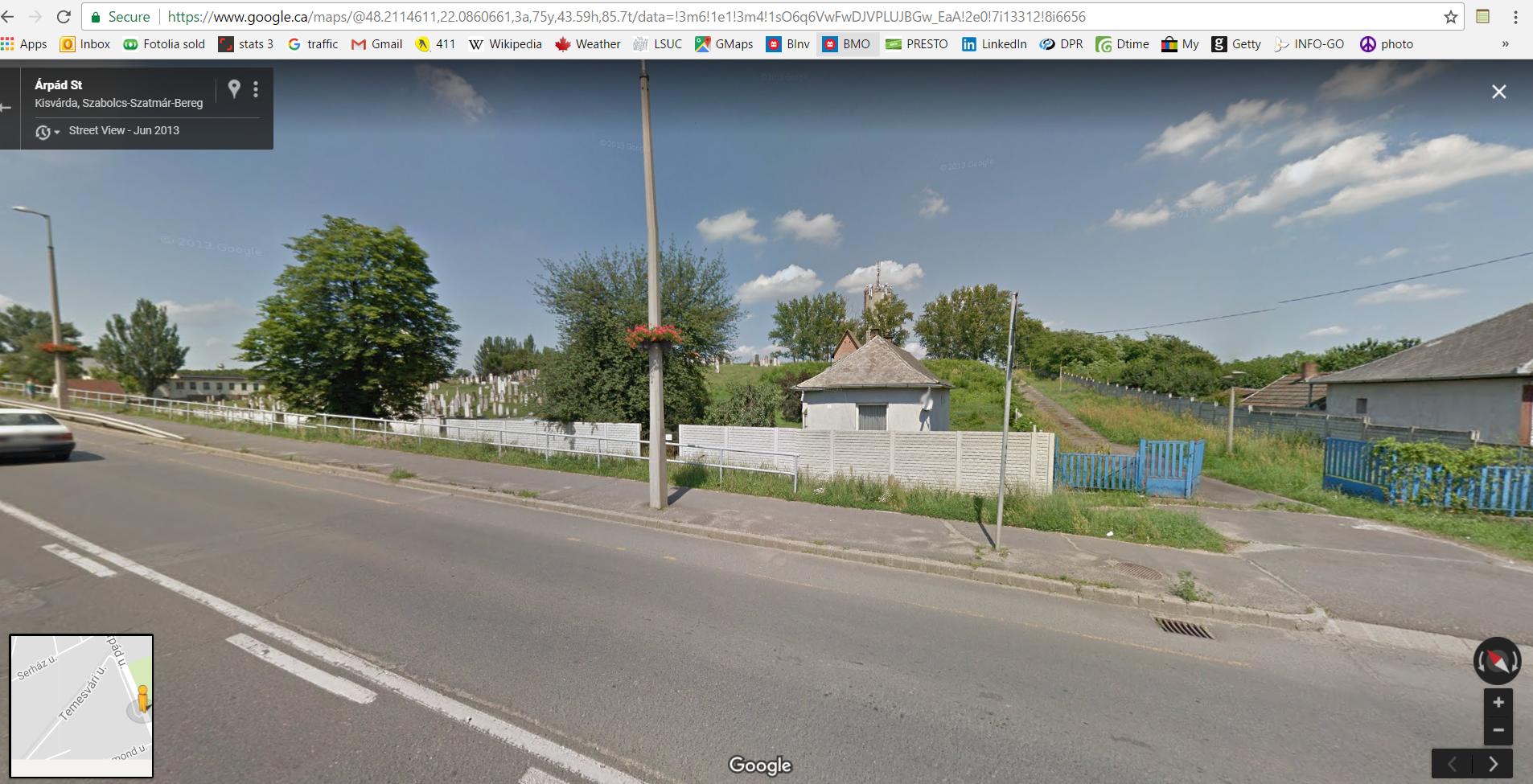
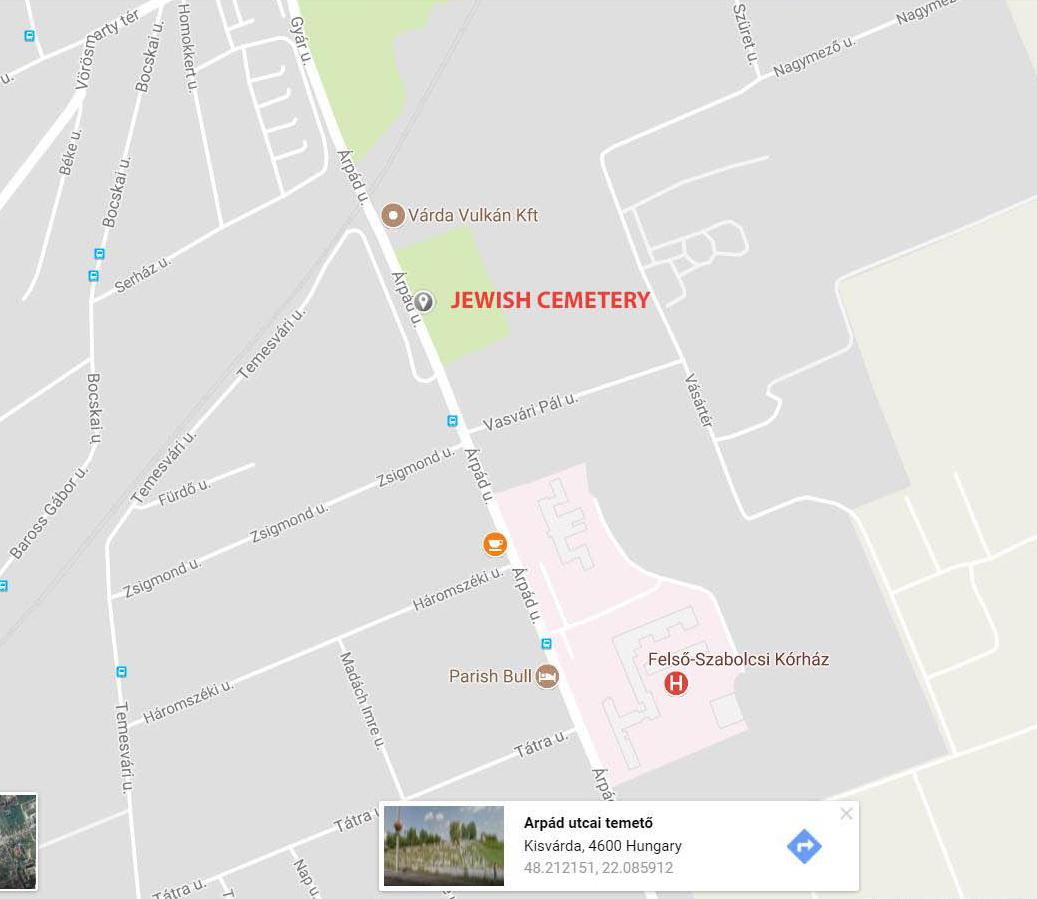
cemetery is at the southern end of town, on the main street heading south
(Arpad Ut). First there is a large
Christian cemetery, and the Jewish cemetery is on the left
hand side as the road rises to go above the railroad tracks. Because of this overpass, the cemetery is
easy to miss, as you don’t immediately see it from the road. There is a little driveway heading off the
road where you can park.
Click here for a street view photo of the
entrance to the Jewish cemetery. Click here for a street map to find the Jewish cemetery.
A variety of photos
of Kisvarda as it is in recent years can be found here. These are mainly photos I took on visits to Kisvarda in 1998, 2001, and 2007.
Getting to Kisvarda
Unfortunately,
English is still not widely spoken in Kisvarda, as
many people who learn a second language here choose either German or
Russian. Therefore, getting around in Kisvarda is not completely easy for those younger
descendants who don’t speak Hungarian.
There are daily
trains from Budapest to Kisvarda. Taxi service is available once you arrive at
the station in Kisvarda.
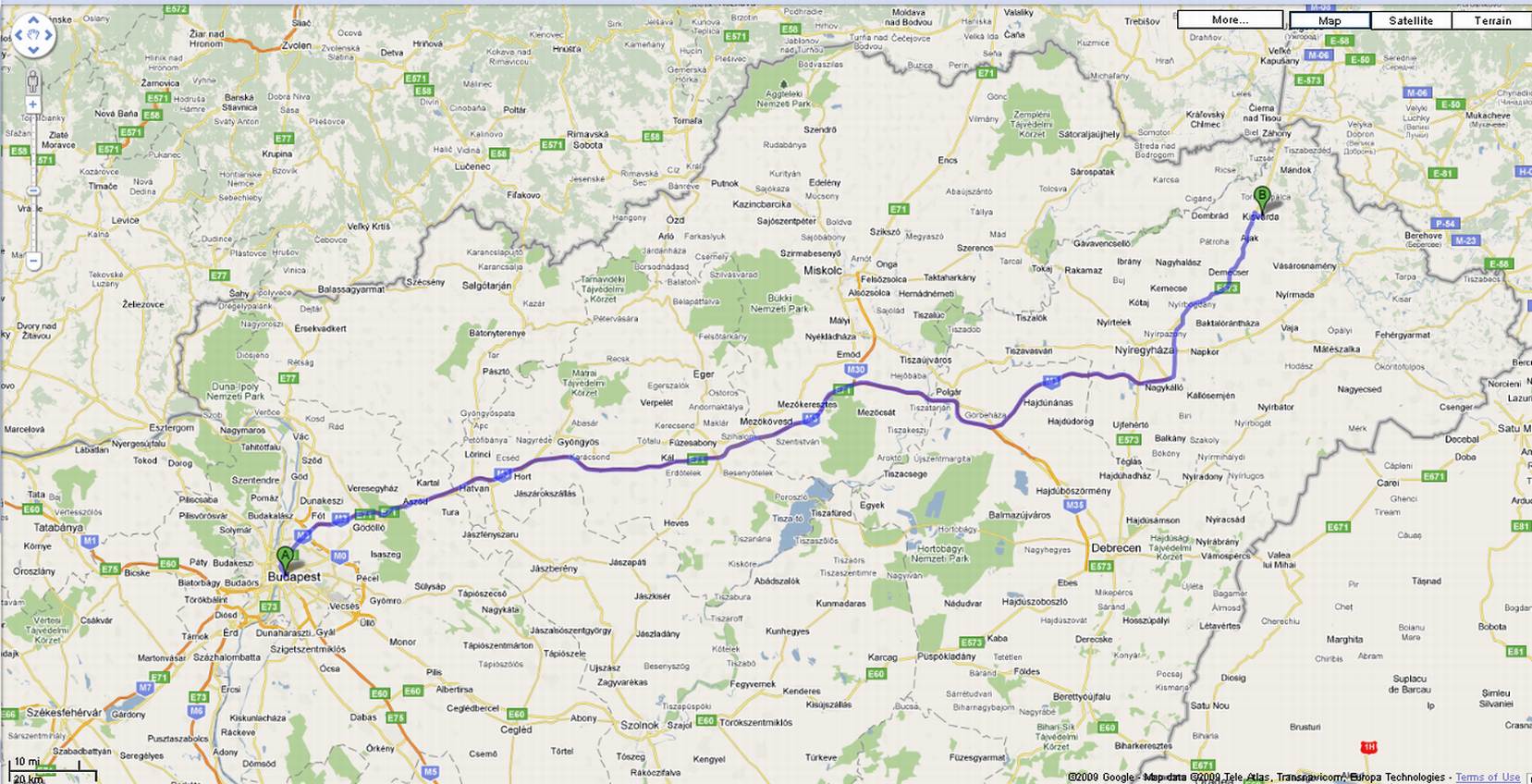
You can rent a car in
Budapest, and drive to Kisvarda in under three hours,
as there is now a major motorway (the M3) that goes as far as Nyiregyhaza, the
capital of Szabolcs county. The distance is 280 kilometers, as
calculated courtesy of Google’s map. If cost is no object, your hotel in Budapest
can usually arrange for you to hire an English speaking
driver to take you there, and it is an easy day trip.
|
Compiled
by Peter Spiro If you have additional
information or old photographs to contribute, please send them to me at the
address below.  |
Jewish Gen Home Page | KehilaLinks
Directory
This site is hosted at no cost by JewishGen, Inc., the Home of Jewish Genealogy. If you have
been aided in your research by this site and wish to further our mission of
preserving our history for future generations, your JewishGen-erosity is greatly appreciated.
Copyright © 2009
Peter S. Spiro